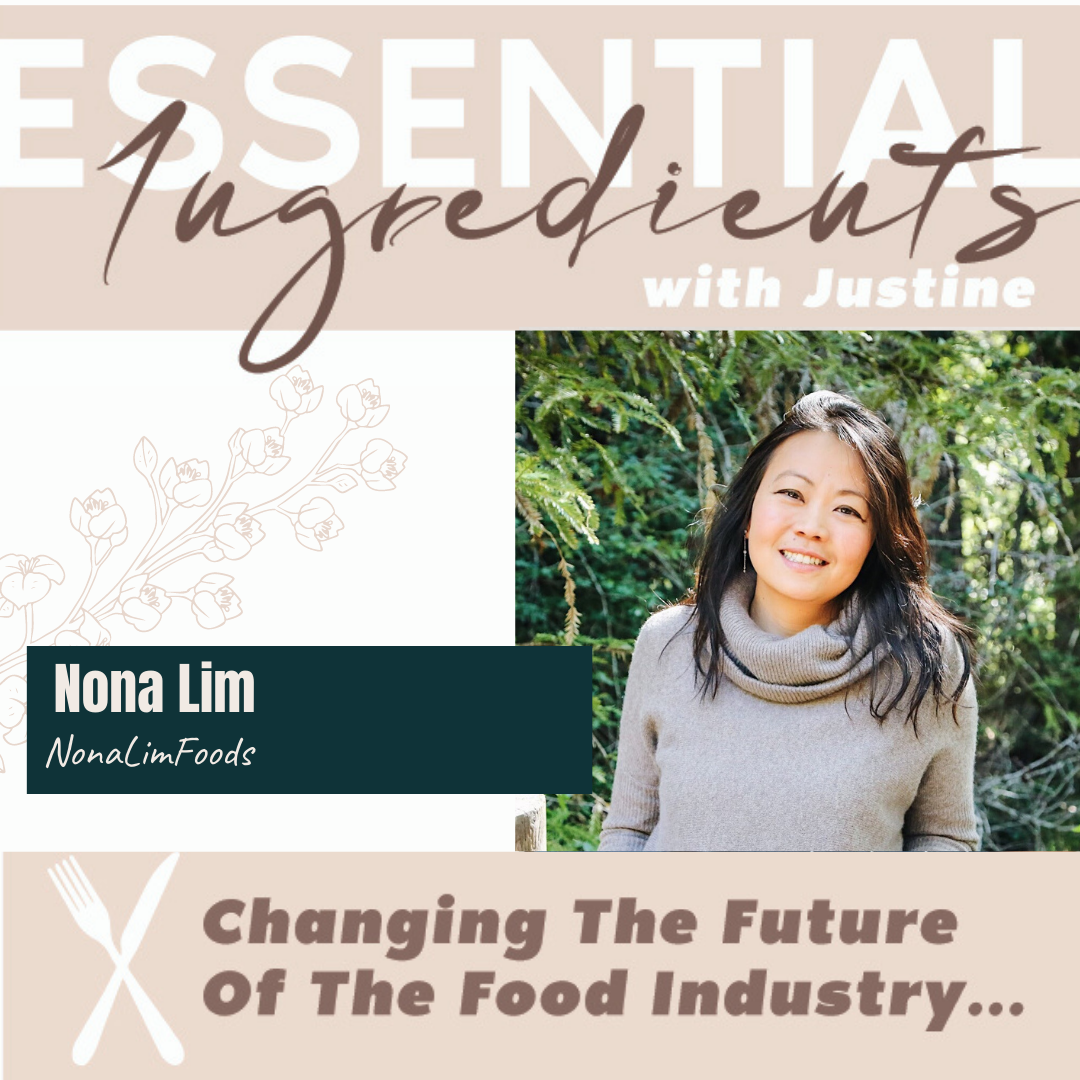
Nona Lim · NextGen Purpose
Watch on YouTube
The Secret to Developing Healthy, Convenient, and Savory Food Products with Nona Lim
The Incorporation Method helps you turn what matters into practical changes that fit your life.
“Product development is tricky. Some entrepreneurs tend to choose between creating a product that captures the taste and something that promotes health. But that era of compromise is now behind us! Justine interviews fencer turned foodie, Nona Lim about blending all of these factors — from choosing the right ingredients to pricing architecture and marketability.”
Full Transcript
Full conversation between Justine Reichman and Nona Lim.
Good morning, and welcome to Essential Ingredients. I'm Justine Reichman, your host. Today, we have Nona Lim, welcome Nona, how are you?
I'm good. Thank you so much for having me.
Thank you Nona, thank you so much for agreeing to participate in this podcast. It's exciting to have you here as we talk about the future of food, I'm excited to get to know a little bit more about you and all the things that you're working on.
I'm excited to share them.
Yeah. I know we started, we spoke briefly when we got on the phone today, and I got to learn a little bit more about what you're planning for the future. But for our guests here today that are not familiar with Nona Lim, the brand or you, maybe you can tell them, you could just give them a little background about you and about Nona Lim.
Absolutely. So the company itself is my name, it's called Nola Lim. And you know, an Asian platform with lots of different nourishing comfort food like rice noodles, or Asian favorite bone broth and ramen noodles. I'm from Singapore, originally. You can probably tell from my accent that I'm not American, I didn't grow up in America. I grew up in Singapore. Spent about eight years working in London before moving to the Bay Area. The company started actually, I won't quite call it accidental, but it wasn't entirely planned. Yeah, when I first moved to the Bay Area, I was fencing competitively. I also had a side hustle where I actually created the very first meal kit delivery business back in, before it was even trendy. I know there was like before Blue Apron and anything else existed, so I created that category but was doing as a side hustle, didn't raise any money. I don't think it went really very far beyond kind of the Bay Area. So I did that one called, it was called Cook Assassin. It was it was very small because I didn't really focus a lot on customer acquisition and other things you should do with online business. It was back then I was doing everything for gluten free, dairy free, using clean labor ingredients, sustainable seafood back before, you know it was even, two ahead of the times. That's why I've learned along the years, which is don't be that innovative where you can't create a trend all by yourself. That's what I've learned along the way. So it's doing all of that, and what happened was in 2012, I almost made the London Olympics. Kind of lost by one point. I was--
Let's go back from it. Almost made the London Olympics?
Yeah, representing Singapore. I was at the qualifications. I was fencing my--
Doing what?
Fencing, sabre fencing.
Wow, you're a fencer. Okay, that's really quite cool. Were you doing this since you were a little girl?
No, no, no. I did a little bit of it in high school and college. And then I stopped and literally picked it up right around in my late 20's, almost 30 by then. I was competing with all my competitors who were at least a decade younger than me, and some of them we're like, yeah, not quite half my age, but much, much younger. So I really needed to have, I would say every single competitive edge to keep up with that. And many of them are like full time athletes trading three times a day, five, six days a week. So it's kind of like doing that back in my early 30's, trying to have a side hustle business as well.
Okay, so you were in London doing, did you say Finance?
I was in management consulting and software consulting.
Okay, so from consulting, to fencing, to food.
Yes.
This is what we're talking about here. Okay. You've got your side hustle going, and that was in food, and that was your, your--
Exactly, exactly. I created this whole detox program called the elimination of, based on the elimination diet that took all the common food allergens. Because for me, as an athlete, I really felt that if I have the right nutrition, I would perform better. So I was really very focused on the whole concept of this medicine. Especially growing up in Singapore, even though I wasn't trained in TCM, Traditional Chinese Medicine, it's something that I grew up with because my mom would make those wonderful herbal soups and things like that.
Yes.
So I kind of brought some of those philosophies here and ended up getting to know some nutritionist, functional medicine doctors, dieticians, and incorporated a bunch of those philosophies into my meal kit program. But then, by 2012, I missed the London Olympics. I got really frustrated, upset, annoyed, gave up fencing, and had a baby instead in 2013. I kind of looked at the business and decided, no, what do I want to do with my side hustle? By then, I decided that, honestly, even though it's getting very trendy by then, I felt that the customer acquisition cost is really high. The packaging cost is really high. There's a lot of packaging, I'm not sure that I will be able to get it to a scale where it will be fully profitable and sustainable. So I shut down that side of the business and actually launched a CPG in 2014, and that's how the Northern Ireland bread was bought in 2014. I took a lot of that same philosophy, which is something that you would think is kind of common sense, but it doesn't exist a lot for a very long time. I would say consumer packaged goods, which is the fact that you can have products that taste fantastic, it's better for you and is convenient. Usually, you get one or the other. When you get products that they're really convenient, but it's full of unhealthy stuff, or healthy stuff that doesn't taste very good. I wanted to put the three together, and at the same time, I wanted to lean into my Asian roots, where I come from. Singapore is such a melting pot of different cultures, great food, I wanted to take a lot of that experience that I grew up with, together with the wonderful ingredients that you get in the Bay Area, and the whole clean labor philosophy that is very prevalent in the Bay Area and bring it together. So what I decided to do is to kind of, I would say clean, try to clean up the Asian CPG space. And I did that with some of my early products. That's how the Nona Lim as a brand was born in 2014.
I'm a big fan, I have to tell you. I know I said that a couple times, but our listeners don't know that, reaching out to Nona Lim was very, for me personal, not just for Essential Ingredients and NextGenChef but on a personal level. I've been eating and drinking Nona Lim for a while now. I found you, I think when I went to the Fancy Food Show. Then of course, when I shopped in my local markets, buying your broth and your noodles, after having tried so many of them and having studied at Pacific College of Oriental Medicine, and learning about Chinese medicine, and learning about herbs, I'm really interested in companies building better for you products. So talking to you for me is very personal, because I'm really excited to chat and learn more about how you built a business that's rooted in Chinese medicine, creating something that's delicious, and allowing our listeners to be able to understand the impact they can have by enjoying something but also understanding how this product can help them and be something that's healthy for them, better for them. And combining the two so that they can enjoy and have something that's healthy, so that it's a combination. I'm so excited that you've built something that combines those two values, that combines those two values. This podcast allows people to really get that information directly from you so that people can make more informed choices and better understand why they're making those choices. You've talked a lot about your roots and what inspired you to do this, and that's so great. I think it gives them a sense about that. I just would love to be able to dig a little bit deeper into that, and talk about the impact you're trying to create on the future of food. And maybe you can tell us a little bit more about what you see for that through Nona Lim.
Yeah, for sure. I think that I was a big believer in better for you, clean labor back when I was doing my meal kit days before, even before 2010. Really trying to pioneer that. And I think that for me, the couple of things that are most interesting or funny is I like to be innovative so I launched the very first package bone broth back in 2014, 2015.
What was your first bone broth that you launched?
The coconut lime.
Oh, my favorite.
So I did that at a time where, before even the brutal article came out in New York Times, before it was even trendy.
And Brodo was my favorite in New York, by the way, we just interviewed them last week.
Yeah, it's a great product. I think it's a great product. So I launched that, and at that time, nobody knew I was right. I will have retailers going, what is it? Why is it twice the price of Pacific when it's not on the shelf stable SATS'? You don't make gravy with it? In fact, there was a lot of education that was needed up front. I'm grateful that at that time, [inaudible] was a big supporter and was willing to take a chance on me. So fast forward, two years later in 2017, if you go to Expo West is a big trade show for a lot of companies. Pretty much, everywhere you turn, you could find a bone broth brand. So I'm happy to know that I have kind of led the way a little bit in some of those big trends. And likewise, when I first started, I was probably one of the few kind of clean label authentic Asian brands out there. And if you look at it today, just 2020, there are also many other brands that have come along. So to me, I think that it gives me a sense of satisfaction that I was able to maybe pave the way for some of this.
You're a leader in the industry.
Kind of, which I have not really thought of myself that way. But yeah, because I like to be the innovator. I'm glad to know that it's good when you see a lot of other companies coming along that I've tried to create a little bit of a category so that it's now becoming more accessible. My long term goal is to be that leader, it kind of authentic, great tasting and better for you Asian food products. Making it much more accessible to mainstream Americans. And now that I've seen so many up and coming brands, that's why it helps create a category, so I'm very happy about that.
I also think that what you've done is create a healthy and better for you, which you did touch on Asian brands. Very often, people don't think of Asian food as healthy. When we go to Asian restaurants, there's a lot of sugar in it. There's a lot of different things that people put into the food. So what you've done is create a category and really put a bar on that food saying, we're making this better for you Asian food. And as you expand, and I'll ask you about this later, are some new exciting things you have in the pipeline that allow this category to expand and allow it to grow into that better for you under the Asian category. I think that it's going to be exciting and it's going to grow. You really are leading that category and adding to it. We've got some new exciting stuff from Nona Lim coming in the next portion of this podcast, so stay tuned. We're going to take a quick break for an advert from one of our sponsors. Stay with us listeners, we have some exciting news. I want to welcome back our listeners, welcome back Nona Lim, excited to get started with the second portion of our podcast. We're gonna get into some of the new exciting stuff that you notice doing. I'm going to leave that portion for the end, keep you guys in suspense. And just maybe talk a little bit about and ask you a little bit about how COVID has impacted you and your brand. How you've been dealing with that in these times, because I'm sure that impactful.
Yeah. I think that we definitely have been impacted by COVID in many different ways. I think the first is that we manufacture our own products. Suddenly, all the approvals and other liquid components. So as a manufacturer, our very first responsibility is to keep our people safe. I think that was something that we really had to go through and take care of. It was real. I was making sure that people don't force it, people don't literally don't die, right? That was a huge focus of ours. I think in March to July timeframe will be put in place a lot of different procedures, where we had to also make sure that our team felt safe coming to work. That was a huge focus of ours. I am grateful that our team has stayed committed, and know the procedures that were put in place have really kept everyone safe. I would say that early on, there was definitely a little bit of trying to react to it. But now that we know that we got really in front of it and are very proactive about it, we're not able to say that it wouldn't, it's been going well, that's an operation. And the second is from a sales perspective. Certainly, I think that we have a lot of products that are much more single serve, like the cups, and those were kind of our front runners prior to COVID because everyone loves the convenience of being able to bring it to work, you take in the car and all that. We definitely see a shift in the kind of product portfolio, which shifts to our consumers wanting to cook at home a lot more because when we have today, when we're not at work and all that. We definitely saw a shift in our product portfolio where our noodles for cooking at home, or blogs, or cooking at home did much better. We also saw a shift in our channel as well. I think our grocery channel was actually affected a little bit in the earlier months of the pandemic. We are refrigerated products, so our products share space with the milk, and eggs, and the bacon is the most basic of necessities commodities. And so we lost shelf space when distributors were prioritizing delivery essentials. That definitely affected our business as well. I think I'm grateful that we were able to pivot more to online, where our DTC did really well. It doubled compared to last year where our online partners did really well as well. So now, we're really kind of a fully omni channel brand, which is something I would say, it's probably less common for refrigerated products, but I'm glad that we were able to accomplish that. So those are the changes. I think that I'm grateful that we have a strong team, a strong team in the community has done well throughout this 12 months, or this 9, 10 months of change.
Are there any recommendations you would make? We get many new founders listening to these podcasts, and I want to be able to share insights from founders like yourselves that have been doing this and have had some successes, and equally some challenges that have come up that you've been able to successfully navigate. Is there anything you might recommend for them? Or to them?
Yeah, absolutely. The things that I'm recommending, I probably learned the hard way, all the mistakes I've made. Hopefully, they can learn from, they can benefit from my mistakes and don't have to make the same mistakes themselves. I think the first is probably about product development. I think that many, many founders are passionate about products, that's why we want to come into the food industry, whether we are an artist and a maker, whether we pivoted from the corporate business world. We have to think about the entire commercial aspects of product development. I didn't think of that early on, all the way down to who the consumers as physically merchandised. Which category does it belong to? What's the price point? All of those things need to be taken into consideration. I didn't do that, I was looking to create the best possible product originally. I learned the hard way that it can be challenging, especially if I'm creating a brand new category, which I do. I think for years, I struggled with trying to figure out which category, which set I belong to? Think about those upfront, it will save you a lot of work and a lot of struggles. That's one big one. I think the second is really just financial. Really knowing your numbers, really began designing a product down to the unit economics. Think about not just top night, but really think about the bottom line as well. I think that also in our industry in the last five years or so. Maybe not last year, in the last five years, there was a lot of capital available from the venture groups and everything. There was kind of a rush and a race to try to get the top line going. Sometimes, at the expense of burning a lot more cash that we need to burn. I think that is something, I think this year is definitely a huge year of change. People are probably already realizing that, about the need to get to profitability. I will say that lots of other little ones, but those are two big ones that come to mind.
I think that our listeners and our founders that are listening will really appreciate those takeaways as they start to build their business, or even continue on their journey. Because many times, we are building from our passion and we get excited about it. And sometimes, we just need to be brought back home to remember that some of these things have a process that we need to make sure that we go through. So I appreciate you sharing that. I'm sure that as you built your business and you developed your recipe, you had a high bar for ingredients without compromising that flavor, and the integrity of the route that you were drawing from which were the Asian ingredients, and the Asian and the Chinese medicine. I'd love to just hear a little bit about that development process, if you would.
Absolutely. I think that I was actually trained well by my previous venture, with the whole meal kit delivery. And with that kind of the elimination diet, I developed hundreds and hundreds, maybe 3, 400 recipes. I had to do many of them very quickly, and I did them all myself. Because of that, I think R&D becomes very easy for me, having to learn to do them in a way that was clean labor. So by the time it came to kind of CPG, it wasn't something that was too challenging. I think that actually trying to develop clean labor, Asian is not as easy as I thought. Because like you mentioned, a lot of the ingredients may not be all that clean sort of looking for things like being a paste, or some other more unique or more, not quite unique, but more Asian specific ingredients. They might come with preservatives or other things that we don't want to include. So for me, when I look at product development, I think as much about what doesn't go in there, as much as what goes in there. So we look at our ingredients, and sometimes ingredients have some ingredients, and we look carefully at the sub ingredients as well. It is one of those where it has to fulfill so many different requirements, it has to fulfill the right taste profile, we're looking for the right ingredient and sub ingredient list that we want in order to fulfill our criteria, and then the nutritional value of that. And finally, the pricing. So all of those have to come together, and we look at all of that. And now, we even incorporate and look at what consumers are looking for. And then even going down to understanding what the pricing architecture looks like across all the different channels, because different retailers have different kinds of promotional requirements. Whether it is what they call EDLP, Every Day Low Price, or whether they play the high low way, with promotions discounts. Really trying to understand all of those upfront in the product development process is actually really important, and it goes beyond just ingredients. I think that when I first started was very ingredient centric. And now, I try to look at it much further downstream as well.
Well, that makes a lot of sense. I'm sure that came up with that way, that took probably a lot of time and wisdom to come up with because it's not necessarily intuitive.
No, not at all. And then of course, there's the fun tasting part. I think we were doing our Indian lentil soup. We must have had 20 different variations right at the end, just playing with exactly how much spice you put in there. What is the balance of how much tumeric do you put in there versus how much cumin you put in there, and play with that balance of spice. That tasting element that takes many, many, many iterations as well.
So I'm thinking that you're probably going to be doing some tastings where you need some help from some fans? I'm offering my services to you.
Sounds great. We are looking for, like a VIP--
Order, or you can send and we'll do level tastings.
Absolutely.
But I do have a question for you as I was listening, and I'm going back to our conversation when you were talking about some of the other brands and how you lead this new category. There's bone broth from a variety of places from Brodo, what is it? Baby, not baby broth. I forget the other one. There's a bunch of them. I'm having a bit of a senior moment even though I'm too young for that, but they're not all rooted in Chinese medicine, they're not all rooted from the same core value. What are your thoughts on that? Because to me, bone broth, I always knew it came from Chinese medicine. But it's not that I get people to make it from a variety of things, I used to always, honestly, I made chicken soup because we make it for the Jewish holidays. My chicken soup is made of five pounds of chicken feet, between you and me. Everyone listening to this podcast, it's made as five pounds of chicken feet, carrots, and leeks, and lemon, and a variety of other things, garlic, parsnip, and turnip, and all those things which in essence is kind of like a bone broth because I have so much chicken feet in there. I mean, obviously, I take it out, but it's kind of a bone broth. It's not rooted in anything other than the fact that I think it tastes like great chicken soup. But then I circle back and I ask you, a lot of people are making bone broth and it's not necessarily rooted in the whole Chinese medicine. Can you talk to me a little bit about that, and the philosophy behind yours versus these? What does that mean for people in the category? How to better identify the differences between them?
Oh, absolutely. The thing is that when I grew up, my mom used to make the black chicken wood chain thing.
The black chicken here, I did that when I was in acupuncture school. I bought it in New York and Chinatown.
Yeah. It was something that I grew up with. But of course, it's not easily accessible here as you can really make chicken bone broth with black chicken. I guess I am less of a, I'm not as much of a purist and I do not judge. I think in many different ways, that's kind of the fun thing sometimes about America, right? It is so innovative, it doesn't cling on to tradition as much, it likes as a country, I think that people like to innovate. I think that there's something cool about that. But I think that when I look at it again, I know a lot that, I'm sure you know that too, whether in oriental medicine or in the kind of the functional medicine, about the typical bone beef bone broth that you simmer for 48 hours and you put maybe, where they go to try to extract the collagen and other nutrients, etcetera from the bones. The chicken bones, chicken bones are much smaller and thinner than beef bones. You don't actually need as much time to extract all the goodness, and I don't think that you necessarily need finagle to extract it. As a consumer, you need to find what works for you. I mean, for me, personally, I think taste is really important. I've tasted different kinds of bone broth, I go to taste [inaudible], I love the flavor of that.
I like the original one and the mushrooms in it.
Yeah.
You can't buy online, you have to get it there at Brodo, in the Kiosk. They haven't done that yet.
Yeah, yeah. I know you have some bone broth that tastes like that you've taken [inaudible], you've bought it for a week and it doesn't taste very good. So for me, that's what for me, I feel that taste is so important. It's one of the most important to everything that we do, just better for you has to taste good.
Yeah, I would agree. I would agree. I was more curious about the medicinal aspect of it, I guess. I'm sort of enamored with the fact that I can look at this as food, as medicine, and the fact that you were thoughtful enough to look at this and create ingredients that are medicinal, or food as medicine and some of these are warming, some of these are cooling and some of these are anti inflammatory. And when I look at some of the other bone broth, I'm sure that they do that. It may not be intentional, it may just happen. I was just curious about where that falls in that category, how consumers can look at those and make a choice. And maybe they don't have to, maybe it comes down to just choosing what tastes good.
It's really interesting. Because I'm trying to make fun of Asian food much more accessible, like you mentioned. Sometimes, in a lot of this in our culture, in our home cooking is actually really nutritious and really healthy. But when you look at the supermarket out, a lot of Asian products, they're filled with, unfortunately, with preservatives or additives that they're just not that good for you. So what I want to create is to elevate that so that you can have all these products, in all these Asian products that you feel good eating. But this is about how far you go, how mainstream versus how niche, and how on the edge, how far you push it on. I have pushed on looking in that in a way that we had a spicy search on growth, which I love, but that didn't get a huge following because it was too spicy. And then we have another one which is another favorite of mine, which is a ginseng chicken bone broth. It is made with chicken bone broth and we added ginseng to it, and there's goji berry and there's some ginger.
Is it good?
It is amazing. The goji berry gives it some natural sweeteners and it's healthy, good for you other superfoods. A lot of Asian American friends, the Koreans love it because it tastes very similar to samgyeopsal, which is a dish that you have in Korean cuisine. My Hong Kong friends, or people who are like ancient Chinese or American Chinese love it because they're familiar the flavor. But a lot of mainstream Americans, depending on what they're familiar with, they may or may not be familiar of the flavor, which has that bitter herbaceousness in the back of your throat, and you might not be used to it. So it had a small niche, and I just couldn't get it on shelves, and the retailers just didn't see it as something that would be big enough to carry on shops. So because of that, I ended up discontinuing it. Sometime, I think last year, I'm sad and we still have a little bit left, you can still get the remnants over here.
I wanna, the spicy one that you said, I think I want to get one of those here and one to send to my dad because it sounds almost like a hot and sour kind of soup dish. The fact that it's like spicy, I think I know people that would like that.
At trade shows we meet people who love it, who are passionate about it, but just not enough of them, for retailers to want to keep it on the shelves. So for me, it's kind of a, that's why it's a fine balance of how much do you introduce and when. And it goes back to the lessons that I learned when I created a meal kit, the whole category more than a decade ago way too early. So for me, now is a little bit about, just understanding when is the right time to, how far do you stretch the envelope? When do you stretch it?
Well, to your point, my biggest takeaway right now is just not about maybe getting people to realize that this is food as medicine, but this is a healthy accessible Asian food. That you can have Asian food that is healthy for you, as opposed to healthy food that is filled with sugars and all sorts of unhealthy food. I think that's the first step, and then we can get to the other stuff, but this is the first barrier. I think you're doing an amazing job with that. And of course, I'm just getting nitpicky and saying, well, this is food as medicine and this is helping you let's go a step further. But just because I'm there doesn't mean the rest of the world is, I think you've got it down. We have somebody here that, our listeners can't see, but we have somebody here that wants to join us. For those listening, it's a dog that wanted to join us. But as we're just wrapping up here, just a couple other questions and things that I just want our listeners to just learn a little bit further. Can you share with us, just a little bit, maybe you've got added something, or your favorite pandemic recipe that you're doing with one of your noodle dishes because I know you eat them, 12 different ways, and you call it your kitchen sink? Is that what you're calling it, your kitchen sink noodle or something?
Everything but the kitchen sink.
Kitchen sink. Share with us your favorite recipe that you're making these days with your bone, with your broth, or your noodles.
Yeah, for sure. I always keep my noodles and my broth handy in my fridge or freezer. So that when I have no time, it just makes it an easy meal. I love the Thai noodles. My daughter's favorite is the pasta, which is the wider one. But it's so easy to have that with just a broth, like our coconut lime broth, whatever you want in there. Sometimes, we could have leftover chicken from the weekend, or we could just add vegetables and we just put it in so that it's like a simple meal that takes 10 minutes. That is almost as quick as if you were to get, I don't know, like microwave food, right? But it's so much healthier for you. And stir fries as well is the big thing for me with the noodles, especially, literally, it could be as simple as whatever's in our fridge. We could say, Oh, gosh, I have nothing in my fridge. I happen to have some bacon, and I can fry with some, to anything, or some onions, or some celery. Or I could have some shiitake mushrooms with me, and some Yuba strip of tofu. So it's one of those where I literally just dice up whatever's leftover in my fridge that's available. I saute, and then I'll throw the chicken, and I'll put in a little bit of sauce. I might have some duck sauce or something, that to me could be a quick meal. Literally is as quick as sometimes it becomes a cycled school lunch when she is going to school, or it could be something we eat for breakfast, or something within.
I have to tell you, I keep my fridge, every now and again, I'll make a batch of Thai curry or something like green curry sauce and I'll put it in, then I'll make my curry sauce in a way. It's not completely a curry, it's my version of curry.
Yeah.
I can use it on salad dressing soup or on noodles.
You can pull it over noodles, yeah. In fact, sometimes, we will order from Daughter's Kitchen down in Montclair, they have some Thai food from them. And I have some leftovers, and they just have leftover green curry and put noodles on it and that's kind of lunch. So the noodles would be just so versatile. They are like a staple like rice, you know?
Everything but the kitchen sink, like you said, for anyone that's listening, literally go into your refrigerator. Take out all the vegetables you forgot to eat before they go bad. Cut them off, saute them and throw them into the pan with your noodles. Alrighty, so the last thing I want to share, I'd love you to share with our listeners here is your new exciting news, because we started chatting about this before we got on. I'm super excited for you to share it because it expands the category of healthy Asian food, it expands your line and your skews. It's new for the new year, it's new for everyone here. It's something special that you're going to announce, and it's something special that our audience can get excited about and participate in, and even support you in with that build up, to build up here.
We're launching our stuff, especially with the pandemic, so many people are cooking at home a lot more. We just want to expand our consumer repertoire. After a while, you kind of get sick of your spaghetti or pizza, maybe your tacos and you cook something, it's all to make it much more accessible and easier for you to have stir fry noodles at home. We're launching on Kickstarter on January 4rth. So starting with our pad thai stir fry kit and the teriyaki ramen stir fry kit. It just makes it so much more convenient for you to do, stir fry at home like if you're doing a pad thai noodle. If you're going to get the pad thai sauce from scratch, you have to get your tamarin, your fish sauce, and all different things and you might not use them again, or you have a big jar of sauce. If you don't use them again, you stick them in the pantry and they just go bad. With the stir fry kit is like you have the noodles and you have just the right amount of sauce. All you need to do now is whatever ingredients you feel like having. And what's exciting about this is that we've made both of them plant based so it's even more accessible for everyone and anyone, whatever you want. The pad thai kit is also gluten free as well, which is a big plus. I've been eating gluten free for a lot of my life here in the US until I got kind of celiac once in a while. I was suffering with gluten products, but I tried to eat gluten free most of the time. So our pad thai kit is gluten free. We're launching the Kickstarter project for just two weeks, from January 4 to January 20. The early birds can get as much as 35% discount on the kits.
How much are the kits going to be?
Oh, retail is probably going to be about 7.99, for two adult servings. So you're going to get two packs of noodles and two packs of sauce. I think that's a really good value because now, for $8, you have enough for two adults. In our household, we have two adults and eight year old, and it is enough for all three of us.
Okay. So you're going to give us a link that's going to go live on January 4, and we're gonna throw that in the show notes. So everyone listening here, that is going to be in the show notes, not to worry. So this is going to go live, and it's going to be in the show notes so you won't be able to miss it. You're going to be able to access the special discount that will be on Kickstarter. So when you go onto Kickstarter and you buy your noodles at the discount, how long does it take to get your noodles?
That's a great question. We should be able to start shipping in February.
February, so you won't have to wait long?
You can always buy our current noodles, the shipping would like two days, three days.
Okay, so they're gonna, they can get their noodles, you'll ship them, and how long will they stay good for?
These noodles are pasteurized so they stay good for quite some time, for like months, for at least three months in your fridge. And if you really want to, you can freeze them. But honestly, I think you should be able to get through them
Okay, for those folks that have not gotten Nona Lim before and want to go out and buy Nona Lim, where can they find Nona Lim?
We are found in, I will say some retail like Whole Foods, Select Market, Walmart and some local groceries. But I would recommend going online is definitely the easiest and the best, nonalim.com, you can buy our products and we ship nationwide.
Great, wonderful. I know that I am going to try to run to Mollie Stones again and see what I can get if they haven't moved it again, or hidden it from me again because I keep having to go track it down in the shop. I'm going to go talk to their manager for you to work something out with those. At least put a sign up so that you can know where to find you. I want to thank our listeners for joining us, and thank you Nona for joining us. And for me, this was really special because I'm a big fan of your product. I was so curious about your journey, and I really appreciate you sharing it from the beginning to where you are today, from fencing to food, from Singapore, to London, to here and all through your journey. It's really impressive. And how you've incorporated building a better for you brand. From building sustainable packaging to making healthy food, and building a whole category for yourself that now has followers and new brands in it that are following suit. I hope this has been inspirational and aspirational for other founders out there. I hope it's been educational for consumers so that they can make more informed choices. So again, thank you for joining me, thank you to our listeners. If you like this conversation, I hope you'll subscribe to the Essential Ingredients channel. I hope you'll download this episode. And if you like this, leave us a review. Let us know what you think. If you want to hear more like this, leave us a note. Tell us if there's anything in particular you want to hear and continue to follow along.
Share This Episode
Enjoyed this conversation? Share it and tag @nextgenpurpose
Listen on Apple ▶Listen on Spotify ▶Your Host
Justine Reichman
Founder & CEO of NextGen Purpose. Host and Executive Producer of Essential Ingredients — 11 seasons, 330+ episodes, and a growing movement.
About Justine →