José Hernandez · NextGen Purpose
Watch on YouTube
Navigating the Food Industry: 3 Tips for Launching a Successful Start Up with José Hernandez
The Incorporation Method helps you turn what matters into practical changes that fit your life.
“”
Full Transcript
Full conversation between Justine Reichman and José Hernandez.
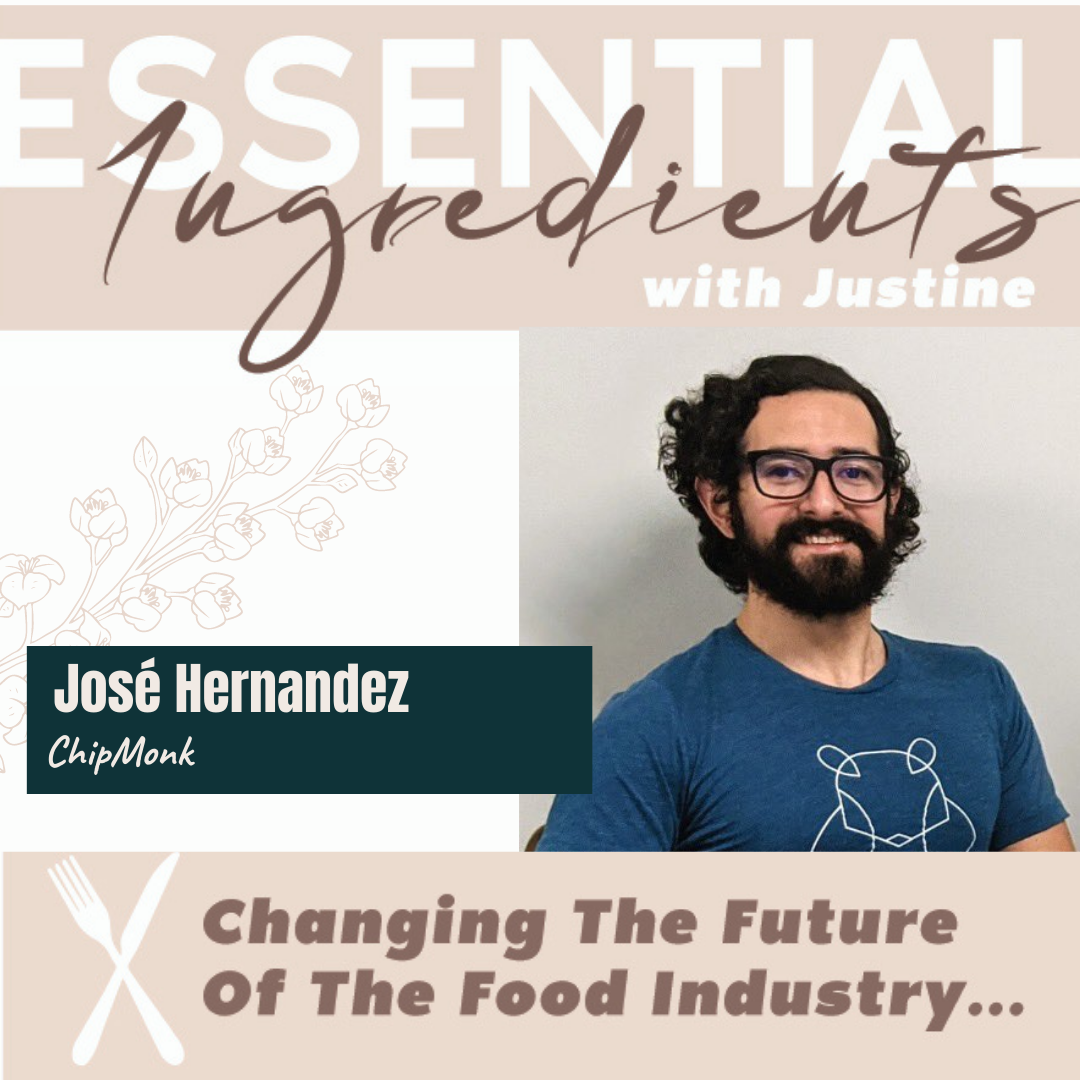
Good morning and welcome to Essential Ingredients, I'm Justine Reichman, your host. Today, we have Jose Hernandez. Welcome, Jose.
Hey, guys. Thanks for having me.
Thanks so much for joining us, because I'm so excited to learn a little bit about you. And is it ChipMonk?
ChipMonk, yeah.
Okay. A little bit about your story, and what you're building there? Because it sounds super interesting from Keto to Peleo, to building a brand that can really talk to a lot of the new challenges and new ways that people are thinking about food, and the diets and lifestyles that they're building for themselves. So can you tell us a little bit about your story and what you're building?
Absolutely. I guess I'll start with a quick intro about myself. Double science guy, I like science, I like learning about the way things work. So when I was diagnosed with type 2 diabetes, I immediately decided to tackle it with food. I figured, if the food that I'm eating is raising my blood sugar, then maybe the food that I eat can lower it. So I changed my diet. And in about two and a half months, I reversed my blood sugar back down to regular levels. I did it all through food, no supplements, no medicine. It was tough, and my doctor thought I was crazy. But in the process, I had to give up dessert, I had to give up bread and things that I really liked to eat. So after a few years of trying to save my sweet tooth and failing like ice cream, and feeling awful, I decided to make something for myself. So I started baking. My roommate David was like, Hey, this is pretty good. We should see if people want to eat this. I was like, okay, let's try it. So we gave out some samples. People liked it, and we launched ChipMonk shortly thereafter.
Wow, that's really cool. I don't know if you know, you probably do know this, but food as medicine is a really hot topic so I'm sure that this is not new to you.
Yeah, I could quote that all the time. Let food be thy medicine and medicine be thy food.
I love that. And it's so true. I think that more often than not, it's really turned into a whole conversation and way of talking about preventative medicine, curative medicine and not necessary in lieu because I don't want to go down that route. If you have breast cancer, you really go get the surgery. But there are ways to support our immune system. And like what you're talking about, bodies heal themselves. I love that. We do a lot of conversations on that, but that's a whole different topic for a whole different day where we bring in doctors and all sorts of things. I'd love to do that with you. But right now, we want to focus on ChipMonk, we want to focus on you so walk me through this. You started literally in your kitchen in town, where do you live?
I'm in Houston.
You're living with your roommate David in Houston, and you're baking cookies.
Cookies. Initially, I started making bread cookies, brownies. There were a lot of accidents, a lot of stuff I didn't like so we were like, let's lean into cookies because we can mass produce this eventually.
Before you go, were you working full time at this moment?
I was, yeah.
So you were working full time, you're cooking and baking cookies, and thinking you're going to mass produce this? Sorry, I just wanted to make sure that everybody had a picture. Okay, so now go on.
So we actually worked in an entrepreneurial space, it's called the Canon. We work, but it's sort of startups here in Houston. So being around all these new startups and working for one, I wanted my own and we were like, there's got to be something, got to be something. Eventually, the cookies clicked, we were like this, let's do this. Let's provide a readily available prepackaged dessert that doesn't make someone like you with diabetes crash. I was like, yeah, that sounds great. Let's do it. That's why I was thinking like mass produce. So yeah, we just started in our kitchen, we immediately had to find an actual kitchen to bake out of because you can't ship things unless you're in a commercial kitchen space. So we got that pretty quickly. We sub leased it from a catering company, and now we're building out our own. So it's pretty exciting.
Wow. So we went from A to Z very quickly here. But can you tell us more about that whole journey?
Neither one of us had any experience in food. He's the business side. He's like the accounting major, and I'm this double science guy. So between both of us, we had to learn to do everything. It's actually been a really big challenge, but it's been fun to figure things out. First time learning to do marketing, for instance, learning to do massive batches of cookies at a time, like 4,000 cookies, managing a team, all that good stuff. It's been a lot figuring out packaging, shipping, there's just so many aspects of the business that we had to learn between two people. And honestly, it's a lot of hats to wear, but we're getting through it.
Walk me through the timeline. When did this all start?
It started early of 2019. That was the first time I baked. We had ChipMonk by February. We're in a commercial kitchen space by March, no, sorry, April. We were shipping over the summer, and then we started picking up traction towards the holidays. So after a big shout out from KetoConnect in January of the following year, we really saw our sales spike. So yeah, we're about a year and eight months, a year and 10 months into it right now.
Okay, so when did you go from two people to a team of?
Three. We really have independent contractors that helped us. My brother and his high school friends showed how to bake. Starting out of necessity, I needed an extra pair of hands so I called my brother. And then we needed more hands and I was like, call your friends. Now we have a team of high schoolers and one of their moms actually working with us now. So yeah, baker bakes, there's about eight of us baking. But day to day operations, it's David, [inaudible] and I for the most part.
Wonderful, that's awesome. So now, are you still working full time?
Now? We actually both made that jump pretty early. I did really early on like a few months in, David did it about 10 months in, and we've just been riding the roller coaster that is startup life ever since.
What was the aha moment or that moment that made you take that leap from being a hobby or a side hustle to now being your full time?
I think we both saw the potential pretty early on. I especially knew how prominent something like this would be in the diabetic community, and keto was like really catching on at the time. So sometimes, you just kind of have to take a leap of faith and jump before you actually know that the ground is not going to hit you on the way down. I think David described the startup once to me as jumping off a cliff and building a plane before you crash. Believe what you're doing, you have so much money and so much time, and you have to get those pieces working together before you hit the ground. So it basically needed all of our attention, and there's just no way we could do it while also manning another job.
So let's go back to the beginning for a minute. When you say you started with bread and then you went to cookies, what was the first thing that you started with? Not just for yourself, but to sell.
Cookies. So we actually started selling cookies first. I personally wanted to make bread for myself because I just wanted something to put butter on.
I understand that. For me, it is a vehicle to eat butter.
Exactly. Yeah, perfect. Me too. So that's how I feel about bread. I was like, I need to make some bread. And the bread was really eggie, there were a lot of eggs involved, it didn't really rise, there's a lot of almond flour. It wasn't bad, but I don't think I can mass produce that. I really don't think the shelf life would really allow me either. Cookies on the other hand are easier to do, there's more variety, you can make different flavors. And if you package them and seal them, then their shelf life goes up pretty exponentially. So that's kind of what we just started.
What was the first kind of cookie that you made and sold?
Chocolate Chip.
How many different kinds of cookies are you selling?
Right now, we have six staple cookie flavors. We do seasonals all the time. We also do bites, which are these little balls, we call them cookie balls. They're half the size of our cookies. We have four flavors of that with a fifth seasonal. We'd like to keep our audience engaged, so anyone that subscribes to our newsletter gets exclusive access to a small batch of flavors, we made up buttered pecan the other day.
That sounds--
Yeah, it was good. We were like, guys, we made 50 batches of this. If anyone wants to buy, or if you order a certain amount, we'll give it to you for free. Not only does it keep our community actively engaged with us, but at the same time, we give them added benefits of being customers of ours.
That's awesome. So how large is your community right now?
Newsletter about, approaching 5,000. And from there, social media is slowly growing, we're at like 7 to 8,000 on Instagram. I don't know how many followers on Facebook, but we have a pretty sizable following. I see the same names all the time. We always write handwritten notes so people tend to like that.
You guys are not marketers, you're not social media gurus, you're a scientist and an accountant. Some might ask, how did you build this following and this community with no expertise or background in that, because that's a pretty good engaged following.
Trial and error, really. A lot of different things, reaching out to a lot of social media outlets, I actually got published in the Houston Chronicle in May, that was a big boost of traffic in salesforce. And it's all really just being genuine, sticking true to your goals and your mission as a company. I personally love to talk so it's not hard for me to go out and say hello to people and make things happen. We used to go to farmers markets all the time, and we would face to face our customers. But it's hot in Houston, and we just can't do it in the summer. So maybe we'll do it during the holiday season, but direct to consumer via E-commerce has been our best platform.
Alright, we're just gonna take a short break and have a word from our sponsor. We'll be right back.
So to that note, I want to ask, your direct consumer, you're doing this a lot online, from what you're saying that that's your largest audience. Imagine everybody that's a direct consumer right now and selling online, COVID has really upped their sales and they're doing well, how has it impacted you, or hasn't it really had an effect?
In the beginning, I think it was very positive. People were more health conscious, their health is more top of mind so people were looking and actively seeking for things like ours. Better for your cookies, made with almonds and seeds versus flowers and sugar. But I think as the economy has been hit a little bit harder, selling specialty food can be a challenge, especially with all the big names getting into email marketing and online marketing, it's been tough. We have to spend more to reach the same amount of people now because there's so many other people in space. But we're trying to do our best. The end of the day, the best tasting product wins, but they've got to physically get it and eat it first.
I think it's the product, but I also think it's the story. And given you like to speak so much and you're good at it, you come across genuine authenticity, I think you have that playing as a [inaudible] because you get to share your story, and it's really a personal one at that. And able to say that you built this to fulfill a need that you had and you know that so many others have, I think it's heartwarming and people can connect with that. And to that end, people out there are looking for solutions that taste good. And the fact that you've built one because you were missing these items, you're really aware of what it tastes like, and you wanted to build something that was going to replicate that and solve that problem for you. I think that that's a compelling story. I don't mean story in the sense that, I mean that it's personal. You know when you share that, you know that I get it. It's like, I don't eat dairy, I don't eat gluten, I don't eat all those things. And when I can find a great thread that replicates that feeling of that, and I could smother it with fire, and it's chewing, I'm so excited. Then I found my vehicle for my butter.
I relate to that so well.
And then I like things without sugar, because sometimes, sugar doesn't agree with me. I just don't, I don't like it. So I get excited when I find that. When I hear your story, I'm like, wow, there's somebody out there like me that's creating products for me too. I may not be diabetic, but there's somebody out there creating something that I can eat. It just makes me that much more excited about all these new innovative products and hearing your story.
It's funny that you say that because we did start off specifically to address the sugar issue in food and the diabetic community specifically. Our product is so much because of that, we are gluten free, we're low in carbs. Keto is a big thing. So for anyone doing keto diets, or avoiding sugar, or trying to avoid extra processed carbs, we all of a sudden become this very viable option for so many people when we started, specifically for one audience and kind of branched into four or five.
Yeah. And it's interesting that as your products developed, and as you learn more about the people that are interested in this, your audience grew. Because originally, you are the audience, and you're like, all people like me or the audience. But then you learn more and you're like, oh, well, all people like this, and this, and this, and this, it expands and you realize that reach is so much greater than what you originally thought, and that there are so many people that are connecting with your story. I'm going to find your ChipMonk cookies to be the next best thing or the best thing on the market for them. I wish I could probably eat them.
I have a single vegan option for you, it's our chocolate chip, I send you some.
Okay, I would love that. I would love that. That would be awesome. I'm always looking for a good cookie, and I don't love very sweet. I can't do eggs, okay, that sounds exciting.
We were kind of forced into doing that because here in Houston, the first customers would always ask us about vegan products like, hey, do you have anything that's vegan? I was like, no, but I can try. So we made our chocolate chip a vegan option. It's really tasty, it's just a little bit different from everything else because it has chia seeds and flax seeds instead of egg. Coconut oil instead of butter, and find out that it still has great ingredients.
Clearly, I'm not vegan since. I told you that I eat most things as a vehicle to eat butter, but I do go to the vegan option since I don't need that. That's great, so what's the consistency of that cookie?
It's a really soft baked product. Think of it like a muffin as people describe it all the time.
Oh, I like that.
They're fluffy, they're soft. Unfortunately, we can't make crispy cookies. Allulose draws a lot of water into the cookie so the cookies are very moist. They're tasty, but if we try to make them crunchy, they -- people have to love soft cookies for them to love ChipMonk.
Okay. For me, that works. I was the kid that used to make these, what were the Duncan Hines, or whatever time you put in the oven.
Oh, yeah.
The ones that came in the Pillsbury, the Pillsbury.
Oh, yeah. That's perfect. That's how I like my cookies too.
That's how I like my cookies. Awesome. Can you tell us a little bit about the kinds of ingredients you use? I mean, from what I understand, it's a really clean product. I know that a lot of our listeners, they're really interested in keto, gluten free and all these different kinds of options. But equally, what's important is the kinds of ingredients that go into making it. So talk a little bit about that.
Yeah, of course. When I first saw a cookie recipe I was like, I need to recreate this. But there's so many ingredients on here that I can't have. So the first thing I saw was the flour. I can't have all purpose flour, it's going to spike my blood sugar way too fast so I started looking for alternatives. I stumbled upon almond flour so I was like, okay, let's start with that almonds. I eat nuts all the time, let's just replace a handful of nuts as a flour into a cookie. So from there I was like, oh, I can't have the sugar either. And the sugar was actually one of the hardest things to replace because a lot of the sweeteners out there aftertaste are still affecting blood sugar, a lot of them are sugar alcohols and they're going to affect your stomach too. None of that was great for me. I was looking for something naturally occurring. So Monk Fruit was the first thing I stumbled upon. It's actually a little melon that grows on a vine to make it into, they mash it into a liquid and dries out into a powder, zero everything. Zero calories, zero carb.
I'm sorry, I was just talking about Monk Fruit the other day at SunLife when I was getting a smoothie.
Mm hmm.
They were saying that it doesn't change the taste at all.
It doesn't, no. It's really, really sweet. Really small amount goes a long way. It's actually an antioxidant that gives all its sweetness. So you're not getting any carbs, or any sugar, or anything from Monk Fruit. But by itself, it can't replace sugar because it's, you need so little of it, you still need to fill that void in the recipe. So I was like, I need another sweetener, what else can I find? I eventually found allulose, the O-S-E at the end is like fructose or glucose. It's actually so naturally occurring sugar, just really rare in nature so that means that our bodies just never had time to develop proteins and enzymes to digest it. You can taste and recognize that it's sweet, but you can metabolize it. So 10th of the calories, 70% of the sweetness. It's like the perfect sugar alternative. Those are some of the main ingredients from that that we had to fill in the gaps. Instead of using binding agents, we use psyllium husk, so just trying to keep it as clean as possible. I'm a big fan of wholesome ingredients, and just eating from the earth. If you have to process it a whole lot before you eat, it's probably not going to be the best, just trying to keep that in mind as we build products out.
Yeah, I think it's really important, especially for people building products with purpose, and building better for you products. I know that some of our listeners are building free products, they're entrepreneurs building better for you food and beverage entrepreneurs. I'm wondering, you've had quite a success in the last, in the short period amount of time that you've built your business, are there any tips that you might share with our listeners today?
Yeah, absolutely. Actually wrote them down. So the first thing is probably the most important, you have to be in it because you care enough, and you have to care enough to write it out for the long term. It's not something that's going to happen overnight, it's something you're going to have to spend lots and lots of effort and time. And unfortunately, a lot of people who start in the startup world fail because they give up. So be prepared to be in it for the long run to care about your product. Number two, you have to know your margins, make sure you get an accountant, get a good team member, find a good team to build your business around. But especially knowing the price of your cost is really important. You need to price things correctly or you'll go out of business. You can't really help the world if you're not selling to the world anymore. I personally think this one matters the most, the product has to be a good product, it has to sell, try to sell it before you invest time into it, make a prototype of the product, give it to your friends, try to sell it to your friends, start there and then run with it. After that, you have to have good packaging, it's very, very important. Something we didn't really put a lot of emphasis on in the beginning, we had these clear bags, and we would put stickers on them. But if you ever want to be in retail, or if you ever want to stand out on the shelf, even on the Amazon shelf, you have to have pretty packaging that draws the eye. Those are my tips.
Awesome, listeners, we really appreciate it because there's so many things to think about. Sometimes, we just need a place to start.
Mm hmm.
I appreciate you sharing that. I'm wondering, during this pandemic, have you come up with any fun recipes with ChipMonk, or you've created new fun ways to use the ChipMonk recipe to create something new and innovative.
I wouldn't call it new, but I love making cookie sandwiches with ice cream. I'll take some rebel ice cream and sandwich it between two ChipMonk bites or two cookies and have a good time. I only eat half of it though, just to keep my portion down. It's a lot of calories, but it's also a lot of extra sweeteners that I don't want to overdo.
That sounds yummy to me, especially because we've had so hot weather here in Northern California lately. Ice Cream Sandwich, sounds yummy.
Yeah.
I would have wanted it for a really long time. But I used to really like those. I mean, think back to the day before, just the original chocolate cookie on top with the white ice cream in the middle, I've gone back like 40 years now what I liked the original ones. They were kind of my favorite.
We used to do whoopie pies.
I remember whoopie pies.
We made a nice thing out of butter and cream cheese in our sweetener, and then we would sweetly flavor it differently sandwiched between two cookies and sell those at Farmers Markets. Unfortunately, the shelf life is really short with products like that so they need to be refrigerated, but we do have a recipe on our website for that specific you can buy.
Okay, I love that. So we'll have to make sure that we put that in the show notes so everybody can see the recipe for that whoopie pie. I think that they might appreciate that because that's always fun to do since we're quarantining, anyway, right? Go out and about, you might as well take a fun recipe and have some fun baking,
Why not?
Definitely. Are there any new flavors that you guys are planning for the future? What do you guys see and what's coming down the pipeline.
In the future, I mentioned earlier that we have cookies and we have bites, we're thinking about launching a lot of our cookie flavors as bites just to offer more options. Instead of eating a whole cookie, you can have a bite, which is half the size. So it also allows for people to have multiple bites at a time. Variety is definitely the spice of life. I'm very passionate about that. So the more options we can get people to mix and match their sweets, the more likely they are to keep coming back for our specific sweets.
Are there any other problems you're looking to solve given this challenge that you experience? The fact that you love sweets and you're looking to eat, or you're not able to eat certain things, you're trying to create a different line and that's how you create a ChipMonk. Are there other items that you're lucky to create as a result that you miss on a day to day basis?
All the time, yeah.
Next on the list.
Well, bread is a huge one. For me, really, anything that has a lot of carbs in it that I can't have is something that I miss, especially bread being top of the list, savory snacks like crackers and things along those lines. I've definitely dabbled in making something savory versus something sweet. We don't need as much of our sweetener in something savory, I really just want to have some variety. I accidentally made Hawaiian rolls. The Hawaiian roll is like what you have on Thanksgiving, they're like sweet breads.
I need you to tell me where, I'm not sure what this is. Is this something from Texas?
Honestly, I have no idea.
I'm from the east coast, I've never heard of this.
Yeah, they're amazing. You need to find some
Is it a cinnamon roll with raisins?
No, no, it's like a white bread, but it's like buttery and sweet. And it's so bad for you, but it's so--
Pineapple?
No, I don't think so. Just plain old buttery rolls.
And it's called Hawaiian rolls?
Yeah.
I've never heard of this, really, I need to look up Hawaiian rolls.
It's literally the only thing that I look forward to for Thanksgiving. It's like my favorite item of all time.
Today is October, what? October 5th, a little over a month to make your keto Hawaiian rolls.
That would be an amazing product. Oh, I'll give you a sample.
Awesome. I'm so appreciative that you've been able to come on and have this conversation, share your story with listeners. Before we wrap up, I would just love for you maybe to share the impact you hope to have on the future of food. I know in terms of your specific desire to create your line, but in the larger sense, we'd love for you to share that.
Yeah. Honestly, there's sugar in everything that we eat, from ketchup, to bread, to cookies. I'd love for the world's become more aware of that and to fight back because no one's going to do anything about it unless the people buying the goods say that they don't want to do it anymore. Just bring about this conscious awakening of how bad sugar is for you, and how much sugar we have in our diet. So yeah, lowering sugar across the board, across all foods, I think there's a lot of sweeteners that we can use to keep the same sweetness if we must, but make it with a lot less processed, refined things, and then get back on the wholesome clean ingredient training. Vegetables shouldn't have to cost more than processed flour. So that's something that I'm hoping to have some influence in one way or another.
I love that. I don't love sweets to be like, I like something a little sweet. But I often think things are way too sweet. You could put one date in something and it's far sweeter than any sugar that you're going to put in that recipe. I think that sometimes, playing with some of those types of products or using those, what's the word that I'm looking for?
Like alternative sweeteners?
Exactly. Using those alternatives versus the sugar, we need to play with them so that we can understand, because off the bat, they can often just be too sweet. And then we can sort of scale it back even to see how far we can go to see when we like this, and how far we can get it so that it's as least sweet as possible, and we still really like it.
I have a lot of friends that go overseas and they stay there for extended periods of time, and they come back and their sweet taste buds have changed. They're like, this is too sweet. Now, it's like everything just really depends. So if you are off of sweets even for a few weeks, I promise that you are going back to the way you were eating before it's going to be just overly sweet for you. So there is hope. What I'm saying is I don't have this high of a sweet tooth as I did before. I actually really enjoyed vegetables now because I was forced to, and now, I have vegetables for any major meal.
Wow, I'm with you. I don't love sweet things every now, and again, I like something a little sweet. But even now, when I go to get my matcha, my frozen Moksha, I tell them about the sugar, leave out the dates, leave out this, leave anything with an aftertaste that makes it sweet. And like, you don't want anything? I'm like, no, don't even put apple juice in it because I don't like the sweets. And they're looking at me like I've got six heads. I think it's just because for so long, I'm just not eating so many sweets that might, like you said, my taste buds have changed. So if everyone starts to do that just a little bit more, I'm sure the impact will be compounding, they'll be wanting less and less sweet. So I'm on your bandwagon. Together, we're going to help them, help people realize that they don't need as many sweets as they think that they do.
When they do, go to chipmonkbaking.com and get some cookies and bites.
Awesome. I love that. Well, I'm so glad that you joined us. I'm so glad to learn a little bit about your short story and share it here on Essential Ingredients. I want to thank our listeners for joining us. And for those of you that are not subscribed to the Essential Ingredients channel and want to hear this and other podcasts, join us and subscribe to the channel. You can meet Jose here, and you can also connect with him once I invite him to join us on the NextGenChef platform and connect with him one on one as well as the rest of the community. We have an app and there's also a website. You can learn more about us at nextgenchef.com, you can learn more about me at justinereichman.com, tune in for more podcasts each week, Monday at 6:00 AM.
Share This Episode
Enjoyed this conversation? Share it and tag @nextgenpurpose
Listen on Apple ▶Listen on Spotify ▶Your Host
Justine Reichman
Founder & CEO of NextGen Purpose. Host and Executive Producer of Essential Ingredients — 11 seasons, 330+ episodes, and a growing movement.
About Justine →