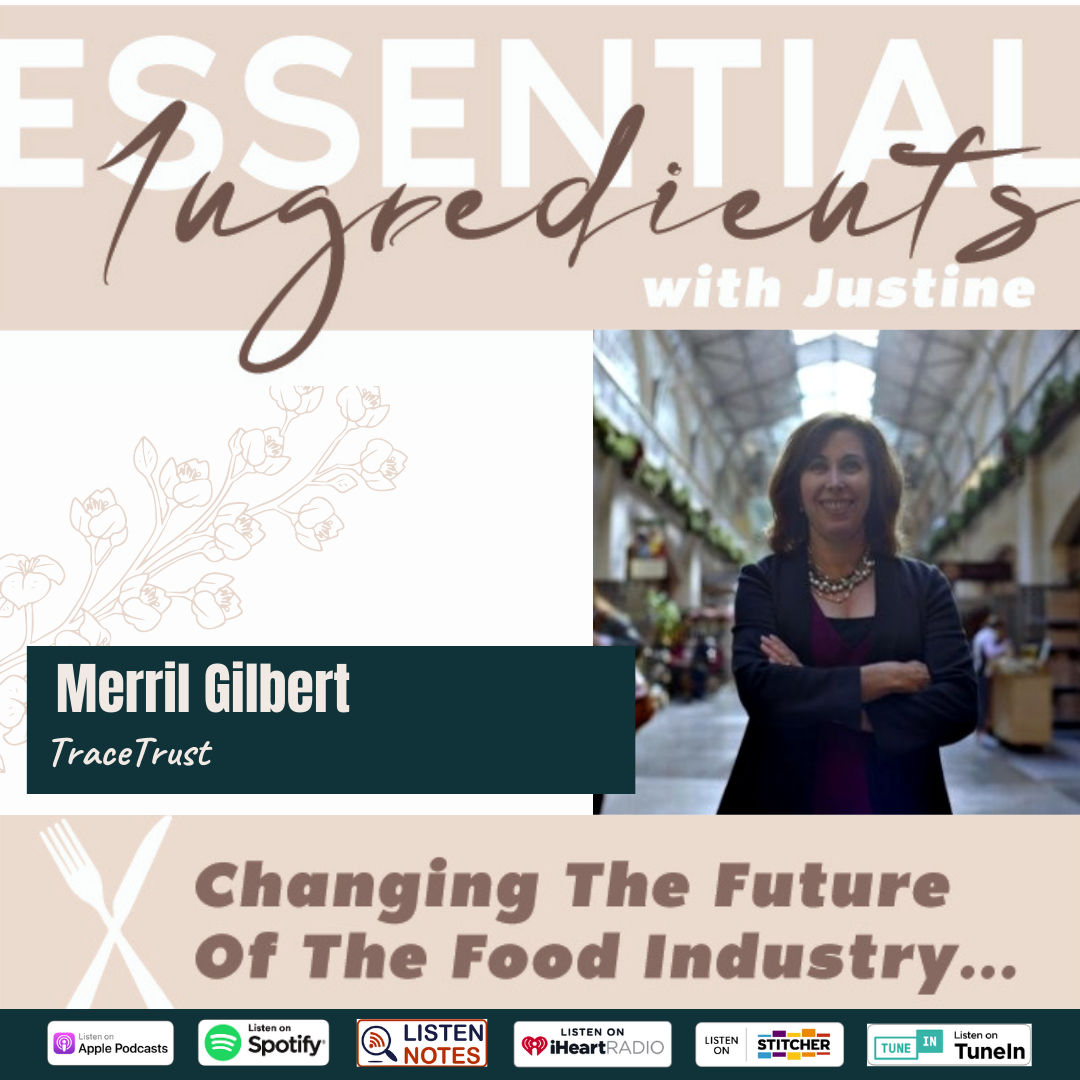
Merril Gilbert · NextGen Purpose
Watch on YouTube
The Bridge Between Good Food and Unforgettable Experience with Merril Gilbert
The Incorporation Method helps you turn what matters into practical changes that fit your life.
“”
Full Transcript
Full conversation between Justine Reichman and Merril Gilbert.
Good morning and welcome to Essential Ingredients, I'm your host, Justine Reichman. Today, we have Merril Gilbert. Welcome Merril, thank you for joining us.
Thank you. Thanks for having me.
I'm so excited for this chat, to learn a little bit more about you.
Well, we have had some great conversations in the past, and this is really an honor to have this one, to get to really share to you an unusual career and how it went from one thing to another, but where it is today, amidst all this going on in our world,
Definitely. I think that your experience is so vast and so varied also, that our listeners can really get a lot out of it, both for inspiration and as well as a way to tap into somebody that has so much to share. I just love to learn a little bit about your story and where it all started.
Fantastic. I was a middle class child. Anyway, I grew up and my parents, my father were in the food business, but it turned out that I had no idea that this was going to be where my life took me. And interestingly, I was lucky to be one of those first generations that really, not only did we travel by car around the country, but really started traveling outside the country, and that really changed my perspective. It changed pretty early on around, my mother could not cook it to save her life. And having TV dinners is really going to these restaurants all over the world. Everything from street food to very fancy formal things. So it really was this perspective that started to happen. And then you go off to college and you're supposed to get a degree, it probably should have been a business degree, but at that time I was into social science. So I got a double degree in anthropology and geology, and it actually turns out to be the foundation for what I really needed to have. The reason is because it has always been just this way in which I enjoy learning about new cultures. I don't really believe you can truly have empathy, you can't really access leadership and really help people achieve and develop to be the best that they could be without having an understanding of where people are coming from.
I'll tell you, I was having this exact conversation this morning with somebody who was just onboarding who comes from India. And it was merely because I went to that nation school and I was explaining about my experience. Going to the school has given me an opportunity to better understand people's cultures, perspectives, and allow me to be more open to adjusting my perspectives and the way that I can think about things. And in line with what is going on in the world right now, I think it's such an important skill. I don't mean to cut you off.
No, but that's what this conversation is about, right? How do we get from where we started our lives to where they evolve, and how do they continue to evolve. And for some people, it's fine to just stay in your world and be that. For me, it's just a constant desire to learn new things and to evolve. Again, back into those early days of school and education in Arizona, I spent a lot of time with native Americans in Arizona, New Mexico, Colorado, Utah. And then after that, after college, ended up in Wyoming, doing environmental impacts in the oil world. That was pretty crazy because, even though I think I'm six feet tall, I'm only five feet tall. And here's this young woman like driving around in the middle of Wyoming by herself. There were some really interesting events that happened during that time. But somehow, after this pose a career as an anthropologist, I ended up really kind of ending up in the food world accidentally, and managing because my parents were in that, and because I've always been very strong willed and not a very good follower of directions or anything else.
Totally opposite.
So making this all have way longer story than it needs to be. I ended up back in the food world, back in restaurants, and it was also at a time when chain restaurants were really starting to expand. So again, as a woman, it was very hard to get promoted outside of the regular, for management, to get to an Assistant General Manager, even a General Manager. At this point in time, this is also when Alice Waters, Wolfgang Puck, all of these, there was now a movement around food that was very different out of this chain environment which was great having foundational business skills of P&L, and budgeting, but not being a decision maker. And knowing that that's certainly not, Olive Garden is not the type of food and relationship that I want with it, but knowing that I really wanted. At that time, my goal was to be behind one of the top 10 restaurants recognized by Esquire Magazine, because that was like the height of the height. But at that time, that was the thing. So I was going to determine how to do that, and I got that opportunity because I had now moved from many different states. But now I was in California and was working for Hilton Hotel, and I was an assistant F&B manager. And this small independent chain restaurant group found me, and I was the first woman they ever hired as a general manager, and got a lot of heat for that, I have this one man that was my mentor. He saw what I was trying to do because I said, yeah, this is my goal. I kind of forced my way into their RD team and to their--
What I would love to just get back to is, you were aspiring to work for one of the 10 best Esquire restaurants and--
I really wanted to be an integral part of it.
Okay, so you want to do and take initiative, pull it forward and have an impact--
Be part of the concept, be part of everything, yeah.
Okay, so you've got this job at Hilton.
I just got in Hilton and then I was picked up by this independent restaurant company and I got to, it's their first woman General Manager in the company, but I got myself on to their concept in the RD team.
Okay. And which company this was?
Oh, it is now known as King Seafood, at that time it was the University Restaurant Group. I got to do this role with the opening of the Water Grill in downtown LA, it has been created, completely re-concept. At that time, it was state of the art. You see it in a lot of movies, it's in the Italian Job, say hey, I like to pick that out. But it was great. We traveled all over the country to create this Seafood Restaurant, to have a live bar, to have this amazing artwork in there. It was in downtown LA because the Music Center was there, we provided taxi service. Thomas Keller was the chef next door. So it was really like, the timing was amazing. And then the Rodney King--
Wait, what year was this?
Citizen 90.
Okay, so now we're up to Rodney King. Okay, go on.
Rodney King, here I am, my good friend that I made in this restaurant organization was the chef of one of our other restaurants in Long Beach, and that's also where I lived at the time. And so the night of the riots, I had guests up at the Music Center, but the taxi stopped running and all their people had their cars at our restaurant in our garage. So I'm like, in my car driving, picking up these guests and bringing them back, and the next day it's like, may have and everybody's shutting down, so we had to shut down this restaurant. The building we were in had an antique bookstore so they were concerned about boarding him up and I'm like, we have a $2 million restaurant, and I've got over a million dollars worth of assets, and if there's like, you're telling me that's more important? I'm like, calling, because this is pre internet stuff. I'm calling all over town that I have cash, I have lots of cash on hand, and I will pay the first person that comes and boards these ones. And then I'm like, Oh, my God, I've got to make sure that the dishwashers, like I've got to make sure everybody gets home, they have what they need. I'm like, obviously, seafood restaurants, fish do not get better with age so we're sending food home with them. But then my friend who's the chef at one of our other restaurants in Long Beach, they just left her like nobody was around. They just left her and she's like, what do I do? I'm like, okay, well, first, let me get home. I have one of the first cell phones, the ones that looked like a shoe?
Yes.
15 minute battery long.
It was like $2 a minute or something.
Ridiculous, right? It was just so crazy. I wanted to take this dishwasher we had, I wanted to chop him off at home, which was kind of a lucky thing. Because he was kind of a big guy and I felt kind of good. But I got to Long Beach, and went and helped her shut down her restaurant, and then we stayed at home for a couple of days. But the whole point being is that, it was all about opportunities. From that experience, once the company started, again, transitioning, and some of their senior leadership started to move out, I ended up going to DC from there. Another great experience, the chef at the time, chef owner Mark Miller, had opened this restaurant in DC called Red Sage.
I love Red Stage, I can pick Red Sage. Wasn't right next to the JW Marriott.
Yeah. The press building up. Again, I am forward thinking.
No, I was in DC at that time.
See?, We could have known each other. And all of that, again, with Mark was another visionary, another personal line. His degree also was anthropology. And this place was an homage to the history of the western United States. The way that it was conceptually built, it was an art. And it's just the creativity. So I came in as director of operations, obviously, that team had been there a while, but we really set out because it was such a unique thing. It had a full retail space, and then it had a casual bar concept. Then downstairs, you had not only had a formal dining room, but you also had private dining rooms. The kitchen was so state of the art, we had our own drying room, again, all not heard of before. And another building that was completely, just a regular office building where everything was built from the ground up. So it was another multimillion dollar, this was not the norm at that time. But again, being a part of that world, what was my goal was, again, bringing in this culture, and bringing in because now you had the second generation of employees, you didn't have him there, because he was now off opening Las Vegas and traveling to Asia. How do you recommit the same level of value that was originally intended when it started? And so this is all leading to, why do I care about the things that I do? How do I get there? It's always thinking, where are we today? Where are we going? Where does our food system fall into this? We have seen that broken down, and broken down. And what has happened is we went from really caring about this, to evolving to caring about this, but also seeing a consolidation in distr ibution, packing, breaking down big agriculture, commitments to small agriculture. So when I was here I am in DC and recruited to come back to California, but to Northern California, this was now the new rise of celebrity chefs. The chef moving in, is brought in to open a restaurant that was the case study, and how not to open restaurants, and a chef [inaudible] who was just crazy. And sitting there with investors that had put up about $150,000 to renovate this place and I'm like, three months in and I'm like, guys, you can come up with another 150, we can retool this and this guy can go, or you have $20,000 in the bank and you can call it a day. You're all wealthy, it doesn't matter, it's a write off. I know we want to try it and I'm like, that's fine. Can you sign my check? The point being there is that, I then became a consultant, right? Because now, that was like the buzzwords This is like the mid 90's and it's like, ooh, I can do that. And I really actually did. I really helped a lot, I worked behind the scenes, and a lot of restaurants that made the San Francisco Best Restaurant lists for many years in a row. Again, it was very much because of this, really understanding on the business side, but also an understanding of what you are trying to achieve. How do you get there, and where does that training go? So it was not just about, it was really leading the leadership to get to the point where you hand them over a restaurant, and work through the training and the development of the staff. And you really build out a program that is not just like hiring somebody and saying, here, go take orders. Like making sure because this is the rise of the connection between the food and experience. So now as we move from chain restaurants, hotels, concept development, everything from fine dining to quick serve, all in the premise of, where's food going? Where are we going with that? So at this point in time, it's now, it's early 2000, the internet's coming on and somehow I come on to this web development program that is supposed to be for the independent restaurant tours. You got to remember, this is like 99, 2000, barely anyone has the internet, barely has moved from an AOL account.
It was right around Y2K compliance where they thought--
And ordering online is like barely conceivable. So this website is, there's one restaurant for a guy who's heading it up and my friend that brought me in to help develop content, but the rest of people are all tech people. They did design a site that was for tech, it was like a great website. But if you are an independent restaurant, or your idea of the Internet and the computer was playing leisure while you wait for the dishwasher, this was not helpful to you. But it's big, they spent hundreds of thousands of dollars and launched it at the National Restaurant show that year. And then quickly, right afterwards, we went to go to redesign it. So here's [inaudible] who knows little about computers at this point of time. All of a sudden, working with the tech writers and the scientists, and working really closely with our focus groups, we've traveled all over as a team and really taken those product managers, and really understanding and leading the conversations of what this information needed to be to be useful. Like, if you're going to give me a job application that I can download, then I need to understand how to do that. I can't take people in an instant, if I can't click through very quickly and it's not intuitive to me, it can't take me a minute or two to find them. Meanwhile, I end up not only helping learn how to do this tech writing, and love the site because everybody else was let go, because now it's like. [inaudible], I'm the one that's loading the site every day for like about a three month period of time, which is actually kind of good because then 911 happens, and everything stops. My husband who is a chef and was working for a big company at the time was also the last person hired as a regional chef in this group. So he is the first one to be let go during the time. We are literally like laying in our flat with a young child who's in kindergarten, and we're like, oh, crap, what the hell are we doing? And literally, with that great brief experience and the fact that our kid had just gone from preschool, a bunch of wealthy families that all went to different independent schools and public schools in the city of San Francisco, we literally put up, we created a company called Mitchell and Gilbert's and did an online meal service. We had organic baby food, we leverage all of our relationships with not only the meat and produce companies in the city, but also at the farmers market where we have long term standing relations. So every Sunday, we go to the market on Saturday and Sunday, and then we'd write them in, you would put up, we'd email it out to all these families that we knew and then we take orders up until like Tuesday, and then we would deliver them on Thursday and Friday. And then we also started catering and doing home cooking classes, like we just survived. And then I transitioned it to a friend because of the next phase of my life. But the bottom line was that, it was, yeah, how do you be creative? How do you, again, look forward? Where are the things? Knowing, what can we do? What can we do out of our kitchen? What can we do? and having that little bit of experience. We even--
A little bit of experience.
A little bit of experience in how to make food, and how to create experiences.
I was just thinking your experience is very--
It was about attention to detail. It was about understanding who, again, in between all of this, there was some additional education, and I did an executive management marketing program through Pepperdine. I understood, realistically, all the things that you need to think about when you are, again, not only communicating, but trying to create whatever that experience is.
I was just gonna say, when you were talking about doing your executive management course, before I launched NextGenChef, I had another company. But in all these companies and all these startups, I feel like I've gotten an on the job MBA.
Yes.
Being scrappy, trying to figure out how to do it, learning how to do it, even if I hire somebody else to ultimately do it, but understanding all the pieces of the puzzle that go into it, I feel that I've gotten my MBA just on the job, not from Harvard.
Not from Harvard, but again, every time I went to do it, it was like, why, but there was a period of time, I think up until last year when everybody's like, Oh, you need an MBA, they have to have that. Now, who cares.
People are not even graduating college, I don't need to do that. But in all fairness, I mean, I think everyone, there's so much experience out there that we get through the process, through our experience, through our interest. If we pay attention to that and we leverage that, I think through these challenging times, we're in a much better place.
And again, that is where it leads to all of this experience. So now, I have a little bit of tech, I have this consultancy that has been in the restaurant and hotels. And because of that relationship to the celebrity chef, now, branding piece of that started to, because I understood distribution, and contracts, and where products come from, all of a sudden, the opportunity on the CPG side of really, how do you bring products to market? That was the next level. Now we've moved from online meal service back into working for others because people have come to me. An independent grocery store, I was with them for a little over a year, trying to work through to help them compete because there was an expansion of Trader Joe's, the Whole Foods opening up all over the Bay Area, and really trying to compete in that world of specialty foods in the Deli areas, in the bakeries, which again, brings me in direct contact with suppliers, and then leads me back to an acquaintance with Bill Niman who brought me into Niman ranch because their teams, everything was being done locally, and the first fedexing of food was just starting to happen. So he was shipping me to all different parts of the country and they were expanding on their retail sector, with their relationships with Whole Foods and Trader Joe's, but he was still the one, really on the bigger platform of running the relationships in the food service outside of that. I got to co-assist him with Chipotle early on Panera Bread, I worked very closely with them to bring a breakfast sausage to market and really leading, really helping evolve their chef relationships because they have these great chef relationships that they always had at their annual hog dinners with farmers, the farmers appreciation and scholarship programs. But we really didn't leverage that in another way. So being able to bring a lot of that to fruition, but I was traveling a lot. So yeah, and when the company was sold, I was still, again, did all that and opened up all the North American food service distribution. So again, everything from specialty cut houses to the Cisco's and US foods of the world. It's that full understanding of all of these relationships. This is now in 2010? Somewhere in there, I don't know, I can't remember 5, 6, 7. It was like three years. My daughter also, the one that was in kindergarten is now in her pre-teen teenage years, and now traveling three, four days a week. I think my husband is now in corporate dining, so he's leaving at 5:00, 6:00 AM. And she is going to bed at 8:30. She had a lot of free time with the early days, Facebook. So I got off a plane one day and half of her eyebrows are gone and I'm like, okay, something's happening here that's not okay. Clearly, you're not watching.
So you're having to do all of a sudden to make a change.
Yeah. I gotta stop traveling and I gotta stay home.
Sort of brings you to the consulting that you've launched now.
Pretty much. So now we're at, 2009. So we have another financial crash, another disruption to, but this is really pivotal in the meat industry as well, right? A lot of corn was ripped off, particularly to create ethanol, and you had big time factory farming, but you're starting to see the first pushes against that. And you start to see where they thought things like -- ranch were crazy. We did make enough of an impact between, now you're starting to see a shift where people are like, Oh, I really do care where my, I do want my animals treated humanely. I have patriots, and you have big corporate companies making stands around that. Not just the trouble lies, but really starting to go, we have to care about this. So it was a perfect time to kind of segue into that, but it also gave me another opportunity to, again, travel again. I went with a friend and spent a few weeks in Asia, again, started looking about this connection about food, what was happening on the UN front for the decades approach, the Bill & Melinda Gates Foundation and their initiatives knew that I needed to figure this piece out as well. So I really started to get involved with, and am always trying to figure out who's really making a difference and how am I going to meet them. Because I'm a strong believer in that six degrees of separation, like somebody will know somebody that will get me into that conversation. So that is what I've been able to, the other part of what continues to evolve is being able to be in those conversations. I got to meet other people that are doing these things, leading some of those conversations and get involved with things like food funding. The Mixing Bowl hub was leading a lot of really intuitive conversations on the future of food and connecting agriculture and investment. Again, continuing these relationships. And the next view of this was going to the plant based world. So again, with those relationships being introduced early on to companies that are creating impossible foods, bring the first plant--
I got to imagine, Merril, as you're reading these, this is like really new, it's really new, its innovative, it's exciting, you're at the forefront of that, what was your initial reaction? Could you think they were fads? Did you think that this is really a movement that you're excited about? Like, I can see the future of this?
It was all always seeing the future of this. I think that I ended up following, generally, if I was smart enough to put actual money and invested, but more intuitively is the fact that, yeah, I know that this is going to be. And then again, who are those leaders that I really see doing it?
Some of the innovations that you were at the forefront of that you think were really--
I think getting behind the curtains of hightail before it got acquired and just seeing that, you trying to be in those conversations, both having the opportunity to be part of the retail side, but mostly on the food service side, it's like, how do you have these alternatives? And during this time, baked goods, all of this gluten free and gluten full, understanding that our grains were changing, how to create those things and communicate that. But the other is, on this plant based side, another woman that was really in the city of San Francisco, but she had come from all over, but she had opened, like the first plant based restaurant here in the city called [inaudible], knowing that I wanted to meet her and figured out how, where I ended up through that transition of helping her have all that and eventually move it on. Because another person that I would get to know well, another business partner of hers, we would end up working together at an agency that he was involved with. Because of their friendship, they're also moved into the future of food and had traveled to Galapagos with their children for a vacation and found the lupane chocho, and that being a really high quality protein. And really now, here they are, three years later, and that will start to get moved into the ingredient worlds and product world. But it's those kinds of relationships that changed these things. Knowing that she figured out a way to make food that is tasty and interesting based on what we like to eat every day, but all plant faces, vegan, organic, all of these things can be done. Now you're seeing them, again, now it's three years later, look at where it is? Now, it's expected, and we have so many choices around this. And then the whole food tech right now, I mean, I get to be involved with lots of ecosystems that bring these things together. Talking with a company right now that is making edibles utensils, spoon, right now is what they've started with.
An edible utensil so that you can eat with it. But then at the end, you don't have to throw it out, you can eat it. What is it made of?
Grains. It's the texture of a compostable spoon, but it's like a hard light. It's like a hard cookie.
It's like a hard cookie.
They're so creative. They're not food people, but they knew that this is one way of solving the issue around waste. Not all compostable things are compostable, right? They've taken time, what a way to solve for that is to make it edible.
My question is, what's the shelf life on it? Because you got to figure out how many you're making so that they don't sit and then you waste them because then you have more waste.
They have it in an air seal type thing. It's got a certain life expectancy in hot and cold items. It's got about a 20 minute life cycle before it starts to somewhat break down. They started with the spin, it's being tested in different parts of the world with chocolate and vanilla, but they're going to be having chopsticks and a fork.
Oh, I can't wait.
This is the kind of thing that gets me all excited. The other is, there's a company that, there's a lot of people talking about packaging, right? So this company though is literally taking waste from the trash companies. And going through both structural and science based ways of pulling out these elements, and recycling, and working on film and plastic containers that will replace a lot. So the innovation around this, again, brings it closer down to, where do we grow food? How do we do it in a way that people think that animals should not be consumed and should not be part of this. And yet a true understanding of the health of soil and the health of the planet does both. Having animals not in feedlots, but having them roam. Having soil and water conservation methods, [naudible]. So it's almost the regenerative piece in this next phase of that. So leading all of this goes to, here's what I care about. I care about people on the planet, I care about, really the innovation and what is coming next, which again, in all of this you're like--
How did you get to Cannabis?
Well, Cannabis was a big part of this too. It is a plant that is medicine, it is a plant that has been around for centuries. Hemp itself is very confusing to people because hemp is for rope and cloth, industrial hemp is very different from cultivated hemp for consumption. But cannabis was definitely, finally going to start to evolve. Six years ago, when I saw that it was going to go recreation here that finally there was some more mature conversations beyond being a stoner culture and knowing that not everybody was going to want to smoke this, or inhale it, and want something discreet, and want to include it in their lifestyle, health and wellness, I knew that that was part of it too. I knew I needed to be in that world, I just wasn't sure what was going to look like. And again, the whole plant based things were happening. There was a thought around creating beautiful plant based edibles, but it really led--
Can we go back for just a second?
I feel like I'm all over the place.
We're talking about being plant based, and how some people want to get rid of eating meat, killing animals and all this, that whole thing. I've never tried to change anybody's opinion, I like to bring the information to the forefront so that people can make informed choices. But one question I have for you, I've been talking to some people about cultured meats, I'd love to know what your thoughts are on that, and what role that plays with this.
So again, here's part of the conversation around that because it's a little more complicated. We just spent years trying to get away from things that we call Non-GMO, but that was much more about a reaction to, again, the big agworld and the control over sea, and planting, and fertilizing methodologies that are harmful, harmful to everybody. And then there's also the disconnect between what it really costs for food, growing it, putting it on plates, putting it in boxes, and what people are willing to pay because we've made it artificially cheap. So these economies are all coming together and exploding. When you talk about cultured meats, it's another way because, again, all of this food tech connect piece that I'm talking about is really trying, people being innovative for solving bigger issues. And so, yes, you are taking, in the case of the impossible burger scenario, you are literally taking a [inaudible], which is basically a blood similar cell out of a plant. And then taking that and in a lab and then adding a bunch of other stuff to make it resemble and perform in texture, flavor, taste, etcetera, sensory wise to a hamburger. And again, kind of going back to what I said [inaudible], it was changing the mindset for where people can accept this change. You're not going to adapt to change in understanding and even try to get people to think differently about food. So maybe I don't need to necessarily give up meat, but man, I'm willing to try.
Yeah, I would say, I'm trying to be more plant based. But I also think it's for my health, as well as the health of the planet. I'm not about, I eat meat, I eat all sorts of things. But I am mindful about where they come from, the soil that they were grown, and how the cows,and how everybody was bad because I feel like, if I can make informed choices, there'll be greater demand. So if we can all learn a little bit more about the process on how things are delivered to us, we can create grains that will impact the future of food. And with that, I'd love to know from you, because there's so many innovative things that you have touch points on, and that you're part of what you're investigating. But what's the impact you hope to have on the future of food? Where do you see digging your own meals, and really having an impact?
Where I'm doing it today, if I can support some of these companies as they make that jump into the mainstream. Where do you go from novelty to acceptance? Where do you start from small to large? What does that transition mean in between pieces? And how do you maintain the original values and vision of a company over time? Those companies that we all tend to align with that are all from your leaders, so how can I continue to mentor and support leadership at all levels that continue to build really great companies from within? Because if you're real, yes, you want to try to keep your people that you like best close and part of that, but sometimes, letting them evolve, like I always want the person that's like, someday I want to be you. I want you to be equal or smarter than me.
I feel the same way, I feel this way.
But if you are a young manager and a young leader, you don't always feel that way because you're trying to manage everything yourself, and you're trying to hold on to. I think that if I can make any impact, it's like, it's okay for things to be messy and not to control everything. But when you're young, you don't know that.
I would totally agree. I mean, as somebody building a startup, the best advice I ever got was from my mom who told me: "You don't have to know how to do everything, you want to surround yourself with people that are smarter than you. You have the vision, that's what you're good at." And then I get it done. But surrounding yourself with people that are smarter than you that know how to do some of the things you don't know how to do, is the best way to be successful. Because you can keep everybody on point and make sure that you achieve your mission, and equally have those people that have the skill set that you don't have.
Right, exactly.
For startups, it's about being scrappy, it's about leveraging people's expertise and bringing it all together, which is what I'm trying to do at Essential Ingredients. I'm so grateful to have you here to share your story for our listeners so that they can have a little inspiration and guidance and feel like they can get dirty, and scrappy, and messy because that's what it's all about.
It is, it is, yeah. It's never the way you expected to be, and it's sometimes easy and sometimes not so easy. Just to share one other thing of the other thing that I really would like to be known or at least be part of is that, it's partly the belief in the company I have today with Trace Trust. I really want to help women in a way and people of color, this is not about lip service, this is about really equitable, inclusive society, you're seeing that our planet, we're seeing our government, we're seeing so much about those that have and those that have not, and the biggest connection to what we all do have is breaking bread together, building community. And just to touch very quickly on the plant based side, you and I recently have been talking with a woman who's been creating a plant based product, I have another African American woman today that I'm speaking to that is also trying to change the food in her community. Another woman who I'm not working directly with, but just doing a delivery service like a doordash and Uber, but more for her community in the East Bay that has the potential to grow. But she's here overcoming odds of formerly incarcerated, lesbian, just every single way. And as a woman that tried last year to raise money, how hard that is, but when you're a person of color, how much harder it is. So if there's any way in which I can help pave that way, make those introductions, help somebody do a better pitch, I want to be supportive of that. And that's always at the foundation of where I am right now.
Well, I appreciate that. I think our listeners will too. If anybody wants to get in touch with Merril, you can connect with her on the NextGenChef app, you can text, you can email, there'll be some contact information also in the show notes, of course. I appreciate that offer that you make out there. Merril, I appreciate you joining us today and I'm grateful for the listeners here. And if this is something you want to hear more or learn, tune into more podcasts like this, please subscribe to Essential Ingredients channel. We are on iTunes, I HeartRadio and a variety of others. So we will be here again next week with another guest to bring to you the Essential Ingredients you need as you build your business.
Share This Episode
Enjoyed this conversation? Share it and tag @nextgenpurpose
Listen on Apple ▶Listen on Spotify ▶Your Host
Justine Reichman
Founder & CEO of NextGen Purpose. Host and Executive Producer of Essential Ingredients — 11 seasons, 330+ episodes, and a growing movement.
About Justine →