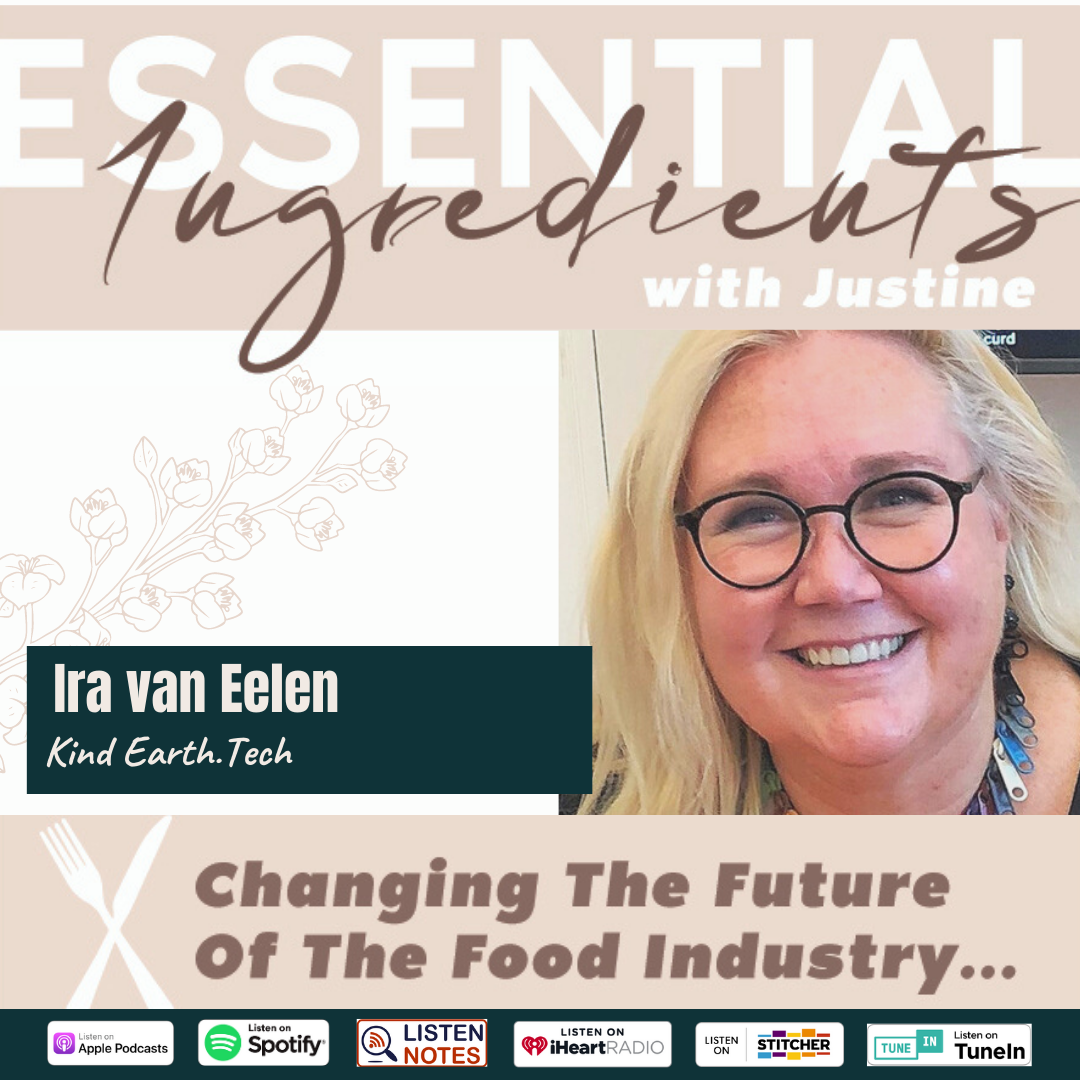
Yvette Yi Yuan and Ira van Eelen · NextGen Purpose
Watch on YouTube
The Elevated Way to Enjoy Meat Without Killing Animals! with Yvette Yi Yuan and Ira van Eelen
The Incorporation Method helps you turn what matters into practical changes that fit your life.
“Is it possible to enjoy meat without killing one single animal on the planet? Of course! Since its introduction in the 2000s, cultivated/cultured meat is slowly changing the future of meat. Justine and Yvette Yi Yuan interview Ira van Eelen on this controversial topic — exploring what cultivated meat is, how you can produce meat without animal slaughter, and what potential it brings to the future of food.”
Full Transcript
Full conversation between Justine Reichman and Yvette Yi Yuan and Ira van Eelen.
Good afternoon, and welcome to essential ingredients. I'm Justine Reichman, your host. Today, I'm excited to welcome Ira Van Eelen and Yvette Yi Yuan. Thank you, ladies for joining me. Thank you, Ira.
Thank you.
I know it is so late there, but I'm really grateful that you have agreed to chat with me in the middle of the night from Amsterdam.
Yep. Well, I'm almost rocking asleep here because I live on a boat in Amsterdam. And it's November here so we have some storm, and then the boat is slowly rocking so I'll try and stay awake for you.
Oh, well, I appreciate that. I got to ask, living on a boat has always been a dream of mine, it's a very romantic dream. Is it as great as I imagined it is?
Yeah, yeah. Everybody who comes here has a certain image that it's small and dark. Then we have low ceilings which we actually don't have. It's very light, there's light everywhere. We have extremely high ceilings, and it's very spacious, especially for a small time town like Amsterdam, where all the houses are actually my nude. And you are outside a lot, you know what the weather is like, and we have all of these outside birds. We even can hear the fish nibble at the boat. And yes, it feels as if I am 365 days of the years on vacation. Yeah, it does actually feel like that.
That's amazing. I've always wanted to live on a boat. I grew up, my dad had a powerboat, and we spent a lot of time on that boat. And many years ago, not that many in the last 20 years, he had been moving around and I kept saying, forget about buying an apartment. I'm like, buy a boat, live on the boat. I'm saying this, and he lives in the middle of New York City by the way. He's like so wet, it's raining and sleeping. That sounds like fun to you? On the upper west side, there's Mareeba. East, 23rd Street. He didn't really listen to me. Still it sounds idyllic to me. But anyway, I want to talk about Kind Earth. Tech, which is right behind you. So tell me, how did you get involved in the space of alternative protein?
Well, that happened quite some time ago, I think when I was 14. And that's quite some time ago, when I was 14. It's over 40 years ago. I suddenly noticed my father going out of his way to meet all kinds of scientists, and starting to talk about creating meat from stem cells. And having conversations with friends, doing the math that, if the Chinese in this world would also start eating meat like the Americans and the Europeans, they actually did the mess. So when I was 14 they told me: "Ira, what is going to happen, we will need, if we continue this way for planets and there's a big chance that we won't have any polar caps? And probably the Netherlands is a hole in the ocean. And at 14 you just listen to your parents and you think, okay."
Yvette is nodding.
Yeah. Okay. Yeah. Okay. And the most difficult part was probably at the time trying to explain what my father was working on to people. These days, if your parents are doing something else in alternative protein, or in solar power, or in something else sustainable? Wow, that's a good job. Wow, this is great. While in the 1980's, saying that your father was creating, let's say, what we now call cultivated meat was kind of a hard job to do.
It's an interesting point that you make. As you're sitting there saying that, I'm thinking about myself, and I remember I can never explain what my father did. He wasn't an attorney, or a doctor, or something straightforward. But now, how cool is that if your father's creating cultivated meat or something, or stem cells meter. That's awesome. You have a good point, I'd like that.
Yeah. I was one of those kids that actually would have liked my father just to be, I don't know, a bank director or something, that was easy. So my father works at a bank. And again, to my friends, what's your father do? You really want to know? Are you sure? I actually think that sometimes, I wasn't invited back. It was so outrageous. And in the 1980's, trying to do cultivated meat and trying to explain to somebody who had done a lot of work to become a medical doctor, and also at that time, probably leading in his field, going around telling the world all of his great scientific achievements. Telling a guy like that, hey, I think you should change your career and come with me. Start using your techniques, and your career, and everything year to create steak to be sold in a supermarket. It took him about 10 years before anybody actually wanted to seriously work on this and start writing some stuff around this. Writing the first proof of concept, it was 1993. It was 30 years later.
Well, your father was ahead of his time. I mean, he was a leader in this industry.
Well, I know. Right now, before I thought, but now I know that currently, somehow all the cultivated meat companies somehow work on cultivated meat because my father did this work when he started in 90 days. And of course, it's a matter of domino tiles, there's never one person that does the trick. But I do think that there were many domino tiles aligned. My father did give the first notch so that they went down, falling down. But it was a lot of hard work, a lot of convincing and a lot of frustration as well.
When did you realize that this was your father? That your father was the conduit here?
I always knew that because I knew, what I didn't know is that my father became sick. I think one year after the first big media hype was happening was the first hamburger, and that was in 1913. I think in 1914, he became really sick. He was sick for about a year and he died in 1915. And from, let's say, the hamburger till 2017. I didn't read, do listen to anything around cultivated meat. I wasn't interested. It was not top of mind. I miss my father because he was a great guy to talk to. I like talking to my dad, I did that almost every day. I was an only child, so who else to talk to when you're a bit crazy.
That's my experience as an only child.
Yeah, and he was fun, he was fast and he was smart. And then suddenly, so two years after he had passed away, I got an email from Josh Tetrick from JUST Inc.. But most people know them as Just Mayo, or Just Egg, or Just Cookie Dough. All of them were great stuff, actually. But at the time, I didn't know anything about a guy named Josh Tetrick. I was under the impression that cultivated meat was something that everybody had forgotten about and was going to be one of those ideas that we should have worked on. And then Josh emailed me, we acquired your father's fattens, we want to talk to you. I was really like, why? But if anybody knows Josh Tetrick, if you don't respond to an email from Josh Tetrick, you get another one and another one. So at a certain point, he sent me another email that he really wanted to talk to me. And in that email, he also did a link to a film and that little film was called Eating The Chicken.
Wow, I just watched that one. I saw on YouTube
Yeah, YouTube. I advise everybody to look at that film because that film, it's actually made by an amazing guy called Colby Macri. And if I wouldn't have seen that film, I think I wouldn't be doing what I'm doing right now. But because of the fact that in that film, somebody had portrayed in an amazing, beautifully artistic way, exactly my father's vision and the vision that I had been aware of for the last 40 years of my life. I had talked about for so many years, and seeing that portrayed in a short film, which is a really good film and explaining exactly what cultivated meat is supposed to be, I got tears in my eyes, and I send Josh a very short message like, you can call me anytime, this is my phone number. So the next day, he called me, and it was really funny. What happened is that Josh Tetrick was under the impression that he had to explain to me what cultivated meat was, I think two or three sentences and I started laughing out loud. He said: "Hey, wait a minute, you're not going to tell me what cultivated meat is?" I know what that is, and I know what it is supposed to be. I know how that works. And then we found each other in the fact that I had so much knowledge around cultivated meat. And I wasn't even aware of that. It was one of those things that I just, yeah, I knew a lot about cultivated meat, why not? But what I didn't know at the time, and I had to learn fast. That actually was a growing industry that had taken off that magical hamburger Mark Post made, that actually was the tipping point of death to a lot of interest. And yeah, so Josh invited me to come over to San Francisco. I was sitting in the plane, was looking outside and said: "Dad, thank you." Wow, invited to San Francisco and invited to eat cultivated meat, which I did. So they fed me all kinds of amazing stuff. There was cameras there, and it was, yeah, all kinds of people. What was great, they also showed me around in the lab, and they had actually a picture of my dad as an inspiration.
Oh, that's so nice.
Wow. Yes, I am indebted to Josh, Andrew and Colby forever. Because of them, I had the chance to even get to know my father better than I did before. Because now, I was actually walking in his footsteps. I met the same people he met, I had the same conversations he had. Of course, in a different time zone, but still was hurdles, still with difficulties, still with things that people don't understand, a lot of frustration there as well, and I grew to be to have more respect for my own father than I had before because he worked on this for years, and years, and years. And yeah, it's kind of sad that he's not here to witness it. But on the other hand, I have found so many amazing, beautiful, fantastic people. So even though I don't make a penny out of this because it's not something that pays the bills, and I'm not a startup getting any investment money. At the same time, I am very rich with everybody who I know the things that I get to talk about. I even got myself talking on stage with people being not at all afraid to do that because I know the story, I know the content, I know what it is supposed to be. It touches so many of the problems that we have, whether it is animal cruelty, whether it's sustainability, whether it's climate, whether it's being going about water in a better way. Maybe even creating jobs for farmers, it is a possible solution for many, many things.
Yeah, for so many things. I'd love to talk about some of the challenges that we see in realizing the full potential of this movement. Could you talk to you a little bit about that, and what you see for that?
Oh, there are many challenges. There are many challenges, and this can still just, actually, even though we have 45 to 50 startups working in this way, if you look at it more closely, if you divide 50 startups between all the different kinds of animals you can eat, like fish, and pork, and cows, and chicken, and then also the different techniques that they're working on,. this is not a huge industry at all. There has been some money into it, but I think all the money together in the startups currently working on cultivated meat. I think in the last year, most animal producers or meat producers have invested more in slaughterhouses than all the money together in cultivated meat, so this is still a small industry. And the tech is there, the knowledge is there, and the mission is there, everything you probably need is already somewhere on this planet. It has to work together, it has to come together, we need more open source in this. So more and more Universities are actually educating people in this direction. We have to do the tech, and the engineering, and the automation and the digital citations to scale this. So what we can do right now in very small quantities and the knowledge that we've built around small quantities of cells, how to scale this up not to something that is this big, but yeah, can stand here and then be multiplied, that is still a challenge that has not been built yet.
Right.
So the potential is there, everybody can actually see it. It's not rocket science to understand that this is a huge potential. But we still have to do the work. On the other hand, if you look at what the price range was in 2013, and if you look at what the same hamburger would cost today, that is a decline in price and that is that is amazing. So if we can keep that up, that we can make hamburgers for an affordable price, was really clean meat, so healthy and clean meat, for those that actually want to eat meat, I think this can even become a commodity that goes to supermarkets for people to eat. I believe that as soon as you have the choice, whether to eat real meat, which has been produced in a very transparent way that you can follow from start to finish or conventional meat, you will actually start to think that, why not eat this meat? And it's going to be the first time that you can ask somebody that you do want to eat meat, or do you want to eat a dead animal?
Sorry, when you put it like that.
It's exactly what it is.
I'm not eating that at all, right? And it's true. It's true. It's totally true. I wonder, I think that they're still vegetarians, the vegans that don't want to eat animals at all. We're not even talking to them, I'm sure because they don't want to eat it regardless, it's not for them. But I do like animals, and I would prefer not to eat one that was killed. I love my dogs, and I love all my animals. And pigs are really smart, then you start to learn about these animals, right? The more you learn about them, the more I don't want to eat them.
Yeah.
It's hard. So the more we learn, the more information we have, the harder it is to continue to do some of what we've been doing unconsciously, which is part of what drives this podcast. It's about making informed choices. I cringe when I say that, only because I know that with the information, I'll make a more informed choice, which is really what I'm trying to encourage everyone else to do.
Rest assured that you're not alone in this. You would expect in countries that are well informed where you can eat whatever you like dead, a large percentage of its population would start or stop eating meat, especially given all that people are aware of. In a country like the Netherlands, last year, we've been eating more meat than the year before.
Wow.
Exactly.
2020 or 2019?
Last year for me is 2019.
Okay, just curious.
But that's an interesting question. If that because COVID?
COVID has impacted meat consumption patterns, plant based meat and other meat consumption patterns a lot.
Well, that's where my head went when you said that I was like, Oh, interesting, because I would have thought it would be higher because of 2020 with COVID.
Yeah. But if you look at for instance, most menus that you have from takeaways, if it's not Indian, or a specific fee and restaurant, still the choice today is 80% with the main thing in it, the meat, and maybe 20% also nice dishes that are vegan or vegetarian. And during COVID, we've been ordering out like crazy. And yes, we are more aware of our health and maybe feel there's maybe a little bit guilt somewhere nibbling at us. So yes, plant based products are surging, especially dairy by the way. But still, we eat too much, I, too much. We're hooked on meat, and all the numbers are telling us that meat consumption is still rising, especially in Asia.
Yeah, absolutely. The Asian population, especially China and India with the current projected growth rates, the math just doesn't add up to feed the population, not to mention the environmental and economic challenges. In fact, we are speaking with Sonalie from Green Queen right after, so we were discussing how alternative proteins are faring in Asia, and in Europe, from your perspective, and in the US. Really interesting to compare how these cultural elements and the geographical factors play into the business of alternative proteins. You have mentioned, in terms of challenges on the research and development aspects, also on the consumer awareness education aspect, from what you said, is any of this specific to Europe, you've mentioned the Netherlands a little bit, but you're really interested in comparing across countries cultures how does this lens escape look like, for example, the Netherlands market is similar to the US, how is this similar?
I'm not an expert on this, to be quite honest. I do know that we don't eat as much meat or animal protein as in the States, as far as I've been told because I never did the research myself. I just listened to people saying this in the US, it's almost 60% of the diet going on to 60% of the diet. Whereas in the Netherlands, it's around 40% of the diet going on to 50. So the US is a very bad trendsetter in this aspect. And currently in Asia, the amount of animal products or animal protein that people eat is around 10 to 15%, which is if you look at it from a health perspective, that's not a bad number. But they want to eat more animal protein, and it's the largest area on this planet. Asia is much bigger than Europe, it's a couple of times bigger than America. Also Africa, as soon as they can get their hands on meat, they want to have this because it's also something cultural. If you are well off, you buy a fridge and you put in meat before you build a house. That is not something crazy. I'm saying that actually, some researchers have found out that people, as soon as they make a little bit more money, buy a fridge and start eating meat. Also, if you are used to eating meat, meat is nice to eat, it tastes well. You have certain people that are really disgusted by the taste of meat, but the majority of people actually like to eat meat. Then if you look at the impact that I say, current produced meat has on the planet, we will do the math and understand that that is not possible. So cultivated meat is for the people that still want to eat meat, have that sensation, have that taste because we will not be able to have as many animals as we currently have. And if there's one person to say this, coming from the Netherlands, we have more animals in this country than we have people.
Wow.
By the way, we're a crazy country. We also have more bicycles in Amsterdam than we have people. But yeah, we also have more pigs, more cows, chicken, more eggs, and we're one of the biggest meat exporters in the world, and we're a really small and tiny country.
I'm curious, you're talking about cultured meat. You've been in this since you're 14, you're continuing on your father's mission, so to speak, even though the patents have been sold, etc.
Yeah.
What is your goal, your objectives? What do you hope to achieve as you continue on this journey?
Okay, what do I want to achieve with what I'm doing right now? Normal sane people ask that question, and then they make a plan, and then they go after their plan or their objective. I just, I just landed here and didn't go away. So I got to San Francisco, I met Josh, I met all of these amazing people, I went on a learning spree and kept on learning and meeting people. I wasn't really sure what my role was going to be, of course. Everybody asked me to come speak to them or do a talk somewhere around, can you tell me something about cultivating meat? And I did, but I knew that was not my role. And at a certain point, I met Tony Hunter. He's a guy from Australia. He does a podcast on future tech. We had a fun conversation in San Francisco. I said: "I don't really know what I'm going to do here. Maybe I'll just stick to my own career." And he said: "You should give Olivia Fox Cabane a call." "Oh, yes, I remembered her. I had been to a party with her, I found her funny and real fireable. We clicked, so I actually gave her a call." And then she said: "Hey, but aren't you working for JUST?" "Oh, no, I'm not working for JUST. I'm on their advisory board, and it actually means that nobody asked me a question, because if somebody doesn't need advice as Josh Tetrick. So yeah, no, no, I don't do anything. I sometimes help them out or whatever." And she said: "Oh, girl, you are going to be so busy." And I said: "Okay." And then we sort of clicked, we became really close friends, and we got to work. And to be quite honest, I don't know what the objective is. But having fun, creating a platform where we highlight amazing future tech is something that we ended up doing with Kind Earth. Tech. We're both in the middle of a network of people that want to change the world and make it a better place, create better food, tasty food, healthy food, amazing food without a horrible footprint. And if we meet them, if we find them, we just put them on stage and create an event around them in a way that an event should be, and in a way that it's an event that I would like to go to myself. So when I started doing this in Amsterdam, I actually did breakout sessions on canal boats.
That sounds fun.
Yeah. And we had a waste dinner in a disco take, because that is something I would like to do myself. And right now, this Friday, I'm organizing an 11 hours long event. It starts in Amsterdam, Europe. We stay there for three and a half hours, then without a break, we say hello to Sonalie and Sandhya, and they will host one and a half hours in Asia. Then from there, we travel all the way to the East Coast of the US where we are met by Shannon Theobald and Isabella Grandic, and they host three hours. Then we go to the West Coast, there I meet up with my friend Olivia and say, Hey! Hi, girl. I've been on this road for a couple of hours, now it's your turn. And she will host a couple of hours. And then we head back to Amsterdam, and we do a virtual after party, have some amazing talks there to do some announcements around something that is really new. The whole reason that we started doing these virtual events, something I didn't want to do because I don't like virtual events, was the fact that I had been doing research with Wageningen University on the possibilities of farmers doing cultivated meat on their farms. So converting an actual farm into a cultivated meat farm. We've done research on that, and the research actually stipulates that we present the research this year so we had to do something, and we couldn't do it live. I postponed, and I postponed, and postponed until I couldn't postpone anymore. And then at the very last minute, I decided to do something around the research. It was supposed to be an event that would take about two or three hours max, and also living hours.
How can our listeners find more out about these events?
Okay, how they can find out about the events? Well, the easiest way is to follow me and Olivia on LinkedIn, because that's sort of our social media platform. We're called Kind Earth.Tech. And if you type that in, it's K-I-N-D-E-A-R-T-H.T-E-C-H. And it may sound funny, but it is my firm belief that people take to tech very easily. We speak, we cook, we write. And for us, it's our second nature, but it's actually adapting techniques, which are easy. We have now actually adapted to our phones in such a way that we use it as our second brain. Hardly anybody still knows a phone number from somebody. Kids don't even have to learn languages anymore because you can just talk to the phone. why would I? i Have more important things to do, stuff to learn in my game. So the world is changing like crazy, And we're technical beings. And as soon as we make sure that we consider tech as something good, if we do the right things with them, then I think it's very important to highlight people that are creating stuff on a high level of techniques. So really cutting edge tech, for food, because food is the biggest industry in the world. It's what makes us people in the world run. If we impact the food industry, a lot of the problems that we're facing with climate change can be solved, or even made better. So I think it's worthwhile what we're doing.
Ira, thank you, we're gonna take a short break, have a word from our sponsor, and we'll be right back. So listeners, Stay with us. We'll just take a two minute break to hear a little message.
So we'll come right back from our sponsors, They'll give a little announcement from me. I want to just thank you guys for joining us today. Thank our listeners for bearing with us. And welcome you all back as we come back for the second half of our episode with Ira and Yvette. In this portion, we just want to really have Ira to share a couple tips that she has for our listeners, maybe talk a little bit more about the event coming up, and maybe get to know her a little bit more on a personal level, and have Yvette maybe ask her a couple of fun questions so she can share them with our listeners. Yvette, maybe you want to lead us in this second half.
Yeah, absolutely. So from our first segment really, she was talking about the importance of consumer education and how Kind Earth.Tech helps to deliver that element to this very nascent field because the challenges are not only in the research and development, which the scientists are taking care of. Consumers also need to get excited, and also feel that they have a great appetite for this technology. I think what you do at Earth Tech is exactly what the chicken movie did to you. You're trying to communicate this very sophisticated technology and to translate it into a delicious, fun and exciting message so people around the world, in the Netherlands, the East Coast or West Coast of the United States and Asia can all hear about it. It's like a marathon of fun and great technology. In addition, you mentioned the research project you did with the university. That's really interesting because I was at this other event and then they mentioned mercy for animals. They have this project called Transformation, in which they introduce chicken farmers into alternative proteins to help them to transition from conventional farming into animal farming. So if it is not on their R&D, I would love for you to give our listeners a sneak peek of the research because it's very cutting edge and we'd love to hear about it.
The conclusions of the research will be presented during the KET event. We'll also have a roundtable with all the stakeholders that actually took part in the research because the way we did this, or at least Professor [inaudible], she's from Bethany University and I only assist it. As KET, we provided people around this research. I was very proud to take part in this to be quite honest because she does amazing work in this field. We brought together in the first round, farmers, so we are currently working with animals. So animal dairy farmers, meat farmers, and brought them together and gave them scenarios. And started talking with them, is this a feasible possibility for you? And in that group, there was quite a lot of skepticism in there like, this is not for me. But there was also a very enthusiastic group that said: "Hey, this might be for me, I want to go on with this." And at the time, she thought it would be possible to actually already start working with these farmers on cultivated meat. But she found out that it was not the technical solutions for somebody. Actually converting a farm into a cultivated meat farm and doing further research on this is not possible at this moment. So we got to talking and then said, well, why not do the same with the stakeholders? Because sometimes, we forget that between a farmer and your plate, there are many stakeholders like the slaughterhouse, the veterinarian, the feed company that provides to feed, the bank that gives away money or lends money to the farmers. There's a whole ecosystem between you and a farmer. And I got together groups of stakeholders. And in each group, we had a farmer, and somebody from the industry, and somebody from government, it was a rich mix. And we gave them, again, four scenarios to look at. Well, I'm not going to tell you about the outcome, but I've learned a lot from this, from doing this research. Seeing people really crack their minds open during our conversations, because people could freely elaborate on what their ideas were around these topics. And it actually confirmed my belief that in the cultivated meat sphere, there is room. It's not the one route to Market, but there is definitely room for a substantial part of the farming community actually becoming meat farmers. So just farming sales, instead of farming animals, it's the whole idea. And then if you want to look at it, and the funny thing about people is we think in images. So if we think about a farm, we have a certain image in our head. And if we think about cultivated meat, we have a totally different image. The farm is green and brown, and animals and rustic. And cultivated meat is something that has a white coat, a petri dish, and it's a lab thing, it's tech and it's high end, it's futuristic, and it's probably wise, and very wide, and more wide. Whereas the reality of every food is, especially most of our porridges, or your current soups that you can buy, they are all created in kind of lab conditions. Whether it comes from a factory, or whether it comes from a food producer, but it is never produced in a lab. And like beer, you have these gigantic beer factories, but you also have craft beer or people that have small breweries. So it's my firm belief that meat will go the same route. You will have big factories, let's say factories where they make automated meat, absolutely. But there's also room for local people making this in a high end weight transparent. And making food locally is important, because that is food safety, and maybe also creating your own taste. So I try to highlight the possibilities for farmers that are currently being told in not always the kindest way that their future is not with animals, the farming should stop, less animals. Everybody has something to say about this, and nobody is giving them besides, of course, people doing a project like what you said, an alternative. I think cultivated meat is one of the alternatives. And yeah, it might be one of the things that comes out of this research. Not sure.
Wow. I guess all the listeners, and we have to stay tuned to Kind Earth. Tech this Friday to learn about the really cutting edge research results. I love that the analogy between cell based meat and breweries, it's really fitting because the food grows in a nutrient dense environment, and then it produces this very local, delicious and healthy food or beverage. It can compare something you're so familiar with, like beer, to solve this meat, which is very cutting edge. So that's amazing. And before the end of our show, could you share with us some of your quarantine recipes. We know that you have been cooking quite a bit.
I have been cooking quite a bit, but everything that I could possibly want, I can buy here so it wasn't really a quarantine cookie. But one of the things that I have turned to the last year is the richness. I think with us, it's called [inaudible]. And I think you call it fungi?
Oh, mushrooms.
That's the one, mushroom. I always ate mushrooms. But I have started eating these really large ones, and a little bit long. You cut them in half, and you bake them, and they're so yummy. So if there's something new on my plate these days, it's a wide array of mushrooms.
Yum. I love mushrooms. That's an added bonus, I hear they're really good for the mood. So like in the pandemic, if you're ever sort of feeling tired, or lethargic, I read an article that they're really good for the mood. So that's an added bonus too.
I did something on my birthday, when it was possible to have a few people in your house, right now, I can only have two people, at the time, I could have four. So we were a week, I actually had dinner on my birthday.
Happy birthday.
Well, one more year. I made one of these big mushrooms, and I put on top.
Wow.
Portobello, and on top of the Portobello, I did an amazing Beyond Burger, and then it was a really nice seasoning, it was a really rich spec that one.
Wow. Well, maybe you can share your recipe so we can put it in the show notes for everyone, Beyond Burger, the portobello mushroom and some nice herbs.
They were big like a saucer, and then a Beyond Burger can go on top of it, and then you rested on a little bit of rice. It was really, wow.
Wow. Very nice. That sounds very good. Well, thank you for sharing that with us. Before we go, I do want to invite you, Ira if you haven't, to download the NextGenChef app, because the other way that listeners, and other founders, and community members can connect with you is through our app, it's a tailored linked in for people in food and beverage. So it's a place for minded individuals or people building better for your food businesses to connect. You can chat, survey, share things on the community board, and talk about all things food better for your food.
I love that.
So for our listeners out there, it's a free app. It's called NextGenChef, they're one of our sponsors. They host a lot of events, they host the Essential Ingredients podcast, which is what you're listening to now. If you like this, subscribe to the channel, download, leave a review if you like what you hear, we're here every week. This is a special series that we're doing on cultivated meat, and I'd say that we have Ira here to talk about that. So for those of you that like this, please download the channel, subscribe. leave us a review, we want to hear from you. If you like this and you want to be a sponsor, send me a note. If you want to share your story, send me a note, we want to hear for you. Ira, thank you so much for joining us. To our listeners, thank you so much for listening to us. Yvette, as always, thank you so much for both participating, for being a great producer and making this podcast possible as well. And good luck on Friday.
Yeah, thank you.
I'm excited for you. We're gonna make sure to get this out there, spread the word, and we hope that it's a great success. We know it will do.
Go on and see what we're doing. It's 11 hours so maybe you have some time. Well, the thing is, I would love to offer your members something special. But if you go to the website and want to buy a ticket, we would love you to buy a full ticket, which is actually, I think it's $18. But if you can't afford it and think that's too much because you only want to go an hour, you can also just pay $1 because we also have a ticket that says Pay What You Can & Attend.
Yeah. I think a lot of people are doing this time, in this environment with everything going on, so that's actually very gracious of you. I hope that our listeners will hear what you're saying, go on and be able to pay what they can, hear the information, we're part of the community and change the future of food.
And ask your questions. As long as we understand what you don't understand, we can explain it better, we can make sure that we get the right speakers on stage. So if anything about what I just explained here makes you skeptical, especially the people that are skeptical, I don't want haters, haters just want to hate. But if you're skeptical and you're curious, do drop me a line.
Send her a note on the app because I recommend you to download it and you're gonna be able to contact her there as well. Yeah, go on Friday, be part of the community, let's change the future food together. Thank you, Ira so much for joining us.
My pleasure.
Share This Episode
Enjoyed this conversation? Share it and tag @nextgenpurpose
Listen on Apple ▶Listen on Spotify ▶Your Host
Justine Reichman
Founder & CEO of NextGen Purpose. Host and Executive Producer of Essential Ingredients — 11 seasons, 330+ episodes, and a growing movement.
About Justine →