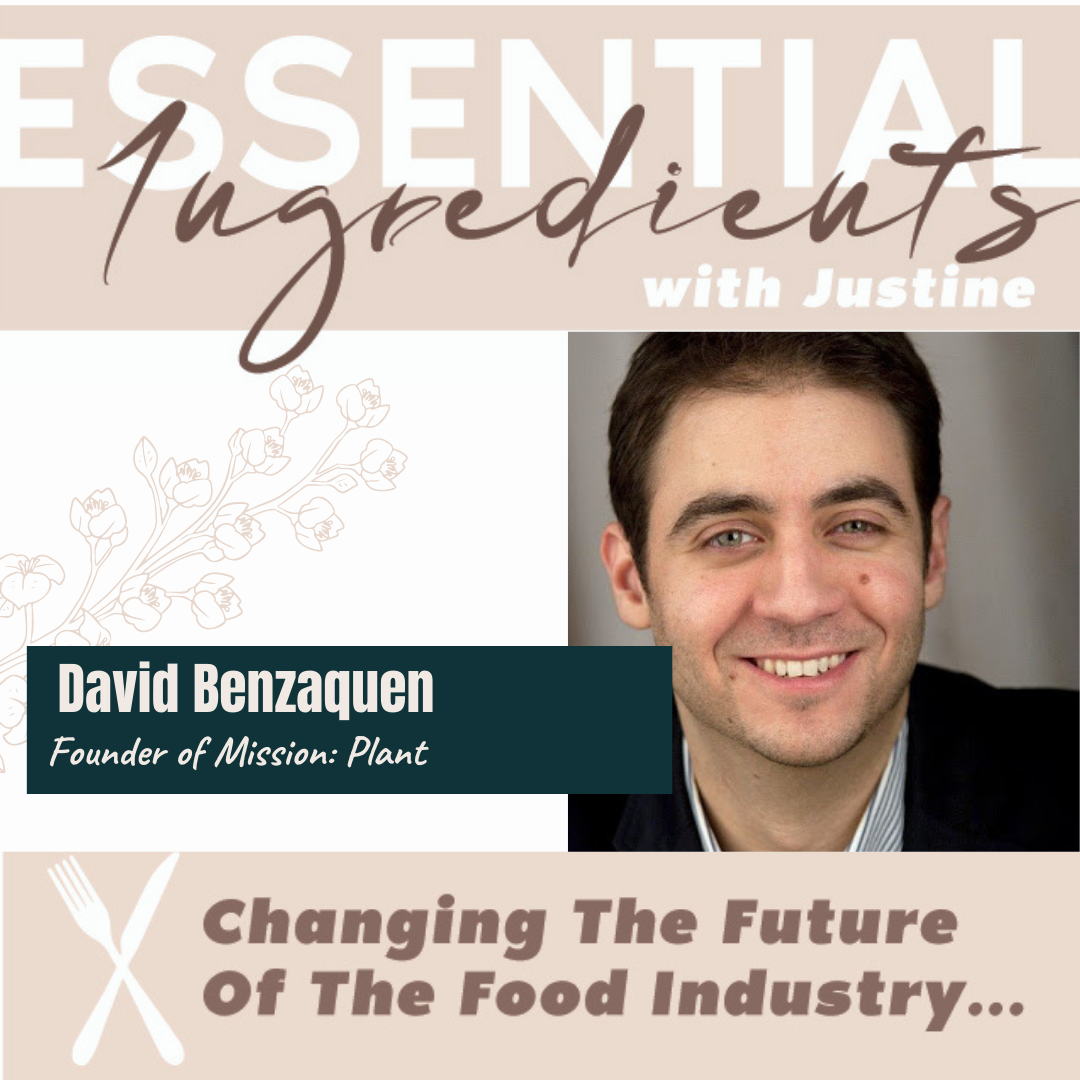
David Benzaquen · NextGen Purpose
Watch on YouTube
The Healthy, Sustainable, and Ethical Way to Build the Future of Meat with David Benzaquen
The Incorporation Method helps you turn what matters into practical changes that fit your life.
“”
Full Transcript
Full conversation between Justine Reichman and David Benzaquen.
Good morning, and welcome to Essential Ingredients. I'm Justine Reichman, and I'm your host. Today, I'm excited to introduce you to David Benzaquen, and he is our guest today. We also have Yvette here today. She is with NextGenChef, a passionate marketing analyst about the future of food. So anyway, we're excited to have David here. David, I'd love to just chat with you, hear a little bit about your story and how you got where you are today.
Sure. Thanks so much for having me.
My pleasure to--
I'll go ahead and jump in?
Yeah, jump in. I mean, I'd love to just tell our listeners, maybe first a little bit about how you and I connected because I think it's a little bit of a story. David and I connected on LinkedIn. We share probably some contacts that overlap, some similar interests and missions that align. And once we got on the phone or were chatting, we realized we're both from New York City, we both went to schools that probably played sports against each other, went to the same university a couple years apart. And now certainly, years later and ahead are now in the same industry and trying to share our passion and support people on a mission to change the future of food, which I think is a perfect intro to have David talk to you about himself and really share with him a little bit about how he got where he is today.
Sure, thank you so much. Love the connections we've shared, and I'm just glad to find people are joining the same space for the same reasons. We definitely need all hands on deck to fix this system. Fortunately, we're starting to head in the right direction. So I got--
This collaborative conversation. I mean, I think that I can't do it alone, you can't do it alone, we need to work together. And I think this is where we start.
Absolutely. So I got my start on the mission side, I started actually a nonprofit world. I spent about a decade working in Animal Protection nonprofits around advocating for plant based eating, and working on policy to reform how we raise animals for food, and all kinds of work around corporate practices, government policy and consumer behavior, all in the direction of changing our food systems to protect animals to improve the environment and to protect our health. And that's my big passion. I've devoted my life to plant based living, and eating, and foods, both as a consumer myself as being 20 years old. And as a business person who is looking at finding any way I can to advance these foods that I believe can really make less healthy, less sustainable, and sometimes less ethical products obsolete. So that's where I devote my career now. After working all those years in the nonprofit world, I came to believe that it was more difficult to change consumer behavior by telling people what to do and by pointing out problems than it would be if we offered amazing, delicious, affordable and convenient solutions. So in 2010, after a number of years of studying, I started my agency PlantBased Solutions. What I did was I recruited people with strategy backgrounds in large food companies, and I asked them to join me in my firm where we provided strategy consulting to early stage plant based consumer products companies. Companies like Gardien, Daiya, TreeTreenut Cheese, Health Warrior, a bunch of companies. But a lot of them weren't even in the market yet when we started working with them, and we worked with them on branding, marketing, strategy, fundraising, everything around the business side. Not so much around the operations or products, but rather business implementation, launch and scale. I was privileged to have that company for nine years, had about 150 clients in that time and my agency sold that business last year to practice on a food startup.Thank you. Thank you. For some reason or other, I decided to get on the operator side. I don't know which was the right direction to go, but they were both great.
What started you to go to the operating side?
At a certain point, I felt like I was telling people what to do without necessarily knowing that I could do it myself. I was surrounded by good fortune. The people who worked with me were really, really talented and had worked as operators themselves. But I guess I really felt that it was important that I walked the walk. I also found a huge whitespace opportunity in the industry where I thought there was a real need. When you look at the oceans, when it comes from climate change, human health, or from animal welfare, really, the oceans are perhaps as serious as any other part of our ecosystem. We're just not addressing those crises, particularly with food solutions as aggressive as I'd like to. You'll see so many companies coming out with the great burger, a great new non dairy milk, or this or that, but nobody was really touching sea water, very few were. And the number of fish that are dying is higher, the number of species that are going extinct is much higher in the ocean than on land, the amount of carbon being released from coral destruction is even higher. So I'm just really concerned that this industry wasn't being dressed.
So what was it? Or what was that moment when you realized, or where you learned there was a really big problem in the ocean?
Oh, man. I don't know what it actually is, I always knew in the back of my mind, but it's just I haven't worked on it because it's a lot harder to regulate. And when I was working with animal protection issues, there's really very little that can be done around the oceans in advocacy because they're governed by international law. They're really no man's land, no pun intended. As long as you're 200 miles off the coast of any country, nobody has real jurisdiction of how to enforce any laws. And that's why so much fishing, pirate fishing and illegal, and why there's so such poor traceability around slavery and about species practice, and everything else. So it was just something that I hadn't had the chance to work on. Whereas working on issues around poultry, beef, dairy and eggs was a lot easier on a policy side and as a product side. But after reading the story, my co-founder, I found somebody who had found a culinary solution to the issue, and that's really where I came from. So I met this chef, I read about his story, he had developed plant based alternatives to raw tuna and other seafood products. And his story really inspired me. The background was he's an incredibly talented chef. His name was James Corwell, a Certified Master Chef. One of only about 60 in the country, and was a runner up in the Cuckoo's Dough. So really, like a top notch global chef. And after years of being at the top of the industry, he was sent to Japan on assignment while he was teaching for the Culinary Institute of America. He went there and visited a place called the Tsukiji Fish Market. Tsukiji is the largest fish market in the world. It's renamed now, but the largest fish market in the world. He saw the most astronomical destruction of the oceans where they do this daily tuna auction, where they sell 4 million pounds of tuna every single day. And he just realized that it just couldn't be sustainable. Even though he wasn't himself a vegetarian or anything else, he was so motivated by this shocking issue that he decided to dedicate himself to it. And when I found somebody who would create a culinary solution to solving this problem, I was inspired, because I knew that I could help take his creation and make it into a business that could expand its impact.
Wow, that must be so neat. I mean, such an amazing feeling, ready to have this idea to want to solve this problem, to read about him, and then be able to actually take what you'd always dreamed of being able to fix, and then be able to find a really good, impactful solution.
And made it possible.
And the fact that you've done, you've been in policy, and you've been in all these different areas of animal protection, has this been something you've been interested in ever since you could talk, walk and eat?
Pretty young. I've always been passionate about social good, and about every aspect of social good from human rights, feminism, sustainability and everything else. I think what really inspired me around animal protection is the fact they're truly voiceless, at least to us, and the sheer numbers. But also more than anything, it's the fact that so many issues are tied together at the intersection of plant based eating and living. When you think about the fact that our diet is the number one reason for most of our major diseases, from heart disease, diabetes, cancer, etc. One of the number one causes of climate change is animal agriculture. When it comes to animals, more animals are harmed for food and for all other industries combined many times. World hunger, the amount of grain deficiency, the amount of floor deficiency, when we feed all these plant foods to animals just to get the animals in a much smaller amount of protein later, it's just inefficient. So in every aspect of every social issue I can think of, it was nary recognizing the real impact. And what really inspired me was, I met somebody who, I asked them how they could get involved in their organization. I was actually going to a club fair for all these student organizations, and there was the the anti-death penalty club, and the feminist club, and that this club, and that club--
Is it AU?
It was at AU. And yeah, I love that they were all doing. But I would ask them: "What do I do if I'm in your club?" And they say: "Oh, we signed petitions, we write letters, we protest." And I asked a woman who was leading the animal protection club, which she should say: "Are you vegan?" I said: "No." She said: "But we'll help you go vegan. You'll save another 50 some odd lives every single year. And then every single person you help encourage movement in that direction will save exponentially." And as somebody at 18 years old, as somebody who wanted to feel empowered and fuel, I got to actually make a difference. The idea that I was going to protest against the Iraq war with George Bush as the president kind of futile. But I didn't exactly feel like I was going to convince them. But the fact that I personally, just the power of my fork and my dollar could save animals and improve my health. So that's why I got into it. I was inspired, and I haven't turned back.
Wow, that's great. That's great. Yvette, I think I cut you off before when you were just about to ask a question so I want to give you that opportunity.
Yeah. I was going to add two things to the story behind Ocean Hugger. One thing is, he mentioned the infamous tuna auction in the largest Japanese fish markets. Not that really just highlights why this is such a whitespace, because you can choose a variety of species to create analogues off sardine, skipjack tuna, but those are a very low value, whereas tuna, especially as the tuna, the larger kinds are so expensive. That's really the business incentive to get into the space. You need that to build a sustainable business. So I just agree, that is a really brilliant idea. And another thing in addition to you also mentioned that I will still have a voice to advocate for myself, and that is particularly true for fishes. It's easier to empathize with things that have a face that looks remotely animalistic or like chicken, but professionally kind of, or even like lobster for locals like alien species, monsters. It's hard to empathize with them. That's intuitive. What's counterintuitive is this the stats that the vast amount of fishes in the world, and how the numbers that die collectively even if they have a trace of conscience, that just overshadows the chickens and the pigs that die, relative quite a low quantity. I think you identified a really nice whitespace. Just wanted to share that.
Yeah. We assume about 100 million cows a year, or the food in the United States for about 50 billion sea animals. So when you consider the numbers, it's just astronomical. Absolutely. Your point about the economic opportunity was a great one. And it's a big part of what I was interested in, also was the fact that I felt that we could really be impactful because we could disrupt the industry in a financial way. I'm motivated by my mission. However, I do believe that using the markets effectively means making it viable and profitable for all involved. And by using commodity ingredients like tomatoes, because the incredible technologies, my chef development, developed by using commodity ingredients like tomatoes and eggplants to replace 35, $40 a pound tuna Nagi, which are endangered, getting less popular because of sustainability concerns among the most toxic fish in the ocean because they contain the most mercury, because they get all the mercury from the smaller fish below them, and are just outrageously expensive because they're so endangered. Suddenly, I could sell something at a fraction of the price that created [inaudible] experience. So being able to disrupt on price is a rarity in plant based, and it was a really, really nice opportunity to get into the supply chain and make a lot of people really happy along the way. So we have chefs, and distributors, and restaurant tours who were thrilled because they could make the dollar on it while making an impact.
So out of curiosity, a lot of people are talking about the plant based movements, right? It's a hot topic. And people are talking about sustainability and building a regenerative culture. And as I look around, I'm talking about New York, San Francisco, these large metropolises where people are forward thinking, but what does that look like inside the rest of the world and inside the middle of the country? What are your thoughts on how this is going to play out? And what does this look like for the future of it?
I think we have to look at the global perspective and the domestic perspective very differently. First of all, we have to recognize that for the vast majority of human history, and still today, the vast majority of the world's population is largely plant based. They have to be largely plant based, because that is what they can find, what they can afford. So with the exception of the fact that there is a large population, that is dependent on seafood right now, for the coastal fishermen who frankly are being damaged by the corporate fishing industry. But with the exception of that, most of the global south in the world is right now largely plant based, because it's hard to store, hard to maintain, hard to catch and expensive to farm. So the very America meat centric diet is something that is only in existence for the last 70 years. World War II ended, we had this massive Industrial Revolution, we had railways, and all kinds of industry that had been put together for munitions, and I had no idea how to utilize that. And it was an opportunity for the food industry to speak to women who wanted to stay out of the home and the workforce, because they've been in the workforce, and make food more convenient and make food more affordable. And sticking to this very individualistic consumer culture that came from not having to want to anymore, for post depression, or post war, we're finally able to celebrate being a superpower as a country and start to live it up a little bit and celebrate capitalism in purest form. And suddenly, that means that we get what we want, how we want when we want it, demo the impacts. We know about a lot of the agriculture and everything else we had. And the amount of meat, dairy and eggs that we eat in this country. Additionally, salt, sugar and fat, and everything is so astronomical that it never is sustainable. Never was, and it never would be. And the fact that there are some cultures who are following our footsteps is really scary. I hope that we're able to in China and India in particular, and I hope we're able to mitigate that with new learnings we have around the health impacts and sustainability. But I think that in terms of the plant based foods industry, the reason I bring that up is because there is a real role to look at technology and the future of foods to undo some of the damage we've done, and to offer solutions that can enable people to transition away from the things we've gotten so used to. But there's also just the fact that there are millions and billions of delicious crops that we can be incorporating back into our diet every day as most of the world is, and then we'd benefit from doing so. So I think we don't have to hope that we're gonna suddenly become an impossible food kingdom to be a sustainable plant based world, or to the natural world or anything else. We can understand that that can exist in multiple factors. I do also, however, think that the adoption of these kinds of progressive foods in this part of the world is just the beginning. One of the things that I've been speaking a lot about is that in the next five years, we're going to see a major acceleration in Asia. I think it's most necessary there, and I think the BRIC countries are where we need to see the biggest advancement in plant based. I think we're going to think Brazil, India, China, and to an extent Russia, particularly resilient in China, are gonna see massive growth in these areas. And a big transition from seeing these foods as coming from a place of faith, or a place of restriction to coming from a place of abundance and celebrating the vibrancy of being able to live your fullest self, and of living in community with the resources that we have abundantly to us. I think that's a real change of mindset. And the way I think that as a Western consumer is, when I first went vegetarian or vegan, I thought I'd be limiting my diet, and I think that's the assumption that everybody makes. But when you've grown up with your dinner plate usually being 80%, three or four different kinds of protein in the center of the plate, and then 20%, one or two pounds of starch, that's not a diet, that's really, really limiting. And when I went vegetarian or vegan, white rice expanded dramatically, the amount of different foods I eat now is so much greater. I hope it's so much better, and I really enjoy textures and flavors that I never knew were there. I think that's true for a lot of people. So I think that the future of food and how we move this industry forward is a combination of celebrating the old and the new. And knowing that the one thing we can't do is continue treating the earth, the animals and our bodies as commodities to be used up as quickly as possible. But we're doing it to all three the same way.
It's interesting that we've had a couple of conversations with regards to farming and all sorts of things that relate to food, and the future of food, and people are going back to the way they did things so long ago. So you're not the first person to mention that or to say that, and it's really, I think a common thought now for that, how we have to rethink and reframe what we're doing. And a natural question, at least for me, how is COVID played into this in terms of where we were going beforehand, where we were headed, and now where we're headed. Has this derailed us in a good way, in a bad way? It's affected the supply chain, it's affected so many different things, I'd love your thoughts on that.
Sure. There are so many so many impacts, some of which flow together, some of which are complete contradictions to each other. Among them, I've seen a tremendous reluctance to things like raw fish, other certain kinds of other animal proteins that would be seen as particularly prone to foodborne illness. I understand that it also, unfortunately, means that those of us who are dependent on those industries can be impacted by that. So ironically, even more than any other kind of animal protein analogue might companies sold so intentionally, so clearly and exclusively alongside the price we were disrupting, because we were selling in places where people use fish which is really in those restaurants, that with that industry is suffering, our business has had to shift a lot too. And we're actually in the process of restructuring to launch next year with a new set of products, or at least an expanded set of products and possibly different channel variety. So we're not just in food service.
Before you go on, can you tell me a little bit about that? Because it's really interesting to see where people are changing and pivoting.
Sure. I can say that when we started Ocean Hugger Foods, we knew that we were focusing on premium raw and smoked fish alternatives. Those products are almost exclusively eaten prepared and found outside of the home, 96% of sushi is eaten outside the home. I'm guessing the propagation is even higher for tartar and sashimi, these aren't food the average American is preparing at home. One of the reasons that I've seen in consumer research is that people are intimidated about the idea of handling raw fish at home because they're scared of getting sick. So while our products are vegetables, we still had to overcome the fact that people hadn't learned how to make those foods. And when it comes to launching new products, one of the most important things is understanding the usage occasion, and the meal occasion, how are people encountering these products? How are they fitting them into their lives? And teaching a new behavior is extraordinarily hard. So rather than saying, let me teach you how to roll sushi, and then let me convince you to not position it, you know, we felt that it made more sense to sell at the restaurant where people were going to go for it anyway. And to say, now you can go even when your friends are with you because they can have this way, you can have that. And it made a lot of sense. Unfortunately, the COVID, the restaurant industry really suffered. We were very dependent on that. We were also very focused on a lot of success in institutional food service, like massive adoption in colleges and corporate offices. Also two industries that were two areas that did not fare well in getting into COVID. So we've had to think about expanding into retail and other environments where we're seeing not only not loss, but actually massive growth in plant based. You asked about the changes, we were very rare casually that the reality is that plant based as a whole is exponentially growing because of COVID. In some ways, people are turning against animal protein because they saw what happened with transmission of foodborne illness or an illness from animals to humans. It's not the first time, and it won't be the last. It's estimated that the vast majority of 24 hour bugs are stunning flus, which are not really things or actually borne pathogens, we're seeing a lot of that. So people are turning against that, people are looking for cleaner foods because they're more and more concerned about their health. We have a dichotomy where some people reverted to like a junk food diet when they were at home and just eating microwavable meals and chips. And other people were like, maybe this is the time to start taking care of myself. As somebody who was locked down here in New York for months, I've never walked as much as I did when I finally realized that I wasn't allowed to do it much. So as soon as I could only leave my house for a short while, I took a very, very clear advantage, and my 10,000 steps became very important to me. I wanted to be safe, but I also need to be safe up here.
So we're gonna take a short break right now and then we'll be right back with David. We're gonna have a little advertisement from our sponsor. Thanks so much.
So with COVID, we've seen more demand for plant based foods, more time spent at home cooking and getting to know the food we're eating. And also, at least in my family and many others, I've heard that there's a return to the dinner table. There is more time being spent at the dinner table with loved ones cooking and eating together.
So are you experiencing this yourself?
I am. As a single dad, I'm finally taking the time to be able to spend time with my son at the dinner table. That's really valuable time. I grew up in a very European household where dinner for me -- Fortunately not, but it was like at 7:30, I never understood the 6:00 o'clock dinner--
Mine was at 9:00.
Yeah, my cousins, aunts, uncles in Spain certainly at least that late, so I can relate to that. But dinner for me, it was always a home cooked meal, always was some kind of lean protein, some kind of whole grain and some kind of salad. And the dessert, 90% of the time, is always out on the plate. A lot of different whole food ingredients, nothing processed. And it always meant that everybody was responsible for participating. I had to set the table, I set the dishes, right? Everything my mother did, fortunately, she was very generous with her time in the kitchen. But that time at the dinner table was spent not only eating really healthy food, but also spending so much time on social, emotional and intellectual development. At a very young age, I was being encouraged to spend that time speaking about how my day was, talking about what I learned, discussing current events, openly experiencing that conversation over breaking bread literally, and I think we've lost that. I knew that when I went to friends' households that were much more American style, when I'd have a sleepover, the kid would say. let's go get frozen cheeseburgers out of the freezer, stick in the microwave, and then we'll all sit down in front of the TV with our trays and look straight ahead--
Seriously?
Absolutely. I did that tons of times. It was very confusing to me because I'd never experienced--
I never experienced that either.
Very, very, very common though. So I think COVID is actually allowing us to recognize and appreciate the time that is so valuable being with our food and being with our loved ones. And that kind of slow food philosophy, I think, does so much for our mental health and our physical health.
You know what's interesting though? As you're sitting there talking about your experience when you were growing up, I'm sitting here remembering mine. I grew up, my parents were divorced. My mom ran her own business in Chelsea, and my dad had his own business. We had an au pair and my mom would give me 20 bucks every day to go to school, I'd use it on [inaudible] so I was always late. So I'd come home. I was allowed to use a credit card for emergencies, so this qualifies as an emergency because I was hungry, right? So I order my 695 Chinese lunch, or I'd go to the grocery store, or the au pair would make me a curry or some sort of food, or I'd have leftovers from my mom's homemade chicken and vegetables, whatever it was. So we would eat late because my mom was working, but we would sit down, and we would have chicken, and we'd have broccoli, and we'd have a nice meal. And it was on in front of the TV, it was around the big table and we'd all eat together. And even when I go to my dad's house on Friday night, we all eat together, it was a thing. And even now, I incorporate that into my life. I can't imagine not doing that. I feel like it's a tradition, it's part of culture, it connects you and I think that food, it's rooted in food. And if you're cooking it, and you're thinking about what you're putting on the table, and making it beautiful and thoughtfully putting the ingredients together from the herbs to the, it's mindfully done, it's thoughtfully done. I think it goes back to what you're saying about, if we're trying to build a sustainable and regenerative food system, and thinking about the future of food, and we bring it back to family, and we talk about the values that we want to introduce to our children at a young age like, how old's your son?
He's 5.
Okay. He's 5, and how to bring him into the kitchen and to participate, and to cook with him, and he starts to be part of this tradition. I don't mean in a religious way, it sort of just is cultural that it starts with part of his value system that if we can start to change that, we can start to change the future of food.
Absolutely.
Equally as important as we look at the future of food and all the innovations that people are building. I'm glad to hear that you're doing that with your child.
I am invested in a new plant base fresh pet food delivery company if you're interested.
Tell me more about that. I mean, we just make our own pet food, we chop up the carrots, we try to--
Yep. feeling more and more popular. This company is doing that with a special protein blend and with a lot of different awesome fresh--
What's the--
Called Bramble, the website is bramblepets.com.
Okay, they're just launching out in New York, or where?
In New York.
They deliver out here? Can we get some samples to try--
I'm not sure where the regions are yet.
Okay. We've tried Nom Nom, we tried. Just food for dogs, have you heard of them?
It is the first one I've tried.
You do have a dog?
I do. Well, I tried to do that actually, I did actually taste it. It tasted bland.
Well, the thing is it's like--
It's full of vegetables. Sweet potato, lentils, brown rice and chickpeas.
I got Just Food For Dogs too, because they have a kitchen where they prepare it off. I mean, you can look online and you can go in, and I think the dogs treat, they're preparing it as if you're in the kitchen, and you're there with a chef. It's kind of fun. My dogs love to go because they get sweet potato chips, that all sort of thing. But we've kind of digressed, and I don't want to take up. I want to get back on track a little bit, and kind of just finish off with a couple last questions. Just talk a little bit about what the impact that you hope to have on the future of food. Maybe we'll start with that. And that I think that that has a couple others that we'll close out with,if that's okay with you.
Sure. So when I came into the business world, as I told you, my thesis was that I could have a greater impact by making delicious products more widely available, more desirable, and creating those solutions and offering them to people that the alternative would be to be obsolete. I don't want people to say, why shouldn't I? Oh, well, why shouldn't I eat this when it's just as good, just as cheap? And I guess this was a number of years ago before the plant based industry was quite what it is today. There certainly was nobody on the service provision side, there were obviously entrepreneurs who were starting this space, but it was around the same time that some of these pioneers were not the earliest plant based pioneers. This new generation of plant based pioneers were coming out of their food companies that I got into this service side of the business. And I guess, if somebody had, if somebody could tell me what my epitaph could read, I would want to say that he was one of the people who made the plant based industry. I admire and think of Danny Seo who really created the green business movements as an idea. He really advanced sustainability by working with Martha Stewart and others to show that something could be green and actually be a great profitable business. I'm not in it because of the business, but I do believe in the power of these tools to advance this movement. And I would love to do that. That was the impact that I had, that I was able to move the concept of plant base from a political ideology that was for the niche to a part of our food industry. That was the norm and that enabled so much innovation, so much more capital, so much more growth of this super impact--
I'm on the bandwagon on there,let me know what I can do. But I think that's a great mission. I'm there with you, and anybody we can help to rally around and take it to the next level, you let me know.
We need everybody.
Yeah, exactly. It's a movement. It's interesting, I feel like while there's a lot of people that are part of this movement, we still need so many more. I mean, people are talking about this, yet you go to New York, have a bunch of plant powered restaurants or plant based restaurants. But you come here to San Francisco, there's maybe like one. You go to LA, there's a couple.
So close to me.
Jealous.
They don't exist here the same way, and even in New York, there's just a few.
There are now over 150 entirely vegan restaurants in New York City.
Okay. The first one was on right by Irving, oh, my god, and they closed. It was around the corner from Lucky Duck. Pure Food And Wine, and now they have the ex husband or boyfriend who has the restaurant now in LA, which I love. They have that same amazing lasagna, but there's a lot in New York, it just needs to expand elsewhere. Anyway, you've got some other questions, Yvette, I want to make sure that you get to ask them and participate in this conversation.
Totally. So David, you mentioned that you have a focus on marketing, branding and customer insights as a strategic strategy consulting, why don't you share a couple tips coming from that background with plant based entrepreneurs?
Sure. Okay. So first, I think that, because I meet so many mission driven entrepreneurs, they can frequently be reluctant to invest in some of the things that are really needed to make sure they sit down right now. I'm a big, big, big, big believer in getting ready, preparing and knowing where you're heading before you jump. I know that sometimes, we have to take leaps. I'm not somebody who's scared to jump into the deep end. I have many times in the business I've been in, but it always concerns me when somebody says, Oh, I don't want to spend $10,000 on those consumer insights, or on that business plan because I need it for sales. Okay, but if the product you sell is $1 more than it should have been, and you've just turned off 80% of the market, it would be a real waste of your next million dollars spent trying to succeed with that. Or if that flavor was too spicy for most people, or if the packaging didn't stand out because you put coconut water on the shelf with green, blue or white, like every single other coconut water brand. If you don't prepare to learn how people gonna react to something, if you don't get that reaction, if you don't test things and understand what's going on out there, do the competitive analysis to new marketing landscape, then you're really going to risk wasting a lot of money, time and possibly losing the relationship that you could have built with the right path. So what I do is, rather than convincing a retailer to carry a product before I'm ready, and then having it fail, and then having them not want to work with me again, I'll go and form a relationship with them and will say, I am interested in doing something in this. Here's what I'm thinking, I'd be really grateful if you'd give me your feedback. Since you're on the front lines, you see what people are looking at, could you tell me what you think of this? Would you help me in developing something that you would give me feedback so that I can develop something that your customers would like and it would make us both money. I think by engaging partners in the process and making sure that when we go into the market, we're making it successful for all of us, we can really prevent a lot of problems and succeed much more effectively. The other thing is, I've mentioned this before and anybody knows it, but taste pricing convenience governs our purchasing decisions. I'm a passionate plant based consumer, and I have been for many, many years. And yet, I still think that with my mouth, my taste buds and my wallet, and I have to, and my time, because they're just realities. When people go to the supermarket, they have limited space in their basket, and so much they can carry home, they've got only a certain amount of time, and they've got limited amount of the money in their wallets, and they're having to make a decision on a few things so we can't just assume that because our stuff is different, that it's the thing that everybody's gonna buy. I tell people that whitespace isn't necessarily, and isn't always a bad thing. Chocolate couches were new, and it doesn't mean that people should buy them that they would. So we have to understand this difference, and then what is what they want. And tastes, pricing convenience, or how we go around that, we can care so much about a product, we need to have those stories, we need to be authentic about where we are. And I do not have any interest in working with a company, or buying from a company that is just making stuff because they want to make money, BUT they also need to make me happy. I tell people that as somebody who cares so much about social justice, I'm probably wearing clothes right now that were made in sweatshops. And not because I'm a jerk, I'm doing it because it can be hard to spend the time, the education, the knowledge and spend the money. Find the clothing that I like, that fits me, that meets all the ethical standards. So when somebody is not even plant based, it doesn't mean they're bad. It means that, I feel like it's my responsibility, I feel that I haven't made it possible. So we have to be willing to understand that within meat consumers where they are, we have to make products that excite their taste buds and are convenient, easy for them to engage with and try and enjoy, and that they can afford so that we can invite them on this journey. Another thing I'd say is that, sales dictate a lot, or sales really tell the truth. So often, I hear from entrepreneurs who say, everybody tells me they love the product, and it's going so great. But my sales aren't high. What do you think the problem is? I often hear from entrepreneurs who are convinced that their products, and everything about their brand and the product is perfect, and they do have people, frequently, those friends and family frequently tell them how great everything is. But then when the sales reports come out, the numbers aren't good. They're reluctant to hear that because they're thinking, well, if he tells me it's great, everybody loves it. And people seem to love it. If they tell me it's so good, so good, so good. I tell them, sales tell the truth. Something is not working. So when they tell me, all I need is more money for marketing because I invest in companies as well. And when they tell me, all I need is more money for marketing co'z if more people know about it, then they'll be more successful. I say, taking more money is just fuel on fire. But if that spark isn't right, it's not going to need to have the foundation. When people tell me, yes, my gross margins are bad. But eventually they'll get better. Is it possible that you'll get efficiency in your ingredients? Sure. Is it also possible that they're so low that you're never going to make money that spending more money to make and sell more of those items is a worse idea than just stopping? Yes, it's very possible. We have to be honest to ourselves, and being scared to pivot is missing the point. If something's not working, it means there's an opportunity to fix it. It doesn't mean that you fail, everybody fails. If we see everything that we didn't know yet as failure, we all have to pivot. Ocean Hugger has been exclusively food service focused and more general diversified. And that doesn't mean we failed, we made some really good decisions, we made a lot of sense at the time. And now, the market has changed. We have to adapt, rather than thinking, this was the way I was going to do it. And so, that must be right. Holding ourselves up, digging ourselves into a hole, burying ourselves and not doing anything about it, we could be pivoting and discovering even more success and impact. And so I wish that every mission driven entrepreneur would remember why they're doing what they're doing. Focus on that end result, and be willing to learn what it takes to get there. Because being responsive to the market, being responsive to the consumer and to what wins in the marketplace is how you have been. If you want to have impact, you've got to sell your stuff. That means, it's got to be the best out there, it's got to compete with the others because that's how you make money to grow, that's how you sell more, that's how you stop getting stuck.
Yeah, that's really empowering and has a lot of insights in those. So to give our listeners a little recap, David shared that marketing is really important and not just spinning on digital ads blindly. But including the market research piece, incorporate that into consumer interviews, testing, learning and product development, and also to focus on all stages of marketing, rather than just building awareness. But how many of your customers are converting, which is sales, as David pointed out. And lastly, the really empowering piece to be brave enough and decisive enough to pivot into new channels, which could really, really mean an optimistic outcome to venturing into new spaces. This might be a little cliche example, but I'm gonna think of impossible foods that have been very service centric before the pandemic. They pivoted to retailers, and now I can find impossible food, meat in sprouts in a short amount of time, but that's really strategic and brave. Yeah, so I'm glad that Ocean Hugger is doing the same. I can't wait to see that.
I can't wait.
Thank you. Yeah, it's delicious. I'm so excited. I'm still excited that I have so much in my house. I can make my own sushi and such because I'm actually--
Have you ever heard, just a quick thought? Have you ever heard called carrot lox?
Yes.
So you have heard that. There's out here that does that. In San Francisco, you've heard of her. So I had never heard of her before. When she first got started, because she was primarily a chef beforehand and then started doing, and she did one of our happy hour events before we pivoted, and we're doing happy hours and people just loved it. Yeah, it just took off like gangbusters. And she went into all the co-working spaces, she was doing Uber Eats I think in Georgia. If there's a huge market for those types of things and people love them, I just think we're here in this area, people are just not as familiar with that.
Yeah. The biggest thing is getting in people's mouth.
Tasting it.
Yeah. We talked about, this is not meant as a plug, but just to jump into what I'm doing now because it's actually kind of relevant to what we're talking about. Now, I've been looking at specifically some pain points in the industry that I'm in where some brands are struggling because of a lack of resources, not just financial resources. I've actually been forming two companies. One is going live in a couple weeks, we're now in the very beginning of October, so mid October, if you're hearing this then. And that's called Moonshot Collaborative, moonshotcollaborative.com. It's a consumer research panel focused entirely on plant based shoppers. It's a great way to test what products will be successful, what brands will be successful, and how to gear from consumers themselves if they actually wanted to buy something. The other business we've been launching is specifically a driving trial. And the time of COVID is really, really hard to get samples in people's mouths. No stores are wanting you to cook something and serve an open air in people, nobody wants to eat it that way anyway. So I'm working with some of your logic companies to be able to get samples into people's homes, so that your consumers could try them and give you feedback on them.
That's great. We should have another conversation offline about that because there might be an opportunity for collaboration with some of our founders that are building some of those vegan products that are shelf stable and we're looking for some opportunities, we're targeting. We'll have to see who we're targeting, who you're targeting, and see what opportunities we can find work that'll ground to maybe connect over.
Absolutely. I will say the one of the very distinguished things about this company that we're actually looking to do in addition is shelf stable, a lot of refrigerated and frozen.
We have lots of those, we just didn't have a way necessarily do that, so that could solve this problem for many of our founders.
So speaking to an entrepreneur in your area who's investi of mine, [inaudible] foods, is awesome and raised my portfolio. I was talking about the fact that with good reason, because this product is amazing, got approved to go into Whole Foods, but they can't do demos. And when you're in those retailers, they expect understandably that you have to hit a certain volume of sales per week, or else, you're taking up shelf space in something else that could be doing better. They'd rather make more money so you're not going to do it, they're going to bring in a more established brand that has more awareness that people are always willing to buy. That means that the newer, most innovative, more impactful stuff isn't going to survive. So it was speaking to him that made me realize that we needed a new way to get refrigerated and frozen products into people's hands and mouths. So what I'm doing is actually launching the first monthly subscription box for refrigerated plant based products. They can put in free samples in these products and packages, the consumer gets these things, we have an online marketplace, we can go and get them, or find out where they can buy them in person. So it's looking at things like that, like what street is going through, and what other countries are going through.
Yeah. We've been trying to solve a similar problem in a different way. Similar, but different. And the last time I saw Suri, he was sampling his product at our holiday party, because he was one of our founders that was there. We did the holiday party with CPG, SFCPG, with Daniel--, I don't know if you know him, and with, Who is it? Oh, my God, a national, I forget their name. Anyway, it was in December, it was great.He was there, and we had a lot of great brands. We've got a lot of different people like Garlic Goodness, and Local Foods, and a lot of them that we find. We've been trying to put together our own box, and we should really talk about this because there could be a lot of opportunity. I don't necessarily need to do it, but there's no way we can solve the problem.
And vice versa.
Exactly. But anyway, I really appreciate your time on this call and sharing all this information with our listeners. I think that sharing your story was most inspirational and aspirational. I think your insights on changing the future of food, and what you're doing, and the initiatives you're working on are really going to take us into the future of food. I hope that our listeners will be inspired and reach out, and they want to connect with you and your businesses and leverage those resources. I hope you'll download our app and connect with some of our founders at the NextGenChef. It's tailored in LinkedIn if you will, so you can connect with them one on one. And to our listeners, take this opportunity to connect with some of our guests here on Essential Ingredients podcast. So thank you, David, for joining us. Thank you, Yvette, for joining us. Thank you to our listeners for joining us. If you liked this podcast and you want to hear more, please subscribe at Essential Ingredients channel, and we will hope to see you here again soon.
Thank you so much for having me.
My pleasure.
Share This Episode
Enjoyed this conversation? Share it and tag @nextgenpurpose
Listen on Apple ▶Listen on Spotify ▶Your Host
Justine Reichman
Founder & CEO of NextGen Purpose. Host and Executive Producer of Essential Ingredients — 11 seasons, 330+ episodes, and a growing movement.
About Justine →