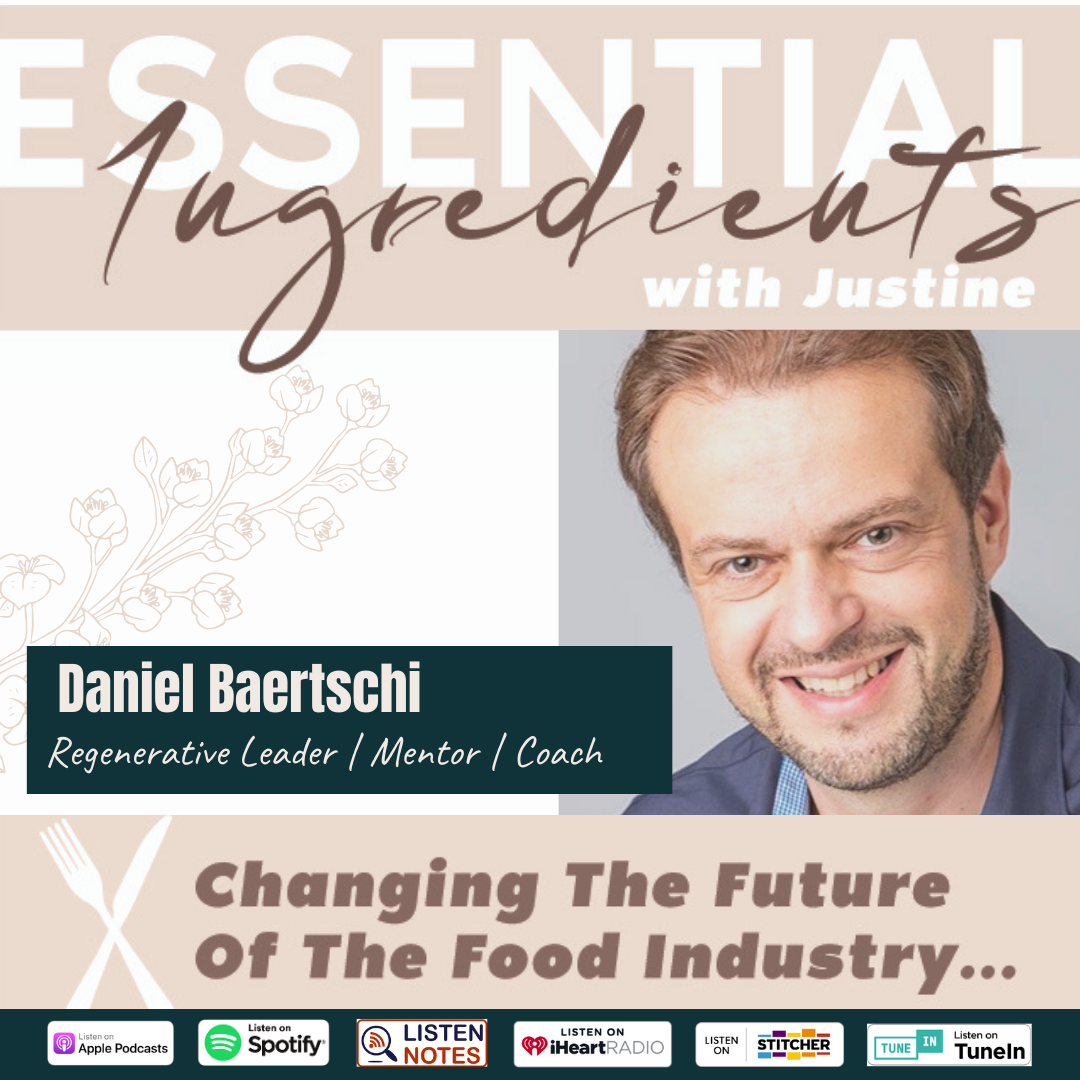
Daniel Baertschi · NextGen Purpose
Watch on YouTube
Regenerative Food System — How to Live Healthy and Stay Healthy During the New "Old Normal" of Food with Daniel Baertschi
The Incorporation Method helps you turn what matters into practical changes that fit your life.
“”
Full Transcript
Full conversation between Justine Reichman and Daniel Baertschi.
Hello, and welcome to Essential Ingredients. I am Justine Reichman, your host. And today we have Daniel Baertschi, someone who is in the food movement and is a leader in the regenerative food system. I'm excited to have you here, Daniel, welcome. Thanks so much for joining me.
Great to be here, welcome.
Thank you. Thank you. Okay, I hear an accent. I detect an accent and it sounds like you're from the German part of Switzerland, is that correct?
Yeah. I grew up in the German part of Switzerland. I spent some time in the French speaking part, and I was working in International Development Corporation, so that's kind of a mix. I feel my English is not perfect, but I hope you will understand.
Well, your English is much better than my French and my German. I had gone to St. Gallen years ago, and I didn't speak any German. Originally when I went to Switzerland, I thought, Oh, well, I'll use my French. No problem.
It's difficult to find people who speak French, yes.
I don't say the upside is because they're Swiss, they're very organized in their directions, and everywhere I drove, it told you exactly where you needed to go. It's organized in any case. So for those of you who aren't familiar with me, my name is Justine Reichman. My goal is to create a platform or provide a platform for food and beverage entrepreneurs to be able to gain insight, expertise and demystify some of the questions we have around building more local, healthy regenerative food businesses. So today, on my quest to do that, I have Daniel here, Daniel Baertschi to talk a little bit about what it is to build a regenerative business. I'm eager to hear from him a little bit about what it is to build a regenerative business, and equally, what a regenerative product is like. So Daniel, would you just tell us a little bit about yourself please.
Yeah, it's a pleasure. Yeah, I'm Daniel. I grew up on an organic farm in Switzerland in the Emmental, maybe you know the famous cheese from the Emmental? Actually my family was producing cheese. Back in the 60's, this cheese was even exported to the US, that's the interesting connection we have with the US that we produce cheese that was consumed in the US. Then I studied Agronomy because I couldn't take over the farm from my parents.
You started what?
Agronomy. So I studied Agronomy as high school and then college. Then I was involved in different jobs as a consultant in the International Development Corporation. Then I joined Organic Farmers Association where I was a CEO for eight years. And yeah, that helped me to discover the whole complexity of our food production of the food system, and how we have to somehow accept the natural limitations we have and get rid of chemicals, pesticides. That was kind of the story why. Well, I arrived here and my goal is to regenerate ecosystems and help farmers to do that because I think we have a wonderful planet. We have wonderful nature and working with nature is much better than trying to work against nature.
I would agree. I'm so inspired just hearing you say that because this is really what moves me and gives me the passion and the drive to be able to continue to provide a platform for people to learn more about this. So what inspired you to focus on building a regenerative food system?
Well, I realized that we have now kind of disconnected systems, especially in the food system. We have a disconnect between the farmer and the consumer. My goal is to bring back this kind of relationship between the consumer and the farmer, and also to see how we can restore or regenerate ecosystems together. Because as a consumer, you have a massive power because with your decisions, what to buy and what to eat, you can influence the work of the farmer. And every farmer, in fact, I have met them and they focus on how we can improve our soil health. Doesn't matter what production system, but every farmer understands that soil health, that's the foundation for good food production. And that's really motivated me to focus on soil health, but also to find how we can find out how we can increase biodiversity and how we can also increase profitability of farms. Because I think, not everybody knows, but most of the farmers that are really not well paid, they don't have a big salary, they don't earn a lot of income. And to help farmers to earn more from their work, from their lands, not having to expand or to have more animals on the farm, because you can't just, I mean, it's difficult for farms because there are a lot of risks involved. You have weather, you have diseases, et cetera, et cetera. And it's known no way just to put all the responsibility on the farm, but also consumers have some responsibility and they want to bring back this relationship with the farmer, with the fruit, with the soil so that people have to understand, we live from soil, and without soil, there is no life on our planet earth.
Right. So you say, bring back the relationships. So how do you think we lost it? What do you think happened?
Well, it started with industrialization because before that, almost everybody was some kind of farmer. At least they had some kind of garden or some kind of, even animals, small animals at home, so they have kind of a natural relationship. They knew where it came from. But today, with the supermarkets, with the processing companies, there is kind of a disconnect. So if you buy something, you don't recognize that it's real food, but it's processed for them. I think people, of course, that's convenient. It's easy to go shopping because you have everything in the supermarket, but you lose this kind of relationship with real fruit. It's something that has to do with our limited time. People have these days to care for their food, people are, I don't know how to cook sometimes. And the funniest thing for example in Switzerland, it was compulsory for girls to learn cooking at school, public school. But at some point in time, it was seen as that's not a good approach, then they introduced cooking for boys too. At some point, they got rid of that because they felt there was no value in that compared to mathematics, chemistry, physics. But I think that's a big value for somebody if you know how to cook and how to prepare food from raw material you get from the farm.
I would agree, but given everything that's going on, it's not a but, it's just that given everything that's going on right now with COVID, I feel like we're getting back to this conversation and connection with the farmers. Are you seeing that as well?
Yeah, that was really an interesting development especially during the lockdown time. We had a switch between March and June. There was a huge increase in demand from farm shops and start delivering from farms. Some farms, they tripled their business in just three months. Of course, now, after the lockdown stopped, it was going back a little bit to the old state, but it's still higher down above, maybe 10 to 20%. And especially what was interesting, there was a huge demand for cooking classes, online cooking classes and cooking books. And that's something I think, because people have to stay at home, they couldn't go to restaurants, they had to find out how we can prepare food and they were somehow rediscovering, well, it's not so complicated to cook finally. I mean, it's just having the ingredients, having good equipment and then just go on and do it. And people, I think COVID also helped them to understand the relationship between how we treat nature and how we can live on this planet. Because I think we can agree on the fact that COVID was also, somehow influenced by the loss of biodiversity that people entered areas, natural areas that were not really suitable to them. And that's something I think we have to learn from COVID-19 to avoid another crisis like this, but also to avoid a bigger crisis, which is loss of biodiversity and climate change we have now.
I'm thinking about this and I'm saying to myself that COVID has really changed my behavior. I really always went to the farmer's market, but I started to go exclusively to the farmer's market. And exclusively ordering from CSA, and exclusively to my butcher, or my farm where I get my meats. I did that for a lot of reasons. One is because I know the importance of going directly to them. Two is because I've chosen these CSA's and these farmers because I liked the way that they create or produce their products. Then I've developed a relationship with them as well so I'm very relationship driven, and I like to go to the person that I know. I was doing this before, I would say that it got exacerbated and heightened during COVID, which it's still going on., For me, this is going to continue. Mostly, I've built relationships, and I like what I've learned, and I'm taking that information, and I'm making more informed choices as a result. I'm learning what's the difference between grass fed and grass finished, and what happens if there's no grass, do they starve? Are they feeding them corn? All these kinds of questions, but what can we do for the rest of the population? How do we make sure that those behaviors and that thought process continues to evolve to be able to maintain that connection or relationship with the farmers?
I think that it starts with children. I mean, if you give children the opportunity to visit the farm and to have some exposure to a real farm life, real farm experience, and that's something which is quite interesting in Switzerland, we have a lot of school classes. They visit farms maybe for one day or even for one week so they see how the farmer works and what it takes to produce. For example, milk, apples or potatoes. And that's not just a quick thing, it takes time, and it takes care for animals, care for plants. I think to start with children is a good choice, but also to help people to better understand what it takes to produce food. And that's all about communication information. I see a big task for farmers also to reach out to people and to communicate proactively. And I like, for example, people like Joel Salatin who opens his farms for visitors, and he has 25,000 people on his farm. And I think, with that direct relationship between the farmer, the consumer, there is a dialogue and it's really building a bridge. I think we can build bridges between the two sides. Somehow also let's say exclude the middleman. It takes a lot of money out, and finds people who are really wanting to discover more. I think the other part is that, if you focus more on health and healthy food, it's always important. Now, where does the food come from? I feel that if you know the farmer and the farm where the food is produced, that also helps you to better understand if that food is healthy or not because you can really ask what products do you use, and what kind of treatments do they make, and then you get some firsthand information. Of course, not every farmer will do that. But I see in Switzerland that a lot of the younger farmers, the younger generation, are really open to the consumers. They feel that, well, if they opened their farm, there is no risk, but there's only a benefit in both. Well, if you have some disease and need to treat, at least you can declare why and people can understand. Well, that's the reason why, then it's a dialogue. And over time, I think it creates a kind of a food network, local food networks that creates stability. So if there is a disease, if there's no harvest, people are not just shifting away and going to other products. They understand that we have now to deal with the fact that we have less food from that part and we take it from the other part. So it's about building bridges and creating better understanding.
I know that you're very active in this movement, what do you think have been the greatest challenges you've seen? Maybe the top three challenges you've seen in communicating this, and parting this information to create change.
The first of course is awareness, because to create awareness, it takes a lot of time. People are so overwhelmed with a lot of information these days. To find their time where we can just give them some information, that's the main challenge. So reduce the noise of the world, that's one of the challenges we have. And the second of course that we have, big players of course that we don't like, to get rid of chemicals in the agriculture industry. Because it creates profits, it's a business. And from my experience in the organic sector, organic world, I see that the big guys don't like to change their business model. So they want to keep that business model, and that's not really a business model that is made for the betterment of soil, let's put it that way. Those are not really the focus on the health and quality of the food. Or for example, the ingredients in the quality of foods, there was not so much focused on that. And the third one is standardization. I think we live in a world where there's a lot of standardization in the food business. Standardization creates a lot of food waste and doesn't add value to the consumer at the end because more diversity in their fruit creates a better fruit balance. I think this uniform standards we have even in the organic sector doesn't really help. Of course, it tells about processing plants, but I think there's too much standardization and too much processing involved now.
So what's the impact you hope to have, on a personal level, to be able to create change within these challenges?
Well, my goal is to connect with people. In Switzerland, we created an umbrella organization that integrates farmers, processes, traders, consumers and other other organizations. For example, produce of biochar or compost just to build this kind of network between different factors in the food system. My goal would really be to have a system that is logical from the fields of the plate that doesn't create food waste, that doesn't need agrochemicals, takes care of biodiversity to be able to regenerate soil, increase in soil organic matter, and that we have a system that basically regenerates our planets. This is possible with the foods we eat, we can make this choice. My goal is that people make better choices and that they understand what kind of influence they have in the system. I think people need to realize that with their money, they can decide the future of the world, how they spend the money, what's the priority for spending, that has a huge impact on our planet.
I think it'd be really interesting for consumers, and I'm sure you do this. But to understand the impact that they can have with their dollar and with the choices that they make, can you give us an example?
Well, if you buy vegetables, of course, you can look at the cheapest price, or you have certified organic or what else. But at the end, it's important that the vegetables that are produced have a higher inner value, a lot of vitamins and minerals. And for that, you need to know where it has been grown and somehow to find out where it is. Is it imported? Does it have a long transport distance? Was it produced with a lot of cheap labor and things like that. And I think people really can understand that it's not about the price, but it's about quality and price. It's about the value. And I say, if people understand the value of good fruits, they will be able or be willing to spend more. Because of this relationship between health of the plant and health of the human beings, the question is, how can we somehow give this transparency about inequality of a product to the consumer? I think consumers need to ask questions. My advice is to always ask questions. It doesn't matter if you've got the farmer markets, or the farm, directly to the supermarket, just try to ask questions and try to find out what's behind that food. What's behind the label, and what's behind the marketing messages we get everyday. And be a little bit suspicious, just be like a cat, not like a dog as a consumer.
Are there any specific questions you think would be really impactful for people to ask?
The basic question, where does it come from?
Okay. You were talking about health and that's really, I think an important thing here is, I don't know that people really understand or maybe they do. I'm making a gross generalization by saying, I don't think people do, I think some people do, but other people don't have the awareness around the impact. It can have where your fruits and vegetables come from? What's in the soil? And I'll give you an example, a lot of times I feel like I've gone out of the city to the countryside somewhere. And there's times when I feel like people are like, Oh, they're just going for the cheapest. And I'm like, why? They're like, Oh, it's just the cheapest. I said, well, did you look at organic? This was 20 years ago, organic was much more expensive. Today, many times it's the same price, many times it's a little bit more, but it's not that unapproachable anymore so I think people had a stigma about it. They didn't even question it, they thought it was maybe in luxury as opposed to something that was accessible. And now that it's accessible, maybe more people will be open to understanding the impact it will have, both for their health and wellness as well as the planet by buying something and understanding where it was grown. I can only hope, right?
There is really hope because if you'll see the younger generation, the Climate Strike Movement, they really asked the right questions. They're very skeptical about all the marketing promises from big companies. I think future foods must be climate friendly to be accepted by the younger generation, but that's the game changer. I think if we can make this relationship between better food, better climate and combine that to outcomes, that would be a big game changer for the future I think. Because the younger generation, at least what I see in Switzerland where they don't have the money to buy a lot of, let's say better fruit because they are students or just in school, in high school. But in 10 to 20 years, they have families and it will be very important to bring forward this rich and [inaudible] culture moving globally. That's my hope. I think I'm an optimist in general, and I always have hope because I look for positive examples. If you look at the general situation, of course you can be depressed, but let's say positive examples. For example, in Switzerland, there are a lot of farmers. Doesn't matter if they're organic or not, but they focus more on soil health. They do a lot of things to improve soil health and they also reach out to consumers, and that ball is rolling. Nobody will stop that ball, and that's my hope.
I also think it's really important, but some of these farmers that are smaller, at least here in the US, it's really expensive to become certified organic. And I think it's important for everyone to understand what questions to ask so that even if the small farmer is not working, it doesn't mean that they don't have the same practices.
Exactly.
And I think it's our responsibility. It's their responsibility also to communicate it, but it's our responsibility to ask the questions so that we can support these smaller farmers trying to build more regenerative practices and better products for us to access.
I mean, to be honest, we need to certify the normal organic farmers. They need to declare that they use chemicals that are not organic. Farmers have to pay a lot of money to be certified.
I agree. I agree. I know you're in Switzerland and I'm here in Northern California, and I'm sure you're seeing all the fires that have gone on here.
Yes, of course.
I'm originally from the East Coast, so this is about the third year that I'm here experiencing it. My eyes, my nose and everything is really being agitated. But my question comes to you, and I don't know that you're going to have the answer, but I'd love to just chat about it for a minute and see what your thoughts are. A couple of years ago, we had big fires and houses were burned. You had all this stuff in the house, it's the plastics, the toxins, and it's gotta go into the soil. It's gotta go into the soil. And this year we have the fires and it's ash, but I'm wondering, it's going to impact the soil for all these farmers. I don't know what that means in the short term and the long term. I don't know what it means for the health of our products even though right now, they're saying it's fine, but how do we know? And how do we plan for that?
I will be a little bit suspicious if they say that there is no problem because there is a problem, but it's not new. I mean, you find plastic in rainfall. I mean, that's because plastic is everywhere now, microplastics. And despite this we'll add a little bit on top of the existing pollution we already have in soil. We have a lot of diversity. If you have health, there's a lot of diversity, a lot of potential to get rid of this problematic plastic, et cetera because soil can regenerate. We originated business, microbial activity. And of course, if you have an active soil, that's not a big problem. But if you have a soil that is already dead, if there is no microbial life, again, adding more burden to regenerate. My goal is that we can really understand what's the importance of soil life and how we can help soil life to thrive and to get rid of this problematic stuff. I think the fire, to be honest, I think there has always been fire and there will always be fire. But it's just how we manage natural ecosystems. I have the impression that we need to better understand the whole system, because other people just look at the fragmented piece where there's a fire. We have to somehow deal with the fire, but there's a reason for that. It is not consistent, that is not balanced. And if we don't put the ecosystem back in balance, that will continue and even worse. I mean, if you take Australia last year, it was one of the worst fires. But in ancient times, the Aboriginal's, they always had fires. Even they made the fires in the landscape just to restore that because that was a natural process, but not at the scale we see now. So a wildfire is never a problem, but it's just the scale. And let's say the frequency of wildfires, that creates problems. And in a healthy ecosystem, healthy forest, the fire is never a problem. It will regrow and that's no problem. But in a degenerate forest, that's the end. That's the problem.
Yeah. I appreciate your point of view on that. I think it's really been top of mind for so many people here. We're very focused on buying local, and accessible, and regenerative products. And the impact that this is going to have for a few years to come is really interesting. I think it is an important conversation that everyone needs to have. As you're building this regenerative culture, what are some of the greatest challenges that you're seeing in communicating your message and getting people to be part of this narrative to think this way.
I think people are a little bit tired of being educated, what they should do. And a lot of people don't tell me what they have to do because I've heard it so many times. So the main challenge I would say is to create a positive attitude and to have to see it as a positive development. If we buy both food from each entry form, it's not only positive for the planet but it also positive for me, it has a better taste. It has more nutrient density, it's better for my health. And if we are able to create this message that, while you can use your health expenses, your health costs with healthy fruits, of course it's, if you take science, they don't agree. But let's put it that way. Science is not always a reality, it's a science. But I have the impression, if people understand, well, I can influence my health status with the food I eat. It's not about counting calories and fat that you can get rid of, but just by maximum unprocessed foods, if you have a plate, fill it half with vegetables and the rest, you just have different proteins. And for some starch, there is the food, but just balance it. And then look at that, it's not really highly processed. And get rid of sodas, just fresh water from the source or from the bottle if you don't have a source. I would say it's about discovering the basics of food.
Right.
And then to make it attractive so that people see it as beneficial to move to the new normal, I would say, but that was the old normal and just rediscovering how our grandparents were just doing it. And somehow, sometimes it can relearn for the past, I guess.
I definitely would think so. And I think in many ways, we go back to the beginning again. And we establish those relationships, even buying some farmers like they did many, many years ago. So I would agree. Who are some of the major stakeholders to align in realizing the full potential of this movement?
Well, my goal is to train farmers, to coach farmers and to support farmers to make that transition. And regardless of their certification or production system, I think every farm has a room for improvement. Our goal as an association, we train farmers and we also share experiences with best practice. I think if the farmers understand better what to do, they can influence the whole system. And then of course, we need to work. We still need to work with the big companies, like the mass list of cargoes, et cetera. Try to influence them in a positive way and still be honest. That's a big task, but I have the impression that if we don't work with the big companies and we try to convince them to shift to a new system, that will be difficult. We need to have a certain outreach and a certain presence on the market. And it's quite promising that at least the big corporations here in Switzerland are quite interested in this movement. They even think about investing in training farmers to improve soil health, and that's very promising. And of course, we also need to work with, let's say with the corporation that provides microbials or natural disease control products. I think there is a huge potential to get rid of agrochemicals with alternative nature based products. Even aroma setup, it could be a system that would be helpful to get rid of insects in a lot of places. And I think it's really about working with the whole system. And if we don't have this whole system, you would just work on the fragment in basis, and that doesn't really help to resolve the problem. So my goal is based on, let's say, organic principles and beyond organic certification to create the movement that is not based on labels, but based on transparency and trust. And if we are able to create that, that will be the game changer. And not the last point is to work with chefs, with restaurants, with people who really understand what's the importance of the quality of the product they buy and have them give them more influence. I guess that would be very important.
I couldn't agree more. We're trying to bridge that gap also. And if there's a way for us to collaborate, I mean, we just had an interview the other day with a woman who is the executive director of The Hydration Foundation who wants to work with chefs, to talk about how plants can be more hydrating than water, and to be able to talk about the soil, and where these products were coming from. Together with that, the chef would be an amazing thing, I think. I think it can be really impactful. And I think that if we work together with the chefs, and some of the farmers, and some of people like Gina Bria who's the executive director of The Hydration Foundation, we might be able to change what people expect to inform them, to provide a new way for them to think about it in a healthy way. It also can educate the end consumer because they're going to start to ask, if they're not already, how do we maintain our health? How do we eat healthy? People are becoming much more aware, and they want to be able to live healthier, and have to protect the planet. Having these kinds of roundtable discussions is just some of the things we're trying to do at Essential Ingredients. So maybe we can bring it back for a conversation with a chef and with some farmers. We can all have this conversation and even bring back some end consumers. What are the questions that they are asking? I'm sure they are different than what chefs are asking.
I think it's always about understanding each other better so that we can respond and create more awareness, and make an impression. I made an experience here in Switzerland that consumers, if they understand better what's going on, they make better decisions. It's not only about, if there is a question or you just check the box, yes, I buy organic, but it's helping them to have access to understand, why is this price at this level? What's involved, and what do I pay with the price?
Why is it important?
Exactly, exactly. And then if you understand that you pay a lot of money for the marketing machinery of the big companies, then you really start to understand. Well, should I not rather invest in the quality of the product and spend more for a product, and not only for marketing, help companies to market better. To be honest, I think marketing for food is not very ethical because a food should be accessible for everybody, and it should not be somehow supported by marketing messages because, I mean, I know what I want to eat, basically. I don't need the marketing guide to tell me what I should buy. Our body is able to express himself or itself to tell us what the body wants and we don't need marketing. Well, I know there are a lot of few that they don't like before that, but we can spend much less money on marketing, and much more on the quality of the product, and better support for the farmers. And if you pay farmers better, that will automatically result in better production, better ecosystem services. Because now we have farmers, they're really under pressure. I mean, the suicide rate of farmers in Switzerland is 37% higher than India compared male group of the population. And so you can understand there is a lot of pressure on the farmers because they're the least ones and somehow the last in the chain, but we should put them first. Put the farmers first and the rest will follow.
Wow. I think that's a staggering number, I was shocked. I heard that it was high and it's high in a variety of different places, but that number is just staggering. If that doesn't make somebody rethink things, I don't know what will because that's unacceptable in my mind.
Yeah. Of course, it's shocking. And of course, as a single person, you don't have an influence but still as a society, I would say we have responsibility to balance that system. And I think we should pay farmers better for ecosystem services. For example, if they build up soil organic methods, they should be paid because they put carbon in soil. And we need to find a system that pays farmers better for let's say, services provided to our society besides producing fruits which is the main goal, of course. But if they restore ecosystems, if they protect water, if they increase biodiversity, it has a positive impact on the whole society. And if we don't do it, our children and grandchildren, they will pay the price and that's not ethically acceptable.
No, I would agree. Is there a story you could share about the most gratifying moment that will allow or enable people to better understand the impact connecting the dots had for you?
Well, it was really about, I grew up on a farm, so it was quite natural to me. But it was first when I was in Africa, I was in West Africa, in Mali for one year. There, it stopped me that they were consuming bread that was produced with imported wheat from France that was subsidized, and the subsidized wheat was just destroying the local market for the local food production. That was just unbelievable. I couldn't believe that there is a system that just kicks farms out of business with imported subsidized fruits. And by the way, this food was not really healthy, you have increased health costs by importing bad food. So that was really the moment I told myself, well, I should really work against that and bring, put some balance in their food system and especially local food production. I'm not against bananas from central America from time to time, but the strawberries in January, that doesn't make sense. Here in Switzerland where strawberries grow in May or June, I just think we just need to read this cover that the food has seasonality, and food is not accessible the whole year in the same quality. And that was our grandparents, they lived that system then, they also could survive. So it's not about survival to go back to an old system, but somehow this experience in Mali told me that, well, this is so imbalanced and this is all insane. Why is it happening that way? That was really the moment that I decided to work against this kind of imbalance store, fragmented food system.
Well, I mean, I think that that's super interesting. That really talks to your passion and what inspires you because I think we all have our moments that it changes for all of us. I think to this conversation, you've brought a lot of things to the table about health for ourselves. And I think a lot of what we're finding is that people are looking at food as medicine too. So if we continue to look at food as medicine, and we continue to look at the source for where it comes from, and more people understand that food can be medicine or utilized in that way, and that we do this as a way to stay healthy, live longer, regenerate the planet, have a healthier planet, hopefully, there's no better reason to do this.
Yeah, and it's fun. Actually, it's fun because food will taste better and it will put more diverse fruit, and you make new experiences. I think there's a lot to discover and it's a win, win, win situation. I mean, it's good for the planet. It's good for your health and it's good for the climate so why don't we change? There's no reason.
I agree. And to that end, did you have a favorite recipe during the pandemic?
Recipe? It's shakshuka, it's tomato, and my wife is preparing an excellent shakshuka. I mean, that's still my favorite. But I'm very happy to have a wife who is really a good cook, I am always benefited from her skills.
Yeah. I can completely embrace that. I love to cook. Although I do find that during this whole pandemic time, it takes a lot more to continue to clean up the kitchen, and keep it neat, and buy the food, and prepare the food. It's taken it to a whole nother level, I love to cook and I really enjoy it. I do find that I just end up cooking and cleaning, and cleaning and cooking, and cooking and cleaning.
And we added planting vegetables in our small garden this time.
But that's more fun. Right now, I have out there, I'm like, whoa, what salad can I make with my mint? My favorite one to make is cucumber, watermelon, lemon juice, olive oil, some celtic sea salt and fresh mint.
Okay, great. Yes, yes, yes. I always feel that you don't have to create sophisticated meals. It can be very simple, very tasty and a lot of fun.
I would agree. So are there any things that you could share on how you're coping with COVID for our listeners here today?
For me, it's important about the mindset, don't be afraid of COVID. Just look at your lifestyle, just eat healthy food, fresh food and go outside. Don't worry too much about COVID. I mean, that's a disease, it's dangerous somehow, but people have a lot of resistance. And if you care for yourself, you strengthen your immune system, don't feel somehow depressed, don't feel that's the end of the world. It's a crisis now, but we can overcome the crisis. I mean, we, as human beings, we have strengths and we have seen other crisis. It's important to focus on the positive things and on yourself. Just take care of yourself, that's the most important thing.
I think that's great advice. Is there any, if our listeners wanted to get a hold of you, you're going to download the NextGenChef app and upload your information, but maybe you could just let them know how else they might be able to find you or learn more about your organization.
Yeah, I'm quite active on LinkedIn. So you find on LinkedIn, danielbaertschi1, it's one word. Of course, just feel free to contact me. The organization is called Agricultura Regeneratio, it's a Swiss based organization. We still only operate in German, but hopefully in a couple of months, we will be able to expand your languages to first, French, then of course, English. We are a platform that is providing information and also connecting people. For example, our consumers that want to buy milk from cows that live in a healthy context. And for example, the calf can be a whole life with the mother and things like that. So we create the platform for consumers, producers just to bridge the gap.
Wonderful. Thank you, Daniel so much for joining us. And I want to thank all our listeners today for joining us on Essential Ingredients. If you like this and you want to hear more of these kinds of interviews and conversations, don't forget to subscribe to NextGenChef. You can find our talks on iTunes, iHeartRadio and all the other channels. Thanks so much for joining.
Thank you so much. It's a pleasure.
Share This Episode
Enjoyed this conversation? Share it and tag @nextgenpurpose
Listen on Apple ▶Listen on Spotify ▶Your Host
Justine Reichman
Founder & CEO of NextGen Purpose. Host and Executive Producer of Essential Ingredients — 11 seasons, 330+ episodes, and a growing movement.
About Justine →