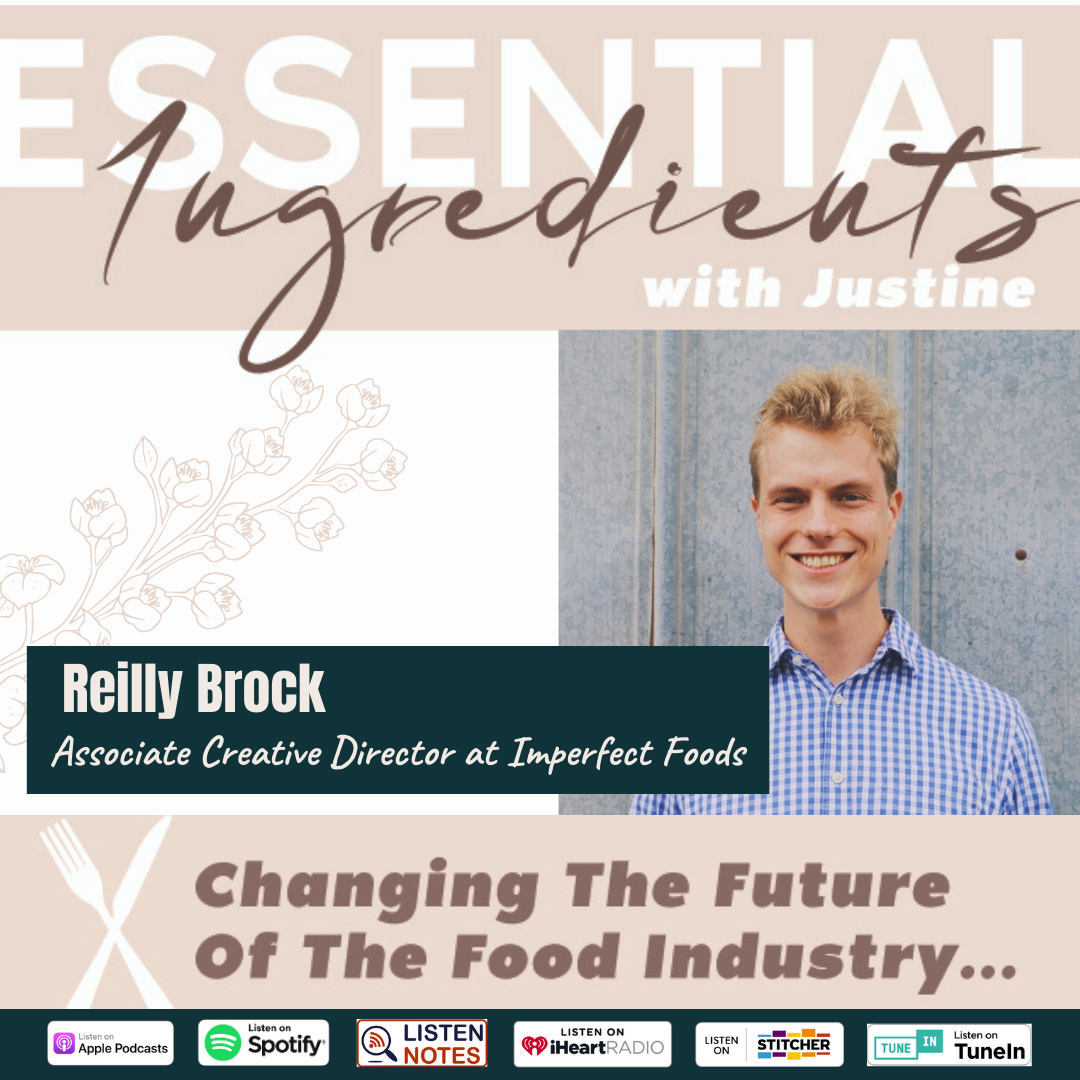
Reilly Brock · NextGen Purpose
Watch on YouTube
Food Waste No More! Enhance Your Food Experience With These Storage Tips and Food Ideas That Will Save Your Day! with Reilly Brock
The Incorporation Method helps you turn what matters into practical changes that fit your life.
“Food gone bad? No worries! Today's treat: cool recipes, storage tips, and refrigeration hacks that will make you love being in the kitchen! Justine sits with Reilly Brock, Associate Creative Director at Imperfect Foods, who provides important things to remember in storytelling, content creation, branding and identity.”
Full Transcript
Full conversation between Justine Reichman and Reilly Brock.
Hello and welcome to Essential Ingredients. I'm Justine Reichman, your host, and today, we have Reilly Brock. Hi Reilly, welcome. Thanks for joining us.
Hey, thanks so much for having me. It's a pleasure to be here with you.
I'm so excited, how's it feel to be on the other side of the podcast?
It feels fun, actually. I like switching it up. It's interesting for me as a host to be a guest every now and then because you kind of appreciate all of the craft that goes into creating a fun episode, entertaining and educational content for people. I always love it. I just love talking to people about food and the environment. So any chance to do that is a good day in my opinion.
I agree. So tell me, how did you get into food? What was that moment that brought you into it?
I first got into food in high school, actually. It was how my high school friends and I would hang out. We'd do these silly dinner parties where we just cook together. At first it was just a way to pass the time in high school and pretty quickly I got into cooking and just found it really fun learning curve. It's like always challenging, but there's always new things you can master and get better at. I think as your audience appreciates it, something that's really fun and easy to share. In terms of like a hobby to be working on as a young person, I found it really rewarding that whatever I was working on, I could share with friends and family immediately and get feedback. And even if you mess up, it's still usually pretty tasty. So that really got me hooked just that experience of cooking with friends. And then when I was in college, I actually had a friend who pitched me a kind of crazy idea that we should start a late night food cart because there was no good food on our campus. This is in rural Ohio at a school called Kenyon college. Yeah, so it was like an hour outside of Columbus. And basically, the only option late night, there was Domino's or Papa John's Pizza which is not great, you'd often wait forever to get food. So if you just left a party, for example, there was nothing to eat the way you see Berkeley, if you leave a party, you can go to Top Dog, or a Tuckery, or something that's still open. But where we were, there was nothing so he pitched me this idea of we should start a late night food cart and I was young enough and naive enough that I was like, great, let's do it. I didn't think about all the logistics, and expenses, and complicated stuff that went into running a food business. However, that was a blessing that we dove into it headlong together and actually developed a business plan that we pitched to the entrepreneurship panel. Basically, they had a business plan competition of saying, pitch us your idea. The top price is $5,000 in startup capital, which is huge for a small college business. And yeah, so we really dove into it together. We were really passionate. We didn't really know what we were doing, but we were excited enough that we were willing to do the homework. And we ended up winning that top prize, which launched our business, Last Call Food Cart. So for basically a year there in college, my senior year, we were running a late night food cart outside of parties, which was wild. It was fun, it was stressful, it was educational, it was delicious, it was all that you would imagine a late night business like that would be, I mean, the business model was awesome and kind of bulletproof and it was kind of shooting fish in a barrel. Feeding kind of drunk and stoned and just hungry college kids late at night. Working late at night, serving food is not glamorous. There's a lot of time in your feet, a lot of lifting, and handling stress, and last minute setbacks and stuff. But it taught me a lot and really ultimately catapulted me into a career of professional cooking for a couple of years. So after that experience in college, I did an apprenticeship at a restaurant in Spain. So I was cooking there and that was, again, I was in way over my head in the best possible way. I was going from this business, which was mine to suddenly working in someone else's kitchen in a second language, the only way I can describe it as running wind sprints, wearing a snorkel, it was just so hard to process and keep up with everything. All of the new systems, end being in Spanish, but it was great. Anything that challenges you that much teaches you a ton. So those years of my like early 20's working as a professional cook just taught me a ton. Skills that are still with me to this day really informed the work I do now, ultimately though I did burn out on food as a fulltime passion in terms of the restaurant world, it was just not sustainable. Around like 23, 24, I just realized like, this is not for me. The late nights never seeing friends and family, it ended up being too much which was actually a blessing in retrospect that I got out of it because, ironically the part of that world I always enjoyed the most is actually on my days off cooking with friends and family, and kind of teaching them the little things I was picking up at the restaurant that they might not know about. And it's really, that became the seed with everything that followed. That experience of learning and teaching and kind of being this conduit between one part of the food world and like the general public, that's what I really wanted to do full time. And interestingly enough, that's what I ended up doing here today at Imperfect. I ended up finding a job that was bridging food but also communications, which is really what I was looking for all along. But I think as a young person, I had to just try it on. Like where are the outfits for cooking, and learn that for myself that, okay, I don't like cooking full time, but I do want cooking to be part of my world. If that makes sense.
Tell me, how did you bridge the gap to food and beverage? I mean, that's a little bit of a leap. It's not completely non-sequitur, it's in the same wheelhouse, but it has a little bit of a difference.
Yeah, 100%. I definitely, I took a kind of sharp left turn around that time, like 24, 25. Basically, I got a job doing event planning out of restaurants and that was kind of a half step away from cooking food to just planning things around food. But I don't know if you've worked in event planning, but I heard it described one says it's like hurting cats, except the cats are on fire, and you're on fire, and you're in hell, which was kind of my experience of it in a lot of ways. Again, I learned a lot, but boy, event planning is complicated.
I haven't been in event planning in the sense that I've, aside from planning family or friends events, right? But I do feel like with NextGenChef and planning all these events, pre COVID, in different locations, whether it was a co-working space or whatever, there isn't an element of event planning from the way that it looks, the feel, the whole ambiance of the event, the way it flows. And even these online events while people think it's just a Zoom, there's a lot that goes into it from the agenda, to the talent that you bring in, and the experts and then the whole flow of the event to make sure that it goes with no hiccups.
100%.
So it's not like you have this mistake in the corner and somebody put the dessert on the wrong tray. This is going to live on beyond us. Event planning exists more now than ever, just in a different way, it's sort of been reframed, I think.
No, absolutely. Yeah, I relate to that a lot. When I was doing it, I was doing events with food trucks and it was just complicated work. And like you said, yeah, there's a lot that goes into setting up something that people don't think about. And so it was an interesting halfway house for me, kind of between the world of professional cooking and the world I'm in now. But basically, the part of I latched onto and enjoyed the most was the content marketing side of it, creating the Facebook page and answering people's questions and sharing ideas about what we're up to. And so that was where it really stuck with me that I would love a job where I got to say, run like a social media page for a food company. And it happened that at that time, this is in 2016, Imperfect was hiring for someone to run their social media page. So it kind of seemed like it was a perfect fit. It was one of those cover letters that kind of wrote itself. The interview was super fun and interesting. I got really excited preparing for it, which has always, I think is a good sign. If getting ready for something is kind of a fun challenge, that's a sign that it might be a really good role for you. So that's how I got into it. They needed someone to be their person, their voice, their communications bridge to the general public. Their social media pages were in their infancy. We did not yet have a newsletter. There was so much that we weren't doing that we needed to do in terms of reaching and educating our audience and our customers, but also just the general public that I got to do from day one because it was a scrappy startup. I liked showing reporters around the warehouse. then a week or two. Again, I was totally unqualified to do, but it was a startup. They needed somebody to talk to the press and I said: "Hey, I've talked to the press before. And I did events, I'll do it." Which I think is one of the most empowering sentences you can say, especially as a new person has all done it. If you're up to it, you end up learning a lot. And if it's something you care about, you can kind of teach yourself a lot of what you need to know. So yeah, they put me in the game pretty early there and let me run with a lot of stuff. They just needed a lot of things done, which was certainly stressful. I definitely felt like drinking from a fire hose some days, but again, really educational. And since then, the company has grown like crazy. And I as I've been part of it, I've just had to learn more and more and really grow my skill set alongside, which has been great. It's been a really fun ride.
So when you first came in, you were doing some social media and it's a startup. I mean, after all, we're all really scrappy, right? We do a hundred different things. So today, how has that role evolved for you?
Today? I'm the associate creative director. So I'm still, I have a hand in the world of social media and that stuff, but I'm more in just the pure content realm now. So somebody else is actually, now, we have a wonderful new copywriter. She's actually writing all the copy for social, and we have someone else who's like running our newsletter, but I'm really responsible for crafting and editing the messaging that ends up living on all these different platforms. Whether it's social newsletter stuff on our website, the Facebook ads we're running, basically--
Storytelling.
Yeah, storytelling. The way I think about it is like keeping the torch of the brand lit. Do you know what I mean? Being the steward of that brand voice and also helping it evolve and change because no company is static, and as we've grown and changed, the brand has had to grow, change and mature as well. Even world events shaped that, like this year, our company has had to learn how to talk about a pandemic, racial unrest, wildfires all in the score, the course of about six months. So your brand has to always grow, evolve and mature as well because that's what people I think want and expect is a company where it feels like somebody's home when they're reading your content. And also that they know that you care about some of the same issues that they do. You're not just about like, we need more signups. You gotta be out there as an empathetic, generous personality, I think. And that's always been our take on brand.
I totally agree with that. I also think they want to see that you're relatable, that you're part of the community, not that you're up here and you're not paying attention. Because right now more than ever, I feel like people want to see empathy. They want to see that you're right there with them because nobody's immune to that. And I think that being humble, knowing that, and communicating that we're all in this together and we all have different challenges is so important, both personally and professionally.
Yeah.
Back to that, you, representing the brand, and writing that, communication for that, tell me a little bit about that. As it's always changing, and we have COVID, and we have the fires, and you don't want to downplay one and up play one, how do you come through that? Represent the brand and be mindful of everything going on, but yet not go in the sort of way too deep, so it's like saccharin.
Hmm. Yeah, yeah. That's a great question. I think it's really hard to be honest. We had a modulator, our brand voice, I think more this year than ever before. And I don't mean that in a jargony business way. I mean that in like the way when you're talking to a friend who's dealing with, they're grappling with the racial unrest in the world, and then they're grappling with the wildfire, and they're grappling with COVID, those are all very different emotional states. They're similar in that level of unrest, uncertainty and stress. But the type of information or reassurance you need is really different in each of them. I think part of it has been really getting researched in the moment that we're in and figuring out, okay, how can we help? Because when you look at what people really want and need right now from anyone, even just a friend, not even a brand, it's really help and support. So sometimes, the form of knowledge, like after COVID really became a serious issue. We did this post that just kind of tried to educate a bit about how food supply chains work and reassure people that look like you're going to see some bare shelves in stores, but trust us, there's more than enough food. It's going to be a little challenging to get it where it's needed. We have experienced that our whole business model is rolling with the punches of how crazy supply chains work. But trust us, there's more than enough food. Literally, our company was founded around the idea that there's more than enough food, we just need to be better about getting it to the people that need it. And I think also, reminding people that like, yes, this is uncertain, but we're really committed to you. Like, we're here for you. And I think for a grocery company like us, at that point, we were kind of part of the safety net. This is no longer a fun luxury option of, Oh, groceries delivered, what a novel concept. During COVID, that's suddenly become an essential thing for people, and that was really humbling for us. And at times, it's challenging in terms of the amount of new signups we are having to deal with, we had hiccups too. More people signing up than we could handle in some metro areas. Suppliers saying, Hey, no, we can't fulfill that many orders, whatever it is, onions, citrus, we are having to adapt in real time. We are just being honest about that. I think a challenge for us was owning up to mistakes because it happens as a business because no business is perfect. Obviously, you want to ideally under promise and over deliver, but at times, you end up doing the inverse and that's really stressful for your customer base. And we definitely had a couple of moments of being humbled by our circumstances and having to come to our customers and saying, Hey, we grew a little too fast there. That's a hard conversation to have, and it's terrible to let people down, even just friend to friend, person to person. Especially when you're a company and somebody is counting on you for the fruits, and vegetables, and pantry stuff that they're relying on to make dinner and then when you have to say, I'm really sorry, but our drivers are just overtaxed and we can't deliver it to you tonight. That's a hard email to send. This was definitely a year of sending a lot of hard emails when we had these moments. I think it ended up just involving a lot of empathy, learning and willingness to be wrong and just try to do our best to make it right the next day. Also knowing that, look, this year, everyone has to be flexible. So in a way, we also had to let go of a lot of pre-existing plans. We had a whole marketing plan for 2020 that we scrapped late in February, early in March just because it was no longer helpful. We come in with the plan we had, people would have said, Oh, this is tone deaf. What are you talking about? We have bigger fish to fry right now. So I think part of it is you got to know when you just need to abandon what you had planned and start listening and learning instead of just talking to people. And I think that was, it was hard.
Just literally, they canceled what show west on a Monday, on Saturday, I decided I wasn't going, I post on LinkedIn and I said, for anybody that chooses not to go, or it's been canceled by your company or for whatever reason you just had to pulled out, we've just posted or put up a free forum. You can connect with other people, we've made all the access free, whether you're a distributor, a founder, whatever. We put it there for everyone to have access to because that was all I knew I could do, to have a positive response to it. I had all these meetings set up, founders, these new startups meetings, people are expecting to do business there. We went from doing events and all these different things in person, cultivating community, connecting people. To now, within 48 hours, literally creating an online community. We then actually launched our app, I don't know if you've seen it, but we have a new NextGenChef app.
Awesome.
So we completely changed. Otherwise, we would be doing events right now and all sorts of things in person, which is a completely different business model than what we have going on at this moment. Still funnels and supports the same mission, but the way that we're getting there is just a little bit different.
Totally. I think that flexibility is the key. That's something I learned early in food, a phrase I heard was, you're never going to out surf the ocean, but you still have to ride the waves as best you can. At the time of that really referred to like, you know, when you're working as a line cook, you're never going to be able to control how many orders for one thing or another come in, and what you have to be cooking at any given moment, you have to react and just do your best to rise, to meet the moment. On a certain level, resenting that, Oh, you have a lot of chicken to make and you wish you were making the salad instead, that doesn't do anything when a bunch of people are expecting chicken from you. So that was a lesson I learned early that I think has actually really helped this year of like, look, we all have to be extra flexible and extra resilient right now. That's challenging, but it's actually a good thing, it can build character and strengthen whatever business you're doing. If you can find a way to roll with the punches and evolve, that's awesome. That's how you really grow and thrive in the long run, I think, because life's always gonna throw crazy stuff at you. This year has been particularly hard, but I don't think it's going to get much easier after this.
Let's hope. I mean, hope is not a very great strategy, but we'll think positive thoughts. I want to come back to what you were saying though, about storytelling just for a minute, because I think that the gift of being able to tell a story is just so impactful. If you can tell a good story and you can share it in a meaningful way, it can resonate with people in a way that creates change and not just in behavior, but in the thought process. So as a storyteller for Imperfect, can you share with us a story about something that you shared and the change that it had for them, for you.
Totally, yeah.
That makes sense. What I'm saying is, based on the stories that you've created on behalf of Imperfect, I'd love to hear the impact it's had directly to your consumer, your customer, and how it's either created change or had an impact for them and for you.
Yeah. I can share a couple. One that comes to mind immediately is we do a ton of content around storage tips. Because when you're looking at food waste, it's really important to remember that it's multifaceted and it occurs at every point in the supply chain. So the Imperfect direct business model is addressing what we'd call upstream food waste, which is about 20% of the overall supply chain and ends up going to waste on the farm or near the farm level in production, in harvesting. But the reality is over 40% of it goes to waste in our homes. So as Imperfect and as any food retailer, your job is not really done once you get the person, the food, because if you care about waste, you really want to make sure they feel comfortable and empowered with whatever you're sending them. An organic, amazing, delicious avocado that you helped prevent from waste is no good if someone doesn't know how to use it or can't finish it before it goes bad. And I know as a Californian, it sounds ludicrous wasting an avocado. What we found early on is one of the biggest reasons stuff was going to waste for people is they didn't know how to store it properly. We've put out a lot of storage content, you get a little bite sized infographics on Instagram, or we put together a downloadable PDF on our content site that basically shows you how to store everything in your kitchen and shows you a little tips and tricks, like keeping your cilantro like a bouquet of flowers, and water in your fridge if you can. The fact that tomatoes, for example, that you'll have better flavor if you keep them on the counter, stuff like that. I think one of the biggest aha moments I had there was we did an Instagram post telling people to not store their onions and potatoes together, which is I'd say one of the most common mistakes.
I put mine together in a bowl.
After this podcast, move them because I'll tell you why. The onions will release gases that make the potato sprout sooner. You've seen the potatoes, they'll launch those little tendrils out of the eyes. They'll do that way faster if they're near anything that's releasing gas. Especially an apple, but even an onion. And then in turn, the potatoes release moisture that'll make the onions get soft.
Oh.
Yeah. So it's counterintuitive. A lot of us buy potatoes and onions together, we cook them together, we think of them as these dry storage root crops, all of that is true. But for the purposes of your kitchen, they really should be stored in separate, cool, dark well-ventilated places. So even if they're both on your counter, just don't put them next to each other. Some people have different bottles for them in a drawer, or obviously like the root cellar concept was perfect for this. But basically, we did an Instagram post saying, Hey, don't store them together. I know it's counterintuitive, but they'll both last longer if you store them separately. And reading the comments of that post, I was blown away. We had people in real time tagging their husband, or wife, or partner, or housemates saying, Hey, you need to move the onions right now. That was really cool for me to see that in real time, something we had thought of we should do this, we tried it and it had an impact in real time. That's something I always love about social media content is you get to iterate, and learn, and try stuff out in real time and learn from it. And that's really beautiful to see that people can take something you put out there, and run with it and use it to make a change in their life.
I love that. I'll tell you, I went to the farmer's market a while ago. I went there to get the meat for the dogs and I bought some apples. The lady says to me, don't put the apples next to anything else, refrigerator. I was like, what do you mean? She's like, they will make everything else go much more quickly.
Yeah.
I never heard that before.
Oh, yeah. Ethylene gas is no joke. And apples and bananas are the two biggest culprits most of us have around. I'll give you an inverse tip though and we've done this on social too, if you want to fast forward the ripening of something, let's say you've got stubborn stone fruit, or a reluctant avocado, put it in a paper bag with a banana or an apple. That enclosed space with the ethylene will essentially fast forward the ripening process. Make sure it's at room temperature. This all happens faster at room temperature. And if it's right, let's say you got a bunch of ripe avocado and you realize, Oh, wow, I can't eat all of these right away. You can then put the brakes on it if you put them in the fridge. That'll slow down the ripening process. As a general rule of thumb, the fridge will kind of keep things in stasis and then the room temperature counter will speed up there. So you can use that to your advantage in your kitchen.
Yeah. Now I'm going to take those tips. We'll put them in the show notes so everybody else feels like they've got some good takeaways as well, for all the listeners and people that participate. But that's super interesting. I'm curious also, I know that you guys had a huge amount uptick in the number of requests during COVID. So just walk me through, tell me more about that in terms of what that meant for you guys, and how you were able to deal with the supply chain, and the change in supply chain, and your customers.
Yeah, it's been quite a year. Our demand grew astronomically between March and April. I think it was something like 40%, like a month increase. Yeah, which is crazy. From an abstract business standpoint, most businesses want that, that kind of freakish hockey stick growth. I will say in practice, it's a lot more stressful than the Ted Talks make it seem, it's pretty terrifying to have your customer base grow that fast. Doing our best to keep up, and we had a lot of things going in our favor, right? We had inherent demand for our product. Grocery delivery was suddenly not a luxury, it was a lot of people were thinking of it as an essential service. We had a really receptive audience for our content, folks who are cooking at home a lot. And there was also a lot of important work to do around our mission, which is preventing food waste because COVID was disrupting supply chains left and right. An example of this that made the news was, basically as everyone knows, air travel has been really down since this started. Way fewer flights so what that means is folks that used to sell food to airlines have seen a huge downtick in orders, but something I think a lot of people don't think about is when supply chains switch, I can tell you, I don't want to order more in a matter of seconds or minutes. But for you as a buyer or grower, that change takes days, weeks, months, sometimes to actually enact in terms of, you can't just tell your fields to stop growing something. You can't just tell your factory to stop producing something. All of these are very intensive, expensive changes to make. I would like him to turn a pretty big boat, it doesn't just happen like that. So we found that the Roth Cheese company who had been selling to a bunch of airlines. Suddenly I had a bunch of their cheese trays that they've been selling to airlines and they didn't have a home for them so we bought up their cheese trays and we were selling them to our customers. Some of it is kind of funny, getting an airline snack tray in your--
Totally.
Silly image, right? It's funny, but on another level, it is really what our mission is all about. Rolling with the punches because our food systems are unpredictable and we really owe it to our producers to make sure that they're getting a fair return for what they're making, growing and producing. And also, if someone's made a bunch of cheese trays, they're not going to end up stranded just because there's a downturn in business. That happens because that's the nature of the, similarly, there was basically a bunch of movie theater popcorn that got stranded. So there's a popcorn producer we were working with and they said that they've been growing, producing popcorn for movie theaters. And then the movie theater industry kind of dried up just like the airline industry, and suddenly, they're stranded with a bunch of movie theater popcorn. So that was another chance for us to come in and kind of serve as that bridge.
Oh, my, you guys could connect with and collaborate with like Netflix and Amazon that are doing the movie nights.
Huh? That'd be fun. Yeah, we've actually talked about that over the holidays, doing like a movie night thing where we have like a fun popcorn, riff on popcorn recipe.
Because they're already doing the movie nights. I don't know if you've seen that. You should do that.
Yeah. That's what this year is all about though. We're all being dealt a lot of lemons, let's make some lemonade. I know that's a cliche analogy, but there it is.
I think more than ever now, people are really open to connecting and collaborating. Not just locally, but globally. And it's opened up the conversation to expand across the Pacific and the Atlantic to learn from each other, to see what different processes are working and how people are dealing with these issues.
Totally. Yeah, well said.
So if that's sort of the silver lining and can create some empathy or empower some empathy and collaboration, I think that I'm optimistic that maybe we can come out of this with a few positive things. What does that mean for you in terms for Imperfect, for the future, how are you guys able to plan based on all this stuff with all this uncertainty?
Yeah. That's a really interesting question. The short answer is our supply and merchandising team are just rockstars. They have to embody all these principles we're talking about every day, this kind of sense of humor, empathy, flexibility, and just hard scrappy work. Yeah, it's been harder to plan one signup rate, like how fast we're growing just changes everyday. And I think also what's available to get, because again, if we sign up a hundred customers today, suddenly getting a hundred customers more worth of food isn't like flipping on a light. Those are all orders that have to be placed and adjustments that have to be made. So yeah, that's been challenging. I think we learned a ton from the growing pains of 2020 so I'm actually confident there that we really have what it takes to ride the wave going forward. I think we were actually able to secure series C funding during COVID, which is a very counterintuitive time to be raising money, but in a way, we really battle-tested our business model and the consensus from investors was this great. It's quite literally pandemic proof and you're rising to the occasion, you're proving your worth to people. It's not been without bumps in the road, but you know, that investment has really allowed us to double down on some kind of unglamorous but important stuff. Even just warehouse inventory management, we're really able to invest this year. Being able to serve more parts of the country, more reliably, like all of the kind of under the hood stuff that allows our business to just keep chugging along. We've been able to invest in this year and that's been helpful because it's needed, and I'm sure you can relate like, anything that grows really fast, you don't always keep up. Your internal systems are often weeks, or months, or even years behind where you would like them to be if you had unlimited free time. So this year has been a good chance to kind of take stock of like, okay, the boat's now out in the open ocean, where are the holes? What do we need to plug? I think we're going into the end of this year like a different, better business than we were, say in January or even March,
I feel the same way, actually. And you would think that with everything that's going on, that's unfortunate and terrible. The fact that I can sit here and you can say here, sit here and say, wow, we're in a better place. We're in a good place. We're excited about the future. I think it's very telling of how resilient we are.
Yeah. It's been a good year to remember that stuff will get hard, but it's within all of us to rise to meet it. And I think also to find ways to reach out to other people, because we're not going to do any of this alone. Like, we're all all in this together. Especially working in food, it's all so interconnected that you can't do anything without collaboration, empathy and asking good questions. And yeah, just like we're working together for sure.
I know that Covid played a huge role in the change of your business and how you guys have pivoted and sort of done all that, but I'm wondering, the fires, and we've been having them the last eight years here in California. They're new to me because I'm from the East Coast, but they have to have a big impact, maybe not today, but they will in the short term and the long term affect the soil that's producing all this food. So how do you think that's going to play a role either short term or long term for you guys?
Yeah. Thank you for that question. That's a really one hit close to home, quite literally. In all honesty, what was it about a couple of weeks ago? There were three fires burning around Salinas, California where the majority of the country's lettuce, broccoli, chard, kale and stuff has grown for a part of the year. We were receiving some pretty sobering emails from our growers saying, this is what the fields look like. We might have to short you on some stuff. It's not for lack of trying, but there's some days where it's literally not safe to pick. They were already dealing with a historic heat wave, which makes the work of picking really difficult. You have to shorten your shifts so your workers aren't out in the hottest part of the day. But then they had a time where they were literally picking as ash was raining from the sky. And again, this is kind of how the sausage is made for a company like us. We got an email saying, look, we're going to send you some of the lettuce you ordered, but it's going to have a small amount of Ash on it. This is what it looks like. This is what you should tell your customers. This is kind of where we're at right now and we just need you to meet us halfway. And we had a moment as a business where we kind of had to put our mission, put the rubber to the road on the mission because if all we cared about was sending our customers pristine stuff or they never had to worry about any aspect of it, we would have said, no, we're not gonna buy any of your lettuce. However, that's leaving a hardworking, struggling lettuce grower dealing with a natural disaster out to dry and also leaving their workers out to dry. So we bought the lettuce and basically had to send out a kind of weird, humbling, awkward email to customers. I mean, I think it was the right move and I think we did it well. But saying, Hey, in all honesty, there might be a small amount of lettuce or a small amount of ash on your lettuce, and we just need to roll with that. Just give it a thorough wash, it's fine. We have no reason to believe it's unsafe to eat, but you just gotta wash it extra carefully right now because a lot of the lettuce is grown in the countries surrounded by not one but multiple wildfires. It's a sobering message to have to send, but I think something we've learned is it's just important to be honest with people, both in your own company and also just out in the world. Growing food is always riding the knife edge of uncertainty. There's so many variables between weather, market conditions, diesel prices, trucking availability issues at the US, Mexico border, you name it. Everything that can affect an economy affects food daily in a really intense way. Consumers are largely insulated from most of that, but there are moments where you have to just be honest and say, look, yeah, broccoli prices are crazy right now. We don't have broccoli, or there's ash raining from the sky, our lettuce isn't quite what we want it to be. There was a hailstorm and your apples are covered in what looked like bruises, warts, but it's just hail damage. It's fine, you can eat it or cut around it. And I think what we've seen and what I've taken heart from is people are fun well to that. If you're straight with them and talk to them like adults and say, look, this is what's happening. They often actually appreciate that more than talking around something, or pretending it's not happening, or not saying anything and then seeing, apples look weird. And then having to come to you and saying, Hey, why does this look weird? They want you to be straight up with them, right? Yeah, exactly. And I think people respond well to that.
I know that we, I don't know the answer to this and you may not know the answer to this. But with these fires, even a couple of years ago, when all the houses were burning and they were talking about the toxins from the plastics and all this stuff in people's garages and in people's houses that were burning, maybe it's not relevant to the fires that are happening right now as much, but that's gotta affect the soil and what people can grow. Is there much conversation with the farmers around that?
I haven't heard anything directly about the soil. I think the main thing I've heard about, which is important, I think it needs more attention is the impact on farm labor. I think farm labor is an often overlooked part of the supply chain. And look, these folks were doing unglamorous, often low paid, really hard physical work before wildfires, and then to have them outside picking and smoke is really troubling. I think that brings up bigger questions about what we can do to make sure farm laborers are really safe. I think that's kind of an unresolved question for a lot of us in the food system. I haven't heard anything directly about the soil. I do hear you that when a house burns, it's not just wood that's being incinerated, it's plastics and metals. If someone's laptop burns, all of the stuff that was in the laptop is vaporized as well.
That cannot be an issue today is what I'm saying, right.? Is this something we need to think about for the future, in the next 10, 15 years? Because it takes like, what? 20 years for all that to regenerate?
Yeah. Truthfully, I don't know. I mean, I will say you're bringing awareness to something that's important, which is soil health, which I think doesn't get enough attention. Maybe this is zooming out too much, but I always find it ironic. And I think I get why, but leading up to every election, the food system has almost never talked about government policies on food. What types of crops we subsidize? What types of crops we don't? Things are on labor standards, things run immigration, all of that impacts our food system. We're a country that's struggling with, not just struggling with, we're dying from some of the most heartbreaking yet preventable diseases there are in terms of heart disease, and diabetes, and metabolic syndromes and all these things. And so, yeah, in short, I wish all of this stuff got more attention from. I wish that the public media would run stories about soil health, I think that'd be awesome. I wish it came up in presidential debates. What are you going to do to make sure that our nation has a healthier diet? That would be a great debate question.
I'm with you, we're on the same page.
But no, I mean, I don't have it easy. I don't really even have an answer for you so I apologize for that. But I mean, I appreciate you asking the question.
And it's okay that you don't. At least we're being transparent or we're saying, I don't know the answer, you don't know the answer, but we're bringing awareness to it. Maybe somebody listening to this will have an answer and share it with us.
Yeah, that'd be great.
I'd love that. At least we can start the conversation and then we can walk away, maybe find some more information and come back, circle back and continue the conversation with more information. So now that you're doing the storytelling and you're talking about the brands, is there anything you'd share with a new founder or somebody that, because you've been with this right from five years ago to now, you've seen the evolution. Are there mistakes that you made then that you know better now? And what would you recommend to a new founder?
I think for a new founder, I mean, I'll start with the brand voice point. I'll be blunt like the public consents BS. So in your content, you need to stand out and you need to be earnest and honest with people because the appetite and tolerance of BS in the public is at an all time low. People know better, people are wiser. So in terms of your marketing and even the stuff you post on social, people see through it if it's not earnest, if it's not honest, if there's not integrity behind it. So I think that's important, you do need to have a sense of integrity about what you're doing and have a clear plan for what you're saying and when you're saying it. And I think the other thing is you need to make your brand stand out in some way and that's obvious. We talked about the importance of story. But what I mean by that is a lot of brands, I won't name names, but I think a lot of brands out there do have a bland or kind of what I'd call cookie cutter personality. When you read their content, it's not bad, but it's kind of, it's very safe and it kind of sounds like nobody's home. You know what I mean? It's like it was written by committee, or written months ago, or it was written after being a focused group within an inch of its life. I think, especially in food, food is all about trust. You really have to build a relationship with your customers and it's not enough about just clearly outlining your value props and what's different about you. I mean, obviously that's important, but that's table stakes. If you're talking about an excellent brand, you need to build relationships, need to generate trust. And I think to our earlier point, you need to tell an interesting story. Because something I've learned through our work is people don't relate to the world through facts and arguments as much as they relate to it through stories. And so that's something we have to learn over and over again. I think in terms of mistakes that we made, I think early on at times we would try content that was really fact heavy. Like, these really intense infographics, or emails that had like a ton of text, social media posts that were like short little novels. Some of them did well, but the majority of people don't have the patients, they don't have the time for, or it's a little off putting to be bombarded with facts. Especially if you're a mission based company like ours, if you're tackling a deep social issue, there's a fine line between giving people meaningful context and kind of bludgeoning them with how depressing the world is. So I think you need to walk that line very carefully and also understand that one person needs compelling stories. And two, you have to, and this sounds kind of instrumental, but especially in like growth content, like an email or a Facebook ad, you need to show people what's in it for them. Not in like a mean or utilitarian way, but you need to make it matter. Like a stat that I've heard especially with email marketing, people are spending about three seconds reading your email rather skimming your email before they delete it or take action on it. So if you're sending, even a customer, a piece of communications, it needs to be very intentional about what are the values you're providing, what problem are you solving in that moment and what do you really want the person to get out of it. It can't just be about you as your company and your agenda, it really has to be about them. So that's where I really think, empathy and curiosity for your customer base, that's at the heart of all of this. I've talked to a bunch of entrepreneurs, there are podcasts at Imperfect, the Unwasted podcast, and something that's really struck me is some of the best examples of these entrepreneurs I've seen. They're really empathetic, curious people that did a ton of homework about understanding the community, the group they're trying to help before they ever built a website, launched their product, started sending emails, whatever. So I think as much as you can be really curious and learn upfront, that's huge. And then also iterate, keep going like, the wonderful thing about today's world especially with things like social media marketing is you can ask your customers what they care about and get feedback in a matter of seconds or minutes. We do that at Imperfect all the time. We'll ask people what ingredients you're having trouble with in the kitchen, on an Instagram story. And folks will chime in and say, how do I cook chicken breast without drying them out? What the heck do I do with artichokes? What is a sunchoke, and why should I care about it? My quinoa always tastes bland, or I find tofu underwhelming. Whatever it is, you can get feedback in real time and then problem solve from there, both with content and even adjustments to your service. So I think it's never been easier to learn from your customers and from your audience. I think I would just encourage founders to do that. Do the homework, it's never done also. It's kind of like painting the golden gate bridge. It's an ongoing effort.
I think that that's so true. And I think that it's an agile process that you constantly have to be a few steps ahead. You constantly have to be aware of what the environment is and be thoughtful about where you're going.
Yeah.
People are just like, Oh, let me just throw it up. I don't think that works.
No, definitely not.
People take attention, don't want that. They know when you're just throwing something up.
Yeah. One other point I have there is I would say, be over informed. And what I mean by that is, especially if your brand involves any level of education, teaching people on our example about food waste. A lot of companies these days involve some level of education about, fill in the blank industry is broken, or problematic and we're solving it by doing whatever, that's a really common trope especially for new startups. What I'd say there is, especially in your content, if you're going to be the bridge between a really complex industry, whatever car insurance, grocery delivery, mattresses, whatever your niche is, if you're going to be the bridge between a complex world and the general layperson public, you have to understand it backwards and forwards. And what I mean by that is, one, you have to distill it down into really simple, compelling terms that people can relate to, understand and get behind. And I think that requires a level of mastery. I think also good content oftentimes involves excellent transitions between stuff, but also knowing what to leave out. So to know what to leave out and what to include in a blog post, in an email marketing campaign, in a social media post, you have to be really well informed about it, both the subject matter. And then also people's pinpoints on how they relate to it. So I think in that sense, being a curious person and doing a lot of research like going into the weeds on stuff, that's very much benefits you in the long run.
The only thing I would add to that is, for me, at least I like to feel a voice from somebody, a person. And I really try to put that foot forward with NextGenChef so that you feel me, you know what my vibe is, you know how I communicate, I try to be approachable. And for me, that's a whole, it's not just one personal level, it's for the brands. I think it's really important for founders and anybody building a business to make sure to remember who they are so that all the communication connects back to your values and your mission. Because sometimes we try to create this perfect thing and in our heads it has to be formal, but that's not really, it doesn't match with the brand. So I think it's really important to remember what the voices are and how you want to come across. If you want to be approachable, if you want to be the pillar of the resource for everybody, and maybe you feel like you need to be really formal and factual. But for me, I appreciate a sense of humor. I appreciate when people can laugh at themselves. I appreciate transparency. I want to feel like I'm talking to a friend sometimes or somebody that's trustworthy.
Yeah, 100%. I mean, another point on that note is you're never going to be all things to all people. And if you try, that's the surest way to fail. The surest way to develop a confusion or hard to relate to a brand is to try to make it so watered down and palatable to every different demographic that it's meaningless. So the surest way to relate to nobody is to try to relate to everybody. So you also do have to kind of pick and choose like, okay, who's my target customer here? What are their challenges? How do I relate to them? Yeah, you're not going to be for everyone, and that's not a bad thing.
The thing actually is it allows you to define yourself and be an expert in your industry.
100%. And it allows the customer to be. I don't presume to say that everyone should get their groceries delivered. If you would rather go to your local farmer's market, or be part of a CSA, or just drive to Safeway or Walmart, awesome, great. Whatever gets you food on the table that you find nutritious, delicious, healthy, meaningful, that's great. All I'm trying to do is show the people that are interested, like, okay, grocery delivery sounds interesting. Okay, food waste. Yeah, I'm concerned about that. All I'm trying to do for them is to show them how we can add some value to their life. But yeah, the reality is no company is for everybody. And I think making peace with that early is beneficial to everybody in the long run.
I would agree. So my question to you is, I buy my proteins from Imperfect, and I want to know what the impact that I'm having by doing this on a personal level but also to the environment.
100%, I can answer that a couple of ways. One food waste is not just food waste because of embedded resources. When food goes to waste, you're also ending up wasting the water that went into growing it, the CO2 that was admitted in growing it, the labor that was involved in growing it, the land that was involved in growing it. Like nationwide, there's an area that's about the size of Pennsylvania being cultivated growing food that nobody ends up eating, that's bigger than just ugly produce that's food wasted throughout the system. I bring up that stat just to illustrate that look when we waste food, we waste a lot of other stuff. And it ultimately means that, right now, we have a food system where to feed a hundred people, we have to grow enough food to feed 120 people because a certain amount of it is falling through the cracks along the way. So on one level, we provide these as impact stats in your account page, you can see what your embedded impact is in terms of water, CO2, pounds of food and all that, which is amazing and empowering as well. I think another under discussed part of our impact about food waste in general is making farming economically sustainable. This is something I really wish got more attention because, look, obviously we want to make farming environmentally sustainable. I have yet to meet someone that's like, no farming should be really inefficient. We obviously all want healthy water, soil, air and fields that can grow food for our grandchildren. However, we can't grow food for our grandchildren if farming is not an industry people can get into or want to stay in when our grandchildren are around. Something I've learned through my work at Imperfect that's been pretty humbling is for farmers, obviously, it's always hard to make a profit between weather and the low prices that they're paid for their products sometimes by big mega marts, just stuff like the unpredictability of demand. We're making it harder than it needs to be in terms of how we buy and sell groceries up until recently because anytime you exclude stuff because of cosmetics or you say, Oh, no, that's only good for processed food, or that's only good for animal feed, that's a chunk of their balance sheet that they have to write off as a loss or a break even. And for a farmer, that could be the difference. Let's say you can't sell 10% of your crop because of how it looks. Or you can only sell it to process food, which gets you usually about 30% of what you'd get selling to the fresh market. Or you can only literally ship it off to become animal feed, which gets you nothing, you're just getting rid of it. A lot of times, that can be the difference between you turning a profit and you not turning a profit as a grower. So at Imperfect, another thing we pride ourselves on that I hope folks understand and appreciate is, this is about making farming sustainable in the long term as well. We're helping it be viable to grow any crop and feed people with it and not have to worry about like, can we sell all of this? We're making it, there'd be less friction in the supply chain there, which is huge. And I think, just on an emotional existential level, we're making a statement that one food waste is an issue we should all care about. I hope we've raised awareness about that in our five years as a company. And also that we can all have an impact. And part of it starts with finding ways to prevent upstream waste. Buying from Imperfect is one way to do that. That's great, but it also happens in our kitchens, in our fridges. I hope a part of our impact has been teaching people that they can be part of the solution when it comes to preventing food waste. How they store food matters, how they shop matters, not buying more than you can consume matters, that's probably the one thing you can do to prevent food waste. Don't buy more than you can eat. No amount of composting, or meal planning, or prepping, or clever frittatas is going to get you out of your bind if your bind is buying more food than you eat every week. I hope we've been able to empower people to have that honest conversation with themselves and their families about how much they're wasting. I think that if we can have that impact in addition to the upstream supply chain impacts, that's when I think we're having a meaningful impact in our food system as a company.
I would agree. And I think that that's tangent. I mean, for me, it's useful to know what I can do with that, how I can store them longer. I'm guilty of wasting food all the time.
We all are.
And I'm ambitious. I go to the store and I'm like, Oh, I'll do this. It's too hot, I don't want to cook. It's too cold, I want something warm. I want to have it all, but I'm trying more recently to be more mindful of what I'm buying and will I be cooking. Of course, it has been challenging with the fires. I don't want to cook in the house. I now have a freezer full of meat just because I don't wanna use the barbecue. But I think that maybe if you have a list of those things, I'd love to share them in the show notes or as a takeaway for everybody so that maybe we can leave them with some tips on how to walk away from this talk and have an impact, make an immediate change.
Yeah, 100%. We've got a post on our medium page, it's 20 ways you can prevent food waste in 2020. We wrote, wow, that seems like ages ago now, right before this year started. And yeah, I'm happy to share that we have resources all in our content site, the whole carrot that are all sorts of these things, storage tips, meal planning, tips, all that. So I'm happy to share those with you. You can put them in the show notes. It would be a really fun resource for folks and hope people read it and benefit.
Yeah, definitely. Well, actually I'd love to share it on one of our resources on the app too.
I love it. Yeah.
So before we close out, maybe I can just ask you what your hope is to the impact you hope to have on the future of food.
You get more people excited about cooking. I think cooking is one of the simplest ways that we can improve our health, the health of the environment we live in and our relationships to ourselves and to other people. So I think if I can have a long term impact, I would love to inspire more people to cook and to understand new things about food, recipes and ingredients that they didn't know before. I think, yeah, if I can help people educate themselves and feel empowered in the kitchen, that's a really positive change and hopefully a change that keeps giving. Because cooking is really a lifetime skill that has so many benefits, tangible and intangible in the long run.
I would agree. Is there a favorite, did you sort of resurrect some recipes during COVID, or come up with something new as a result?
I mean, like everybody else, I think I went through the sourdough bread baking phase, which was fun. I will say I don't want to sound like a hipster about this, but I was actually doing sourdough long before this happened. So in a way, this was just like the bat signal in the sky for me. Like, okay, it's my moment to get back into it. So I'm now a sourdough grandfather. I've given my starter to like five different people who have given it to other people. And it's pretty fun to see.
Is it gluten free or not gluten free?
No, I don't think you can have a starter that's gluten free.
Well, I have a gluten free sourdough.
Oh, interesting. I don't know. My starters literally are like a slurry of flour and water, and all the microbes in there. I don't know if you can do that with gluten free flour, maybe you can.
I don't know. We'll have to ask [inaudible].
Yeah. In terms of a recipe, I discovered, I will share one that I thought was pretty fun. I recently tried making, I think it's called [inaudible]. It's an Ethiopian spice geek, so clarified butter. During COVID, I'll admit I've been ordering more food out than I used to. We've been getting some Ethiopian delivered, and my favorite dish of these lentils that are just delicious, Misir Wat lentils. They're so good, and I found out that a secret ingredient is this infused clarified butter. And so I've never made geek or clarified butter before so I tried making it and I will say, folks should try it at home. It's actually really easy, really fun and really delicious. So basically, what you do is you take like a pound of butter and you chuck in like a bunch of cumin, garlic, turmeric, ginger, cinnamon, cardamom, kind of a whole spice kit full of spices. You simmer the butter until basically all clarified butter is this butter with the water evaporated. You simmer it until the milk proteins coagulate and you take those out. The water evaporates and all you're left with is the milk fat, which is then now infused with all of these delicious aromatics. And I've been using that to like saute kale, or chard, or make really good lentils. I would definitely recommend it.
Okay. We'll have to share that recipe with folks here. So what food fats need to stay and what food fats need to go.
Okay. So in terms of what needs to stay, cooking from scratch needs to stay. I know a lot of people have been nerding out on things like sourdough bread, and making pickles, and slow cooking soups and stews during COVID and quarantine. That's awesome. I really hope people don't stop just because, if things open up and you can finally go back to restaurants, bars and all those things, which are awesome, I think little cooking skills that you can do at home, things like cooking dry beans, cooking beans from scratch, roasting a chicken, making pickles, these are some of the easiest and most satisfying things we can do. So I really hope that what we've been going through in 2020 is rediscovering their charm and not just kind of trying them on as a fad. That's kind of my hope because I think in a lot of ways this year awakened in all of us, that realization that there's so much more we can make from scratch than we thought possible, I think that's a beautiful, empowering realization. And I hope that sticks around.
I agree. I love to cook. I'm really inspired up until now. We've been able to go out. That was the one thing we had here in California with the weather, we were able to go out. And I'm a big fan of picking berries from blackberries to plums, and figuring out how to make compotes and all sorts of stuff. So I've been super inspired. I'm with you on that. I love to cook. I think it's cathartic, and I also like to share it. Share it with my partner here in the house, have people try it. I know that we're not really having people over at the moment so there's no big dinner parties, but equally, it's a way to connect. So is there anything special around food that you're making or things that you've come up with to cope with COVID?
Hmm. That's a good question. In terms of food I've discovered during COVID, I think the biggest breakthrough I've made, and this actually gets into your other question which is around where food fed needs to go. Personally, it's not a pet peeve, but my hot take is I think over-hyped bone broth is annoying and not really helpful. I think what I mean by that is, like buying someone else's bone broth, I think it is kind of an annoying trend. That bone broth is not new, it's just stock, which has been around for hundreds, if not thousands of years. Literally, the origin of the term restaurant is restaurount, which is like a restorative bullion that they'd serve in the 1800's in France. So broth is as old as we are so I think that it's great to get back in touch with how awesome it is. But paying through the nose to have somebody else's broth, I think is a little bit iffy and that it's not hard to make it home. It's actually a really great way to prevent waste so I've been really getting into my broth game, my stock game during COVID. I'll basically have a bag in my freezer while keeping stuff like fennel tops or like the core of celery, I can never finish a full head of celery, I don't know about you.
What about like the bones from meat that you eat?
Exactly. Yeah. 100%, yeah. So if I roast a chicken, honestly, even if I order chicken delivery, I'll like to keep the bones, if there's bone in and then I'll simmer those to make stock. And it's great, it's easy, it's fun. A meat broth takes a couple hours, but you can make a veggie broth in like an hour. It's a great way to use up scraps, odds and ends that you might not use otherwise. Like leek greens, fennel tops, mushroom stems, that middle third of celery that I've yet to see anyone I know finished, it always goes sloppy before you can finish it, that stuff can all live in your stock. You simmer it for like an hour with whatever herbs you have, like some thyme, or some bay leaf. And then you have a delicious base for not just making soup, but simmering rice, or beans, or lentils, or quinoa or whatever, making a sauce. You can even get kind of crafty, we're kind of getting out of barbecue season now while recording this, but even like corn cobs, save your corn cobs, simmer those, you get a corn stock. It's amazing, it's sweet, it's tasty. It's the basis of things like corn soup or a chowder, definitely recommend trying that out. So yeah, I think bone broth and stock are amazing, but I would encourage folks, try making it yourself. If you've just been buying it at a store, at a restaurant, try making it yourself once. I'd be curious to see what you think of it. And if you enjoy it and if you like it, I think you might find it's a pretty frugal dish to make. It's fun, it's satisfying, it's awesome. A lot to love about it.
Is there anything special that you like to make sure you keep to put in, that makes yours unique, or special, or your favorite?
I'd say two things. One, I always try to have the trinity around, like onions, carrot, celery, that's just kind of a bulletproof base for any stock, whether it's vegetable or meat. I think having a tube of double concentrated tomato paste is really helpful because it just adds a little bit of sweetness. And then also a little bit of acidity to a broth, which can be really nice. A good hack is, especially if you're just doing a vegetable broth, which can be a little timid or bland depending on your taste. Put the vegetables on a sheet tray, your onions, carrots, celery, leeks, garlic, slather it with some tomato paste and then roast that in your oven for like 400 until you'll smell it. You'll know when it's done, it'll smell aromatic and sweet. It'll start to get brown on the edges and then make a stock with that. It just tastes so much richer and sweeter that way.
Well, I'll just share with you my favorite things to add, carrots. I love putting tons of carrots.
So sweet.
It really does. It makes it sweet, I like that. If I am going to go to the store and buy bones, I buy chicken feet, they make all the difference. The chicken feet are awesome. And the other thing that I like is lemon grass, and sometimes a little bit of coconut milk.
Yeah. That's a very Southeast Asian, I love that.
So those are my little hacks, my bone broth. And they're inspired by the fact that I do like to eat culturally diverse food. And this way you can make that broth, and then you can make another one with coconut milk, and you can make another one with that. So you can actually make a variety of these, out of that one pot. You just take them in. Everyday you can have a new taste.
100%. Chicken feet are really cheap as well, that's another thing. If you go to your butcher, you can get, they're less than a dollar a pound, at least where I am. Yeah, so you can get a ton of them. They add a ton of collagen to the broth so it makes you say, I have a great body to it. So definitely recommend that for folks.
Awesome. So with everything going on right now, COVID, the fires, et cetera, you must've come up with some life hacks that get you through the day and make it just a little bit easier. Could you share a few with us?
Absolutely, yeah. I'd say I've learned three things in terms of getting through this moment, which is hard for all of us. One, don't use your phone, the news, or social media as an outlet to relax or unwind. I don't know about you, but I've found, even seemingly innocuous things like Instagram lately really stressed me out, they've just over-stimulated my brain. Facebook feels this toxic, angry morass, like more than it's ever been. So I think I've realized that different screens are not the solution to too many screens. I've reached a moment I think like a lot of us did in quarantine where the only difference between my free time and work was which screen I was looking at, or what I was watching on that screen. Instead of a Zoom meeting, now I'm watching Netflix. That's not great for your brain. At least speaking for myself, it leads to the sense of burnout, even when you're unwinding. So give yourself a favor and I find even just like taking a walk, if you can. Reading a book, spending some time in peace and quiet and maybe with nothing on or nothing playing. Little changes like that have been really helpful for me. I think another thing I've found is finding ways to create novelty. I think a lot of us have been in this kind of like perma groundhog day state during COVID. It feels like I'm living the same somewhat mediocre day, just like over, and over, and over again. And it's not terrible, it's not great, it's just in this weird gray area. So little things to create novelty, like changing up your routine. If you're cooking a lot, find a way to order food. If you're stuck in your house, find a way to get out of your house. If you're not seeing friends, find a way to like go to a park and have a socially distant catch up with a friend you haven't seen for a minute. Build some novelty in there. And then I think one final one on the food front is you got to find a way to make peace with cooking more and also doing dishes more. I think I was battling that.
Is just a disaster because working in everything, who's got the time to clean up which now makes me want to not cook because of constant disaster, and garbage, recycling, and then you have all the different piles.
I think what we have to do is make peace with the fact that, look, our kitchens are doing more of a workout now. If you're cooking three meals at home and used to only cook one, that's three times as much dishes, stuff in the trash, and the recycling, and your compost. I've noticed in my life, I need to sharpen my knives more often because I'm wearing down the edge of my knives more quickly, because I'm cooking all the time. So it's been an adjustment. But like we talked about earlier, I think you can't resent it because if you resent it, you're just kind of stewing in your own resentment for the way things are for now. And so you gotta make peace with cooking a little bit more often, doing dishes more often. And so for me, that's been honestly, sometimes just like taking time and like putting on a podcast. Being like, all right, I'm like doing the dishes mode, or meal prep mode, and trying to make it a fun little game, and a routine instead of this begrudging chore. I think that's my last tip.
Okay. Well, I do have one question. Have you ever noticed that you do a lot of takeaways or so much plastic. I feel like we've got new problems around plastic and waste so I'm constantly challenged with, okay, I just want to run out and get something. Okay, I did that. I ran out, got my lunch, but it's in plastic. How do you address that? Like, do we not eat? I'm saying it's like, you want to go out, you want to support the local economy, you want to do it, and then you want to be able to do this because you don't have time to do all that. So I just feel like we've created more waste as a result of COVID.
Yeah. I think you're right. There are very few simple answers in the food world. I think we all need to eat so I think that's obviously clear. Especially with takeout, I have yet to see a takeout delivery option that involves little or no plastic, to be really honest. I mean, some apps or places let you opt out of silverware. I think that's something we should all be doing. You don't need silverware. If you're getting it delivered to your house, you have silverware. A lot of folks I know, even have chopsticks. So even if you're ordering sushi or something, you might want to eat with chopsticks. Or even if you always eat with chopsticks, great. It's very likely you have those, use this, use the utensils you have at home. I think that's the low hanging fruit, but obviously, that ignores the elephant in the room, which all these plastic comes in. I don't have an easy answer for that, honestly.
Have you heard of zero shop?
No, that sounds great.
So is there a shop, [inaudible] is the woman that started it. She lives in San Francisco. And I'll just tell you quickly, it's a grocery that you can get cheerios in the glass. Everything is in reusable glass products.
Love it.
You started to do some prepared foods, which is the only remedy I see to this. Prepare foods in sustainable packaging that can be reused that they pick up or however they do it. I don't know that much about it yet in terms of what they're building out, because when I spoke to her just a couple of weeks ago, that was a little bit of a newer initiative. Up until now, it's been grocery, but you can check it out, zerogrocery.com, I think. Well, thank you so much, Reilly, for joining us on Essential Ingredients. This was a great chat. I learned so much about you and about Imperfect foods, which I keep wanting to call it imperfect produce. So I apologize for that, but I hope to see you again. For our listeners, if you like this, subscribe to NextGenChef podcast, check out others, Reilly has his own, maybe he'll share it with us.
Absolutely, yeah. Unwasted podcast, show notes as well.
Okay, great. And I think we also have a discount code for our listeners. If you haven't signed up or if you order food from Imperfect, maybe you can share that Reilly.
Yeah, absolutely. We made a code for your listeners. So folks are curious about Imperfect foods. Want to check it out? You can use the code essential 30, which gets you 30% off of your first box or your first order with us. So check that out if you're interested.
Thanks Reilly for joining us, so excited to have this conversation. I look forward to continuing the conversation the months to come.
It was a pleasure, thank you.
I want to thank my guests and my listeners for joining me today at Essential Ingredients. If you liked this episode and you want to make sure not to miss any others, please subscribe. You can find us on all the large channels, including iTunes. And I hope that you'll make sure to follow us and share it with your friends. For more information about Essential Ingredients, you can check out the website, justinereichman.com. You can follow myself on Instagram and Facebook at justinereichman. And if you'd like to learn a little bit more about NextGenChef and the platform that powers this podcast, you can find us at nextgenchef.com on Instagram, Facebook and all the other social media outlets. I hope to hear from you and see you again soon.
Share This Episode
Enjoyed this conversation? Share it and tag @nextgenpurpose
Listen on Apple ▶Listen on Spotify ▶Your Host
Justine Reichman
Founder & CEO of NextGen Purpose. Host and Executive Producer of Essential Ingredients — 11 seasons, 330+ episodes, and a growing movement.
About Justine →