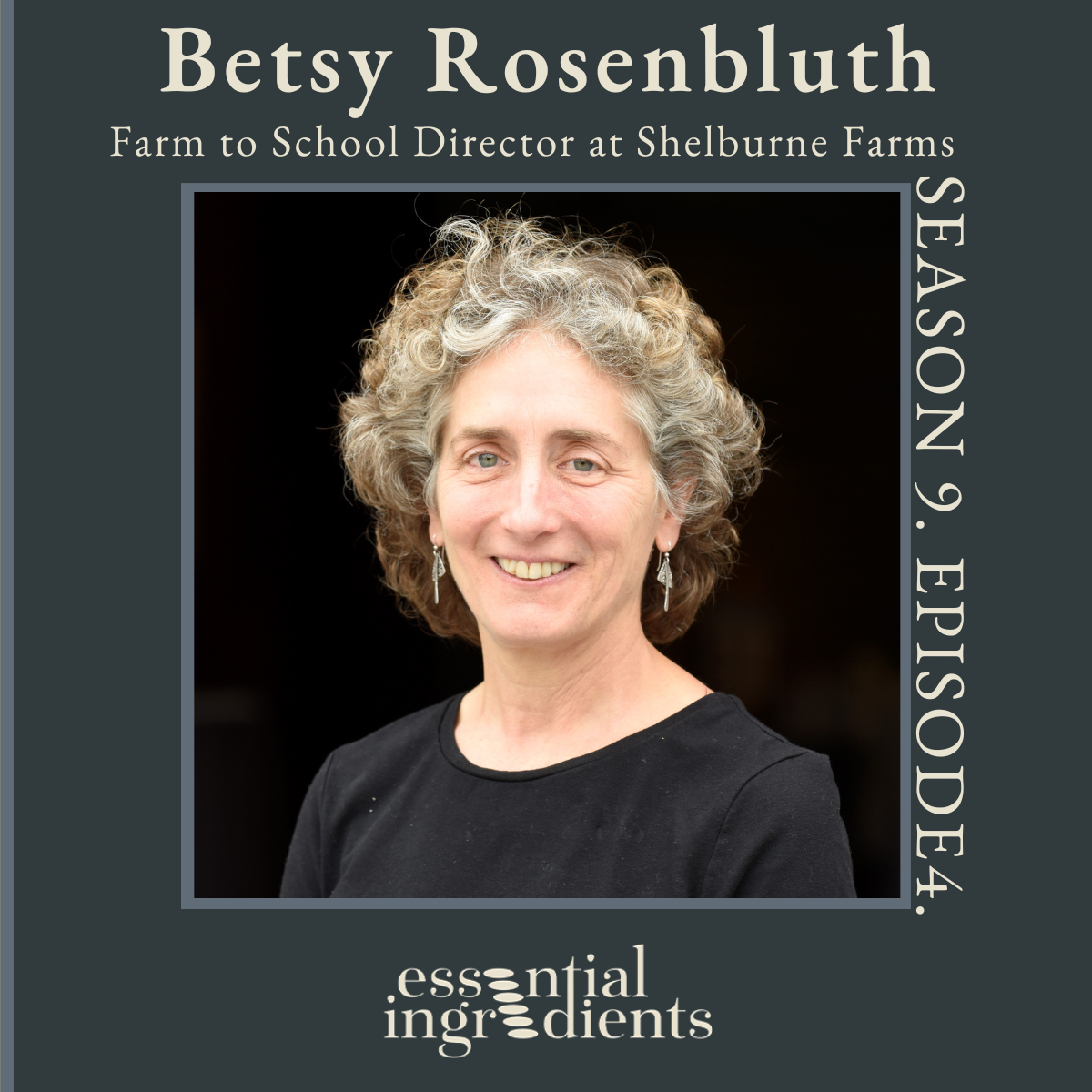
Betsy Rosenbluth · Director of Edible Schoolyard NYC
Watch on YouTube
Bye Bye Bland Bites: How to Make Lunch Time the Highlight of the School Day
The Incorporation Method helps you turn what matters into practical changes that fit your life.
“Betsy Rosenbluth, Director of Edible Schoolyard NYC, explains why school lunch has been the butt of jokes for too long — and shares how transforming the cafeteria experience can change a child's entire relationship with food.”
Full Transcript
Full conversation between Justine Reichman and Betsy Rosenbluth.
Welcome to Essential Ingredients. I'm your host, Justine Reichman. With me today is Betsy Rosenbluth. She is the Farm to School Director at Shelburne Farms. Welcome, Betsy,
Thank you, and thank you so much for having me join you.
Oh, I'm really pleased to have you on, and to invite you to just share with our community what you do, how you got there, and all the inspiration behind it. So before we get started, if you could just talk a little bit about what Shelburne School is in the Farm to School program that you are working on, I think it would give our audience and listeners a little place to start from, and a foundation to better understand a little bit about where we're going with this conversation. Betsy, could you just give us a little insight as to what Shelburne Farms is?
So Shelburne Farms is a nonprofit, and we have a mission to educate and cultivate learning for a sustainable future. So we're on a 1400 acre working farm. We make award winning cheese. We have 1500 teachers we work with every year, but it's really under this mission about a more sustainable world.
And so how long have you been there now?
I've been here full time for the last 10 years.
When you joined 10 years ago, what were your goals when coming on board with this organization?
I had worked many years ago, 20 years ago, with the city of Burlington, Vermont on a farm to school program, and Shelburne Farms as a partner. When I came on 10 years ago, how do we get this programming in every school in Vermont and support basically a national movement of changing the school food system. And so they brought me on to help with that strategy. We know what we want to get to, but how are we going to get there?
So if we go back to Vermont, my understanding from what I had read was that you helped found the Burlington School Food Project. Is that correct?
Yeah, that's right. That was over 20 years ago. And back then, I was working in City Hall in Burlington, and I was running a sustainable city program, and had a big public meeting to talk about all the great things we were doing with Farmers Markets, community gardens and food processing. And a parent who was there at the meeting raises her hand and says, this is amazing what we're doing, but the food my child got served in school doesn't look like any of this. It was a process product that was warmed up. And that began a partnership with many partners to look at, how do we get access to our children to this delicious, local, nourishing food, and change that system where kids are growing up with that knowledge about where food comes from?
So when you started to work on this program, did you work with the states across the country in doing this? Or were you just solely focused? Because my understanding was that you worked with states across the country who are interested in adapting Vermont's approach to integrating Farm to School.
When we started the Burlington School Food Project, we really wanted to first create a model, a national model for how this looks across an entire district. And so we worked on that over three years, and here it is. 20 years later, the program still continues. But over time, we began to work with other northeast states where we are and other states nationally to say, how have we had success, and what have been some of the models that other states can use and adapt for their context? So now I'm working with, for example, we have a program called the Farm to School institute that supports schools, and there's 14 different institutes across the country, West Coast, South Midwest, everywhere in the northeast that are all supporting schools. So our impact multiplies with everybody applying this model in their own state.
Amazing. And you founded this, and became part of this collective, if you will, 25, 20 years ago. Is that correct?
Yeah. I mean, founded it with partners. This city government, the Burlington School District, the nonprofits. When you're trying to create a system change, you really need partners. I don't think one person or organization can create that kind of change. But as a partnership or a coalition, it's amazing what you can do.
You need somebody with the idea, with the inspiration to be able to have that view and that vision, to be able to connect with all those partners, to be able to take it to fruition. So while you might have had a lot of partners, it sounded like you spearheaded this initially from the get go, and that's pretty impressive.
Well, thank you. It really worked for my heart. I just feel like we need to do right by our kids. They're also inheriting a world, and we want to get them ready to see that they can create a role in creating change. So it's really just what I love to be doing.
Talk to me a little bit about how these programs are tailored. Because I imagine in every city or every state, they may change a little bit based on the demographic, based on the geology, all of it. It's agriculture, etcetera. So can you talk to me a little bit about how you tailor the programs in different communities? For example, local food during the school year is very different in Vermont versus Texas.
That is such a great question, Justine. I think it's really the whole approach to Farm to School is not something you layer on top of a crowded curriculum or on top of what schools have to do already, but how does it help you to achieve whatever your goals are? And that's the most important adaptation. And so when we work with other states, or we work with any school, it's understanding what are your priorities, and then how does Farm to School help you do that? So it might be an area where they're really wanting to do more parent engagement. Like you said, a totally different growing season, or they want to reintroduce indigenous foods or whatever it might be. And so we're really about a process that supports people to achieve their goals. Not to say, oh, here's a toolkit, and here's a curriculum. You just drop that down and do it yourself. So it's really about adaptation.
And I would imagine supply chain plays a role in this. When you think about the amount of food it takes to provide meals, how do they manage that? How do they manage its consistency?
Another great question. There are so many barriers for something as simple as, let's get local, delicious food, nourishing food to kids. But it takes some innovation in the supply chain. Takes a lot of communication. So for schools to be able to communicate to farmers or distributors, here's exactly what I want and how I need it. And for producers and distributors to be able to communicate, how can I get that to your loading dock? And so a lot of communication, a lot of innovation of coming up with products that can work in a school and are kid friendly. There's a million regulations that people have to meet. I hear stories all the time. A kid on a school bus goes by the local dairy farm and says, that's where we get our milk or our cheese. The reward for the farmers and producers is knowing that the kids are growing up, they're feeding their community, and they're growing up with that. But it is a barrier. In Vermont, there's a lot of food hubs, so it's a bit of an alternative distribution network. That's true in some other states to get that delicious food in the quantity it needs to be, they aggregate it, and then they get that food to the schools.
I'm curious if you've seen, or if you have any statistics that highlight how this has impacted the student’s health and food?
Yeah, I have a couple of stories. My favorite one is we also do a lot of advocacy for policy in the state legislature for funding and for policies that support this. And so we were there testifying with some students, and they did a wonderful presentation. The committee chairman says to the high school students, what difference does this make to you? And this kid paused, unscripted. Just paused for a minute and said, well, it makes me think twice, and it makes me think what it took to get the food on my plate. I won't waste it. And then he went on to talk about when his mother was sick. He did the cooking in the house, and he started a garden in his neighborhood in the mobile home park where he lived, and there was just silence in the room when you realize, oh, this kid has these skills and this understanding for the rest of his life. And so we hear anecdotally a lot of those stories. I hear from the University in Vermont from the food service there, the Vermont kids who grow up with Farm to School, they're asking for different food in the college cafeteria. And that's what we like to hear in those stories that it's really creating change in the lives of these students.
Those stories are powerful, and they help to create the change. And if people speak up because they have more education and information, it's going to create greater change. So we got to embrace those, empower those, and give those stories a platform so that we can make that change. It's really important for people to speak up, and I think that those stories that you shared are really inspiring. But I also wonder, as part of this advocacy, what challenges do you face trying to recruit new schools and communities to be part of your collective?
There's so much in school right now. I would say labor shortages, staff shortages, and just a lot of demands whether you're the school nutrition person in the cafeteria, or a teacher, or a principal. Schools are faced with so much right now that the thought of one more thing is just too much. It's hard to get the school's attention. During the pandemic, that was an incredibly stressful time, and we would offer some workshops for teachers thinking, oh, nobody's going to come. Who wants to be on Zoom again? And the teacher showed up, I think, because Farm to School is so forward thinking about hope and something positive and a way that they could connect with other educators across the country, and they really were hungry for it. So it's difficult to get their attention. It's difficult work to overcome the challenges we're in a system that really does not yet support local food as it should. But once people dip their toe, then they get excited and are able to move forward. Especially with the resources and support we can offer.
I think it's great. The resources, the support and education, I think, are maybe the three things that I see that really support both the students, the community and the impact for change. Because all of it together is really the whole story. You need to be able to have those people experience it. You need to be able to provide information, both for education but also experience, so that those changes can really be communicated to legislation and try to create change. When you first came on board, or you first started this initiative, what were some of the things that you hoped to do that you weren't able to achieve?
We came on about five, seven years ago. We were always working on saying that school meals are part of the education day. In some ways, the cafeteria is the biggest classroom. And yet, we treat it like kids should just rush through and get out the door to recess. And so one of the things we wanted to do is change the culture in the lunchroom. And in our partnership with our hunger free organization, Hunger Free Vermont, we decided that we should work towards universal free breakfast and lunch. But not just any free meal, but also universal free breakfast and lunch for every student that had delicious, nourishing, local food in it. And kids felt a connection through education. So sort of a tall order. It's called Farm Fresh School Meals For All. And now, we're working on that nationally. And I would say that it's going to take a while to get there. I'm encouraged that at least one of the candidates for President is talking about universal meals. Who would have ever thought on a national stage they'd be talking about school meals? But there you are. So I remain hopeful. There's eight states around the country, including Vermont, that pass legislation for universal free meals. But we still have a long way to go in this country to say, Let's take away the stigma in the lunchroom, and let's just give kids the meals they need to succeed in learning.
So when you first launch this program, it takes money, it takes resources, all sorts of things. How did you go about securing that funding?
Our funding is a real mix of both public and private funding. And when we started, it was really looking for private funders who were really excited about this issue, really committed to it in the food business, concerned with kids, and were willing to make that investment to support us to do that work. And we had a particular foundation a few years back that said, okay, Vermont's amazing. But everyone just rolls their eyes and says, well, that's Vermont. So I want to give you a grant to look at what we were just talking about. How can you help other states across the country? And so that was very successful in supporting us to work with any state that's interested in how to grow some of their Farm to School programs. And now, the last partner is the federal government, and USDA is seeing the results and really investing now in Farm to School.
Just to clarify, though, you left this program now, and you're now with a different organization. Is that correct?
Yeah. So the story is I was working for the city and helping to create the Burlington School Food Project in Burlington. And then years later, I was actually employed full time by Shelburne Farms and nonprofit to take that experience in Burlington, and share that across the country, and across the Northeast.
When you left the program to go to this new farm, how did you leave things? What was the state of things? Are there people there that were in your place to continue the forward movement?
Yes. And I think that's where partnerships are so important. Because when one person leaves, the whole program doesn't just collapse. So it's really thinking about, how do you sustain this? Well, if there's a whole committee engaged and if one of us leaves, the rest of the partners keep it going. And so I left, and the school nutrition program by then had a vision and support, and they really carried the ball in growing that Farm to School program in Burlington. So they've stuttered a bit in covid. It was a hard time for schools, and I think they're looking now to refresh and bring in some new community partners.
I know when we were last speaking, we were talking about some of the challenges that you have faced when you were first launching this and some of the things that were unattainable for you. Can we just talk a little bit about that?
Yeah, I was thinking about that a little bit. We're trying to change a system that has values of efficiency and cost, and those are all really important. But we're trying to insert into the school food system values around the local community, cooking from scratch and nutrition, and connecting kids to food. It's really hard to create that kind of culture change. You're hitting against it all the time, and so everything requires a lot more work to overcome the challenges. So you would think getting fresh local food from a Vermont farm nearby would be easy to get that food to the loading dock, but who was going to deliver it? The school nutrition director is gonna pick it up. Can we get it on the distributor's truck? Do the kitchens even have cooking equipment, not just warming ovens for frozen food? What kind of upgrade needs to happen? How do we do taste tests with kids so that they're excited and not just looking at, oh, now we have roasted beets. What is that we need that food to get in the kids belly? So it really, I would say it wasn't one thing. It was just that kind of changing a system that prefers that efficiency and low price, and trying to insert these other values. It takes dedication. That's where the staff of the school and the community partners really pay off.
So for those folks that are trying to integrate this into their schools now, based on the challenges you've experienced, what would you recommend to them? What would be some tips that you might be able to give them to be able to do this in a more efficient way given your learnings?
That's a great question. I would say, find out what's happening in your school. People aren't calling it Farm to School, but I'm guessing there's a teacher who's maybe growing beans in their classroom. Or talk to your school nutrition staff. Maybe they really want to serve or get a salad bar, and they would welcome sharing that goal and having some help. So finding out who's in your community and creating a team because it does take a team effort. So finding who else is really excited about this, and how do we support those teachers and staff members who really want to create that change? So I was a parent. In my daughter's school, we wanted to change the world, but we started with one thing.A garden for the school, and we found a couple teachers who were into gardening. We created a garden, and here it is. 15 years later, and the program continues because the teachers, the parents, the principal are all pretty embedded in this opportunity for the kids to do hands-on learning in a garden. So find out who's interested. Build a team. Pick a project to get started, and build that momentum. Make sure people know about it.
I think that that's great. Are you familiar with the Green Bronx machine?
Yes, I love that project
Stephen Ritz. He's making things happen to those that are not familiar with the Green Bronx machine. We do have an earlier episode on that, so definitely tune into that to learn about what he's doing in the community and on a global level. He's done so much amazing, great work.
Justine, I think that project and the program in Burlington, they really look to students to be engaged and excited, and to drive some of the projects. So I think the key is, what are the students interested in? So one of the things we started really early on with Burlington was a Junior Iron Chef competition.
Tell me about that.
So the kids were watching Food Network so everybody knew what Iron Chef was about. And we started a competition for middle school and high school teens where the secret ingredient was local. And this has been going on for almost 20 years. Between 4 and 5000 Vermont teens have participated. A team of maybe four or five students get together, develop a recipe, and then they come to the fairground and compete with maybe 50 other teams across the state in a timed event to create their recipe. We have great judges, and it's really a celebration of cooking and food. And the kids are really driving that effort. So that's just been a great project that came out of a dream I had one night that was happening. I shared it with Burlington folks and others, and it's like, we can make that happen. So that's amazing.
So I'd be curious if there are any stories from the students that participated in this competition that had a direct impact by participating and being part of that that you could share?
Actually, we just called up and tracked down a student who had participated both in middle school and high school. So several years, and he's now an adult. He's married, has kids of his own. And when we called him up, he was not shy about sharing two things. One, for him, he didn't do sports or other team activities. So being part of a team cooking and doing something different made him feel the sense of belonging that he's part of the school and part of the team. And here he is as a father, he is cooking things he never thought he would cook before. He tries new foods, which he was open to before. He's got his kids cooking with him. It's really changed how he approaches food. He says he owed a lot to his coach who was the school nutrition director at the time at the school he was at.
Wow, that's amazing. I go back and think about what I ate for lunch. So in one school, I went to United Nations International School in New York City, and it had a cafeteria. We would go to this cafeteria, and the only thing when I'm sitting here listening to you talk about the school lunches that I recall are tater tots. Tater tots, that's what I remember. There was nothing else I would eat there because I didn't really like pasta. I didn't really like mystery meat, as I like to call it. That's what we named it in camp, at least. And so I would eat tater tots, which is not a balanced meal. So when I was younger, of course, my mom would send me in with leftovers, or my dad would send me in with leftovers from a Cornish hen from the night before, a little bit of meat, something like that, a little salad, because that's what I liked. I liked steak or chicken, and some vegetables, broccoli or whatever. But we didn't really have the same access. And I'm not sure why I was not eating those things. But as a kid, most kids like pasta. Most kids like all that stuff. I couldn't stand it. I don't know back then if I knew it didn't work well with me. As my mom likes to say, you're intolerant to it. Now, maybe your body was telling you, but I wonder if you go back all those years and we had integrated this, how many people might have been on this journey that much sooner?
I really believe that. I think we have such a low bar for kids like, oh, they're not going to touch it. They're not going to like it. They like pizza and chicken nuggets. Well, you know what? The kids who are cooking, or have a garden or connected with that food, they're eating everything.
And what I also think it is, I don't know if this is how you were with your children. But I always ate what my parents ate. My parents did not cook a special meal for me. If they were eating lamb chops, or they were eating fish, or chicken, or whatever, that's what I was eating. Now, I really avoid chicken because my mom made it every single day for a while. But my point is that these kids are catered to in a way that they're not empowered to try new things. They're not empowered to like these different things. They're given things that we believe children should like, and then they eat those as opposed to the opposite.
And sometimes, it takes trying 10, 7 times before you know whether you like something. So being patient with kids. I've done this with my daughter. Take one bite at least, and then you'll know. And over time, they get used to trying different things. And sometimes, they develop a taste for it. So I think that taste testing and allowing them to say no, thank you, but at least they've tried it is really important.
I agree. Betsy, thank you so much for joining me here today and rounding out this conversation for us coming back with all the technological difficulties. It's been great to learn about what you're doing, the impact you're having all over with what you kicked off so many years ago. So for those that are interested in learning more about what you're doing, or maybe to get their school involved, what would be a good way for them to approach this?
We are happy that we have lots of resources on our website, and we're happy to talk on the phone or email. We can connect you with folks in your state. There's a nice National Farm to School Network that also has loads of resources so you don't have to invent it yourself. I think you can build off of lots of good materials and people who really want to support you to create that change in your school or your early childhood program in your state.
So for those of you who tune in each week, or are new to this, our episodes drop every week on Tuesdays, and you can hear them wherever you listen to your podcasts. Equally, we do have a video cast on YouTube, so do tune in. Let us know what you think, and share your insights and point of view because we want to hear from you.
Share This Episode
Enjoyed this conversation? Share it and tag @nextgenpurpose
Listen on Apple ▶Listen on Spotify ▶Your Host
Justine Reichman
Founder & CEO of NextGen Purpose. Host and Executive Producer of Essential Ingredients — 11 seasons, 330+ episodes, and a growing movement.
About Justine →