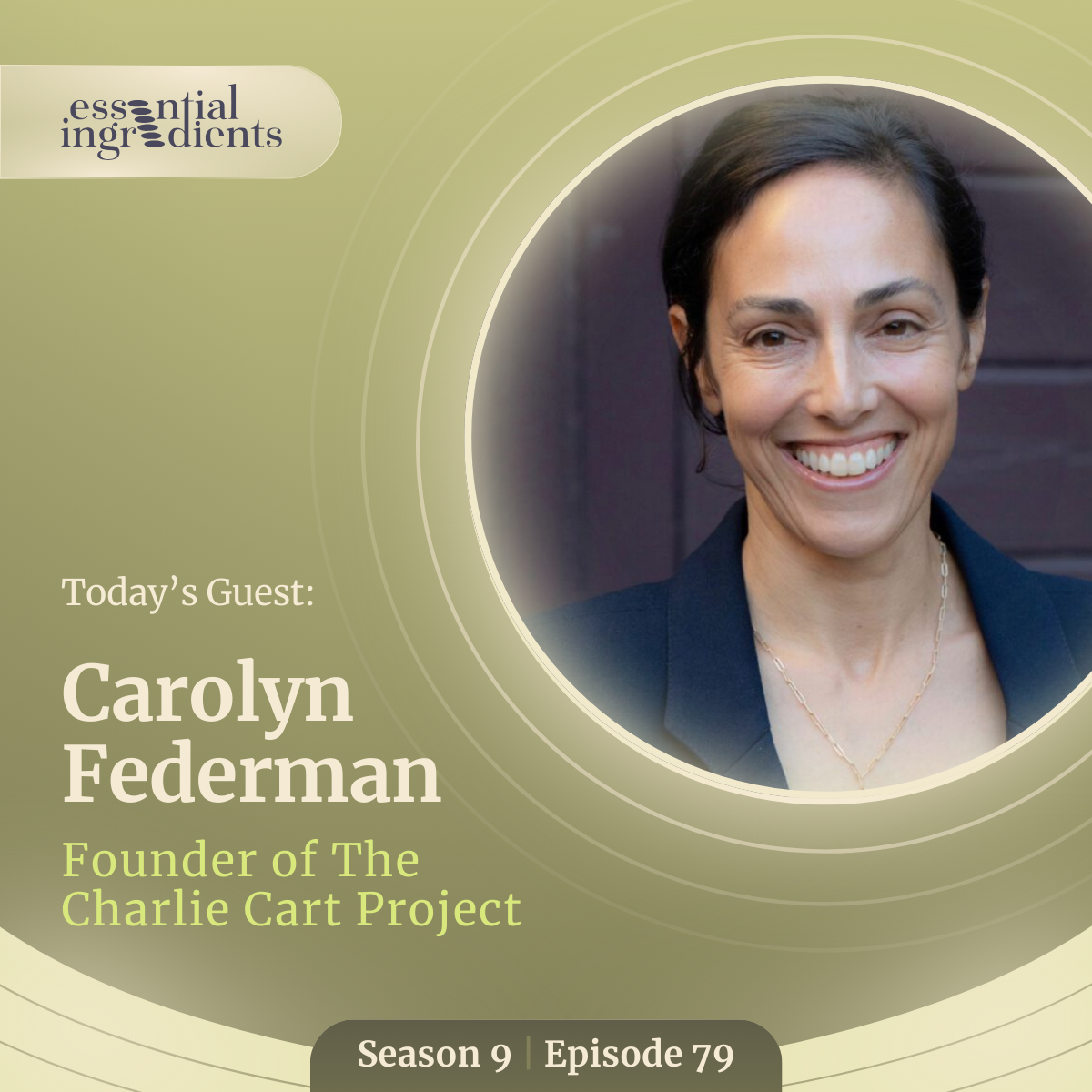
Carolyn Federman · Founder of The Charlie Cart Project
Watch on YouTube
Healthy Habits Start Young: Making Food Education Accessible
The Incorporation Method helps you turn what matters into practical changes that fit your life.
“Food education gets treated as optional, even though it shapes health, culture, and opportunity from the very start. Carolyn Federman, founder of The Charlie Cart Project, explores why bringing the kitchen to kids — not the other way around — is the most powerful thing we can do for the next generation.”
Full Transcript
Full conversation between Justine Reichman and Carolyn Federman.
Good morning, and welcome to Essential Ingredients. I want to welcome our guest today, Carolyn Federman, who's here from Charlie Cart Project. And I want to also just welcome our guests, those that tune in each week, those that watch us on YouTube, I'm so glad to have us all together to be able to talk with you, learn more about what you're doing and the impact you're having on the whole world behind you.
That's just the US. It would be great if it were the world. Thank you, Justine, that's fine.
Either way. We're excited to see, I see a lot of red dots, which makes me feel like there's a lot of happening in a lot of different places. So Carolyn, just a short intro on yourself, and a little bit about Charlie Cart so that we could then dig in deeper and get to know what you're working on.
Yes, thank you, Justine. Thank you so much for having me on your show, and I'm excited to be here and tell you a little bit about myself and about our work. So I worked for Alice Waters for a long time. And for those who are not familiar with Alice, she is a chef and an activist who started a program at a middle school in Berkeley, California that had a teaching kitchen and a garden that were integrated into the students academic day. And I saw the impact of that program firsthand, not only as a staff person there and later as her Executive Director, but also as a parent, because my kids went to school there. I noticed that as we would tour many people through that program, they would sometimes come away thinking, wow, this is amazing, And I would love to be able to do this. But having an entire teaching kitchen and this one acre stunning garden is kind of a heavy lift, and may require more resources than what we can put towards a project like this. So the Edible Schoolyard, Alice's program is well resourced, and it's an exceptional model for what is possible. And I think a lot of people needed something that would allow them to just get started without such a reach.
I thought, okay, if we can't bring the kids to the kitchen, maybe we can bring the kitchen to the kids. So what would that look like? And I worked with a friend to design a compact mobile kitchen on wheels that could roll into the classroom so that the educator in the classroom could administer a hands-on cooking lesson pretty much anywhere in their classroom, in the cafeteria, in a garden, if that's possible, outside on the quad. And now, in live race food banks, hospitals. We're really in a wide variety of organizations. So that all happened in 2015, and it took off from there. It's been pretty much word of mouth growth. We have about 650 cards out there in the world in 47 states. So it's going well, we're having a big impact reaching about half a million kids a year with the program, and we're training educators to deliver hands on cooking lessons to their communities so that kids can learn and experience fresh fruits and vegetables in a way that compels them, and makes them excited about eating more of them.
That is so amazing. And I've read so many different studies around the impact of food on children, both in their ability to grow and thrive, how it impacts their academics, how it impacts their future, and it really roots them in something that they can then grow from. Pun intended, no pun intended. But I think that being able to create something that was mobile was really smart. You took the most expensive part of this whole endeavor that was both inaccessible to so many, nor was there probably the space or the acreage to be able to do all that. And then all of a sudden, you took something that you could make in certain locations. But then was not necessarily accessible to others, and made it accessible. So I'm curious, obviously, you were with Edible Schoolyard, which I'm familiar with. I would imagine that there's a lot of people familiar with both Alice Waters, who she is, and the impact she's had with Edible Schoolyard. But I'm curious, you went from Edible Schoolyard to doing this. How did that play out? And when you were maybe discussing it with Alice, did she have any insight, concerns, questions, thoughts, or excitement around it?
She was super excited about it. Yeah, she thought it was great. Alice is a big believer in going all the way. Let's not start small, let's go big. So she still wants all of the organizations that are using a Charlie Cart to have a fully built out teaching kitchen, and use the cart as complementary to that. And that would be amazing if that were the case. I think she sees the Charlie Cart as a stepping stone to further increasing food education programming at schools and all kinds of organizations. And so I think she's really excited about that.
Yeah, it sounds exciting. And what a nice synergy to bring those things together too. And her reach is quite vast at this point. I think I went to that anniversary party she had at the Foreign Cinema. I'm so glad that I used the word film, and we got there at Foreign Cinema and learned a little bit about that. And of course, I know that there was one in Brooklyn. Because when I was in New York, there were some events there that I had attended back to the beginning for you. So before you ever were Alice Waters, and before there was ever Charlie Cart, while you were growing up, was it family, was it culture, was it school that really stirred up this interest and desire to be in this part of the world, both academically as well as building a business to create greater access to healthy food?
I think you can relate to this because you mentioned that you grew up in New York, and you ate a wide variety of food from a really young age. My parents also were from New York, and they had grown up in Brooklyn, and they ate everything. And so when we were growing up, we often had dim sum, we had sushi, we ate Mexican food, we ate every kind of food. And we also were exposed through our parents and how that food was related to culture and tradition. We did a lot of traveling and saw how the food supported people in their own communities. We just had an emotional, cultural and an intellectual connection to food in my home growing up, and my mother was an exceptional cook. I say that as a daughter, maybe if you compared her to somebody else, you might not think she was exceptional, but she cooked with a lot of love. She cooked dinner every single night, and that was our time to connect. So when I started working with Alice Waters, she talked about how important it was to eat together and eat your meals together, and how children were eating alone. The idea of children eating alone was stuff foreign to me. And everything that Alice said resonated so much because that's how I had grown up. I just fell completely in love with her ideas and philosophy. As I said, it resonated, and I got with it. I found my life path. Everything came together. I studied social cultural anthropology. I did a lot of work on food in college as well, and how it relates to health, tradition and culture. And so then, when I connected with Alice, it all came together.
It sounds very organic. It also sounds very relatable, at least for me, where in my family, every road led to another meal, right? We're eating lunch, we're talking about dinner, we're eating breakfast, we're talking about lunch. And it was such a time of coming together. And whether you're talking about the next meal or politics, or even just what you did for the day, it didn't have to be anything so deep. It was just an opportunity to connect, relax, and be with your friends or your family. And so for me, I know one of the greatest challenges I had when I moved out here was everybody wanted to meet for a hike and go on four hour hikes. And I'm like, okay, well, how about we meet for a cocktail or something? Because for me, growing up in New York and living my younger years there, 20, 30, 40, you're meeting up with people after you're working, when you're not working out, to connect and have human connection. So it was about the food. It was not about the food, but it was through the food that we connected.
That's so funny. I can really relate to that. Even though I grew up here, I can really relate to people that just want to go hiking and they don't want to go out to dinner or something.
Yeah. I love to have people over. I love to cook. It makes me so happy. I just don't like to cook just for myself. I don't know if it's maybe I just need that little, oh, this is such good affirmation, and appreciate it, because I feel like I always appreciate my food. But anyway, I digress. And so my understanding as I was getting ready to talk to you and just learn a little bit about this, was UC Berkeley had a role in this project with you?
No, I was working with Alice as a contractor. I had left the employment of the Edible Schoolyard Project. I was working as a contractor on some events that they were having over there, and wanted to pull UC Berkeley into the fold, and so we developed a course called Edible Education 101, and we started there
Collaborated, but it wasn't for this. It was for the Edible Education within UC Berkeley.
That's right. So that was a course that Alice, Michael Pollan and I produced that happened for three years. It was a public, private course. So students could take the course for credit, but they held several seats, maybe 200 seats. I mean, I think it was like 750 seats each week. And 600 students in the class, something. And so they held the remaining tickets for public people, and they were able to reserve them for free. And it was a lecture series about the food system. And so you had all these incredible speakers from all across the food system talking about how food is at the nexus of pretty much everything.
I couldn't agree with you anymore. I think it is at the nexus of everything. So when was it that you had this light bulb moment around Charlie Cart?
After starting the Edible Education course, I was learning a lot about the food system and the interconnectivity of it all, and I noticed that the university did not have a food systems program. And that didn't make sense because it's Berkeley, and you have Alice Waters right here. It's such a food kind of town. So I thought, well, let's work on that. So I worked together with some folks from the university, and one donor who was interested in supporting something like that, and we wrote the blueprint for a Food Institute at UC Berkeley. And then I was the interim director while that was getting up and running, and helped launch that. So that launched, and then I thought, I really want to go back to something that's a little bit more direct service and get to the root of the problem. The light bulb moment was when I was at this conference, and I saw a presentation called Trench fair, and it was these soldiers, these World War I French soldiers rolling this little cart along with a smoke stack, and they were walking beside it as it was rolling along with a giant outboard wheel. It was called a cuisine roulant. And I thought that's what we need, a rolling kitchen. And that was it.
So when you kicked it all off, okay, I'm here doing this. I was an interim director. I see this thing. I'm now going to build my Charlie Cart, or whatever it was in that moment, my rolling cart. So what did that look like? What did your next day look like? Or that night?
I called this friend who I had met through working at the Food Institute, and he's a designer and just a great strategic thinker. He's not a 3D designer. But somehow, I thought he could really nail this, and so I called him. His name is Brian Doherty. He's on our board now. And I said, this is my idea, would you want to design a rolling kitchen? And he said, absolutely, I have a kid. I care about these issues. He was really influential on sustainability movements early on, and he's written a book about it. And so he just got to work, designed it, and it's really beautiful. He did an amazing job. He built me these little, we equipped it with the foundational cooking gear that you need. Nothing fancy, no gadgets, but just what do you need to learn how to cook. And in order to make the drawers the right size and get the right stuff in there, he built me these little cardboard drawers so I could see how much room I had. I would go to the hardware store and buy all these things, and come with all the stuff. And yeah, it was great. That was a fun time.
What was included in the cart?
There's about 172 pieces of equipment in there. So there's appliances.
The cart is sounding big.
It's small. It's 5 feet by 5 feet. It's like a clown car. You just can open the drawers and pull all this stuff out. And we did a little jenga with it, figuring out exactly where things go. And it's very organized. It has a sink, which is a gray water recovery sink, and then it has several appliances. It has a little oven, it has an induction burner, a griddle and a vitamix. And then it has the gear that it has certain types of knives specifically for different age groups. It has whisks, a couple mortar and pestle. It's designed so that three stations of kids can work on the full recipe together. So they're sharing equipment, and they're working together to complete the recipe.
Has the cart evolved over time? Or are you using the first iteration of it?
Oh, no, it's evolved. The first one had outboard wheels, and then we brought it to a school. The teacher said, I can't even get it through the door. There's been several iterations, maybe five. We've been through three or four manufacturers. And in 2017, we found our manufacturing partner for life who's just this amazing guy who's really supportive of the whole endeavor. He's just great to work with, and he made some improvements. Everyone made a little improvement. Put their mark on it along the way, and now it's just wonderful. We've had carts out there in the field for 10 years that don't have any issues.
Yeah, that's great. And so wow. Now, where was your first location?
Great question. So the first 12 cards went all out at the same time. So we had Waynesboro, Virginia, the Burke County Public Schools. The Wyoming Department of Education purchased a whole bunch, and they regranted them to schools across the state. And the Low Country Food Bank in Charleston, South Carolina was one of our first, and the San Francisco Public Library.
Wow. Now, look at you. Look at all those red dots behind you.
Yeah, I know. I'm about a year behind in updating this thing too, so there's 100 more dots now.
Talk to me a little bit about the growth and the challenges, or any obstacles that you faced while you were kicking this off.
Well, so many. You know how founders always talk about, if I knew, I never would have done this. There's so many things about growing a company, and I'm sure that a lot of people will talk to you about this. It's just hard work, lots of mistakes and learning along the way. So many things I didn't know, so you have to trust your instinct. A lot of people will say, no, that's a terrible idea, and you have to work around that. And one of the specific things that was really hard with this is learning about manufacturing, because that was so far out of my wheelhouse. There wasn't like I could hire somebody to just interpret for me. I had to get in there and learn, go visit the manufacturers and understand the questions they were asking me, and the proposals they were providing to me. I just remember going to one of the manufacturers with my iPhone and looking with the little flashlight inside the cart to make sure everything was absolutely perfect, and they just hated me. They did not like that at all. And also, the manufacturers were by and large. I mean, I think I came across maybe one woman in all of those manufacturing companies, and that was hard because I'm a small person, and they just could see you coming. I'm a mile away. I'm a small person without any manufacturing experience so they are always trying to pull the wool over. So that kept me up at night, for sure. Maybe not the most interesting part of the work, but it's a really big, important part of the work. It is important to me that teachers need all the help they can get. We do not want to send them a product that's going to break, that's going to fall apart, that's not going to deliver. We wanted to keep it really simple and really sturdy, and had to be able to stand up to a whole bunch of kids. And so the manufacturing piece was really, really important.
I would imagine that you want things that people can rely on. And it's expensive too, by the way. Are you teaching people there to do that, or sending somebody that's like a whole nother thing, right? It's like, when my fridge breaks, I have to call Fisher and Michael who have people that send them out, and then they're on YouTube trying to figure out how to fix it.
Yes. That's a whole other part of my business. Every decision impacts every other decision. So the decision to keep it really simple was important because it means less things to break. And to find a great manufacturer that's going to make a solid piece of equipment, that is going to follow through and help you if something goes wrong. There's all those parts to it. And the other thing that's so important about that in the manufacturing piece is we also wanted to provide something that doesn't have a lot of plastic. Is it sustainable? Yeah. So it's produced in the US, and the countertop is a food grade recycled paper composite. So there's a lot of recycled equipment, a lot of recycled material on the cart. Also global politics impact all of this so much too, which is something that people don't think about with a little nonprofit. But we used to get the wood for the cart. We ordered from Russian Birch. It came from the Ukraine, but via Russia, so we had to change that.
What's the most surprising thing that you found that was a challenge? The most surprising thing that you thought like, oh, this will be cake. But all of a sudden you're like, wait a second. I did not realize.
In terms of the entire thing, or the manufacturing specifically?
Let's do both. Let's start with manufacturing. Now, let's talk about all of it.
I think I was surprised by how much you need to formalize relationships when you're dealing with this kind of business. I was not used to contracts and that kind. I think that I had the feeling that if you had a good rapport with somebody, and you felt you could trust them, and you were honest, that everybody would come honestly to the table. And I think I was really surprised by how few people actually do come honestly to the table. Maybe more of a disappointment than a surprise, but that took me by surprise.
I knew why you could feel a little bit surprised by that. I think every industry is a little different. Some people do things with a handshake. Some people are much more corporate or formal about it. I also think it's cultural. Like working with China versus working with the UK or something is very different culturally. So I think that that plays a role as well. And I know for myself, I like contracts because I think you can be transparent and this makes me a clarity. It makes me feel safe. Who knows, anything can happen. I'm not looking to have a lawsuit. I like the idea, because I know exactly what my role and responsibilities are, and we know what somebody else's are.
Yes, exactly. And I think that it was a big learning to just get to clarity. Obviously, I had done that in my other work. But taking it out of the context of nonprofit work and into this business context was just so different. And yeah, that was a big learning curve. Big learning curve on manufacturing. And then in general, I think the biggest surprise was how fast it spread. How widespread the interest was, especially by word of mouth. The fact that it just took off like that, that was the biggest surprise, in general.
I imagine a welcome surprise, were you ready for it? Or did you say, okay, well, this is awesome. Let's go. We got a zillion of these and a zillion of those.
It was pretty much. This is awesome. Let's go. We just have learned everything. Someone asked me once, when did you feel like you turned a corner? And I said, well, what do you mean? What corner? We're just always learning and changing, and we're always charting a new path all the time.
Yeah. I think what you're doing is great, and I think that it can expand. I don't know what your visions are. I'd love to hear when you think about three years out or five years out, aside from covering up any blue on that map, what else are you hoping to achieve? Will we see new things on the Cart? Will we see it expand?
I really want to see food education ubiquitous, everywhere children gather to learn. So every organization that brings children in after school programs, every pediatric unit of the hospital, every rural clinic, all the libraries, I want every child in this country to have daily access to food and nutrition education so they should be able to get their hands on fresh fruits and vegetables. Touch them, taste them, smell them, cook them, prepare them, learn about them, learn how to choose them, and learn how to cook with them. And all of that exposure will change their palates. It's going to inform their dietary habits for their whole lives, and that in turn, will impact how they steward the environment. I think it also inspires curiosity. You can do a whole diversity lesson with apples and have children kind of click in with their critical thinking skills about this question of diversity. And what does it mean? You can cover a lot of ground with food education.
I just want to tap into something you mentioned twice now, and I wanted to circle back on it. Was the cart in the hospital for pediatrics? Because I was wondering what that looks like, and how that education is rolled out, or is more meant as a play through education kind of thing because it's a completely different setting than a school. Is it a little bit about what that looks like?
Yeah, sure. I will talk to you about hospitals. And I'll just preface it by saying, so the Charlie Cart Project, our program is primarily in schools. It's like 50% schools, 30% libraries, and then the rest are a variety of different community organizations. So that might be an after school program, like a Boys and Girls program, or rural clinic, or food bank. So we're not in a ton of hospitals, but I will talk to you about how they work generally in hospitals. The reason that it's not more widespread in hospitals is because they have such specific constraints around what they're able to do with kids, and on how kids can interact and live with food, what they can eat and all of that. So how it works is different, depending on the goal of the organization. But in some hospitals, they might have families participate, so they're learning how to cope. Maybe their child has diabetes, and the parents are learning how to support a child with diabetes. I will also say that the Charlie Cart is used for adults as well, so there might be some learnings where it's just for the adults to learn how to manage a dietary related disease. So it's about teaching new eating habits, getting people used to trying different types of more fresh fruits and vegetables, really, and learning the basics of cooking so that people know what to do with the fresh produce when they get it. And then with kids, we've been in pediatric oncology units where they're just doing something fun. And also at the same time, nourishing for the kids, something that makes the unit smell really good. The whole floor smells really good. And the kids, it's different in that environment because the kids all have to wear gloves, and they have to make their own individual, they can't work collaboratively the same. It's different depending on the organization.
Well, I think that hospitals now more than ever are taking another look, maybe at food and the impact it has. Because loosely, people call it food as medicine. I think for so long, hostile food has been terrible. It's not good. And now, organizations are bringing in chefs that work with nutritions, like the organization in New York called Northwell where they bring in Michelin star chefs to work with dietitians to make food. And so I love how you've brought in something like this so that kids can learn at an early age the impact. And I appreciate so much that the hospitals are on board, so that it's starting with education, and it's starting when you're not feeling well. And if you can encourage children and show them with the dietitian the things that they should be eating and showing them how to make it well, I'm going to imagine their recovery is going to be quicker, easier, and better. They're going to feel better, and then they're going to know how to take it home, and even integrate that into their daily life. So I'm very excited about this. I want to call it a movement, if you will. And I think that it's just so great to see in the schools, in the libraries, and in the hospitals. And I'm curious, are you familiar with the Green Bronx Machine?
Yes, absolutely. He does great work.
He does great work. He's making huge impacts, like you creating these programs that people can then repurpose in different places all over the globe. So similar, but different.
Yeah, similar but different. And it takes all of us.
And people learn differently with different things too. Some work better in different environments. I think it's great to have a garden in the Bronx. That's pretty cool.
Amazing. Amazing. We need all of the interventions together.
So as you look forward and you want to grow this, what can we expect to see with Charlie Cart before that? Wait a second. I don't know why I haven't asked this yet because I've been burning to ask it, why Charlie Cart? Who's Charlie?
Oh, it's the great, great grandchild of the chuck wagon. Are you familiar with the chuck wagon? The check wagon was the very first recorded mobile kitchen, but it was a wagon. The covered wagon that they used to store the food that allowed the cowboys to stay out longer on the prairie and shepherd the cows further because they were able to store food on it. Yeah. A lot of people do not know the chuck wagon, but if you grew up with seeing those ads for Purina Cat Chow. Do you remember Purina Cat Chow? They had that little wagon. They had a little covered wagon that was resurfaced in that ad. That's a chuck wagon.
This is a little funny note. I'll tell you, growing up in New York, my mom was an interior designer before she went into finance, but she designed for me a house. The roof was flat. It had shingles. The roof was my bed. Inside, there was a kitchen. Just like I do now, green carpet, and then yellow walls for sun. It didn't really work, so it wasn't like Charlie Cart.
But that's amazing. That's so nice. That's so fun. But you can relate to the joy that that brought you, and the love that that conveys. The other thing I said when I told Brian, please design this kitchen. I said, make it beautiful, because kids need to feel valued, and they need to understand that they're important so let's not give them something junky. Let's give them something beautiful. That when it rolls on, they feel important.
Awesome. Oh, my God, this is amazing. I love what you're doing. You've done such amazing work and growing. I can't wait to come back and see more red dots.
Thank you. The Food Education Movement, I like you calling in a movement. We want to grow that, and we want to see it part of everything. And we want to make sure that people understand that food education is a critical component of food access. You can't take advantage of fresh fruits and vegetables if you don't know what to do with them. So we've got to get food education into all of these other hunger, anti-hunger initiatives, food sovereignty initiatives, and food is medicine. It all has to start with education.
I couldn't agree more. I think education piques curiosity. I think curious kids learn, ask more questions, and can get a better education on it when it's accessible to them, like that cart. So you're making it accessible so that they can be curious, learn more, know what's good, and know what they want to strive to live a life. Well, thank you so much for joining us today. It was great to talk to you. It was great to have our viewers or our listeners tuning in. I hope that you guys, I wouldn't have wanted to miss this episode, frankly.
Thank you so much. Oh, Justine, can I show my shirt before we go?
Yes, please. Show your shirt. I wish I had one. I would show it to them.
I'm sorry. I should have sent you one in advance. I'm gonna send you one though. So here it is, what is food education? Ask your listeners to tell you what they think the answer is.
Alrighty. So what is food education to you?
Food education to me is access to information, knowledge and skills that help you thrive and have a better life.
Awesome. And what's the greatest challenge you think people have in getting food education?
Access to it. The greatest challenge is that it's just not available. It's not considered important enough, so it doesn't get the resources, it doesn't get the attention. So it just needs to be integrated into everybody's daily life.
And what are three ways that we could maybe empower people to make it more of a priority?
As a parent, you can advocate at your school. Talk to your nutrition services department, talk to your principal, talk to your superintendent about making sure that there's kindergarten education happening in your school, any kind of cooking lessons. So that's one way to advocate. Another way is to raise your voice at the ballot box. You can read things like civil leads, or the Environmental Working Group have these ballot trackers that tell you where folks, where politicians stand on food issues. So vote with your pen, but also vote with your fork. And yeah, number three is to vote with your fork to pick foods that are healthy for us and healthy for the planet. And every time you do that, you increase demand for those kinds of foods. You're increasing support for incremental changes in the food system, and for food education.
And so for those folks that want to maybe learn more about Charlie Cart, what's the best way for them to investigate further?
You can visit our website at www.charliecart.org, or check us out on Instagram @gocharliecart.
And if there's a school, a hospital or a library that should tune into this and wants to maybe integrate this into their curriculum because they don't have it as of yet, what would be the best way to connect with that?
You can either DM us on Instagram, or go to the website and fill out a very quick form with your email and your interest, and we'll get right back to you.
Well, we're gonna have all this and more in the show notes, so you're not gonna want to miss that. So if you aren't following us on Instagram, make sure to follow us on Instagram at justine.reichman, and at essential.ingredients. We have both the podcast and the video cast depending on where you are, what your mood is. So we are on Spotify, iTunes ,and wherever you listen to your podcasts. And our YouTube channel is easy to find, Essential Ingredients. So thanks again.
Share This Episode
Enjoyed this conversation? Share it and tag @nextgenpurpose
Listen on Apple ▶Listen on Spotify ▶Your Host
Justine Reichman
Founder & CEO of NextGen Purpose. Host and Executive Producer of Essential Ingredients — 11 seasons, 330+ episodes, and a growing movement.
About Justine →