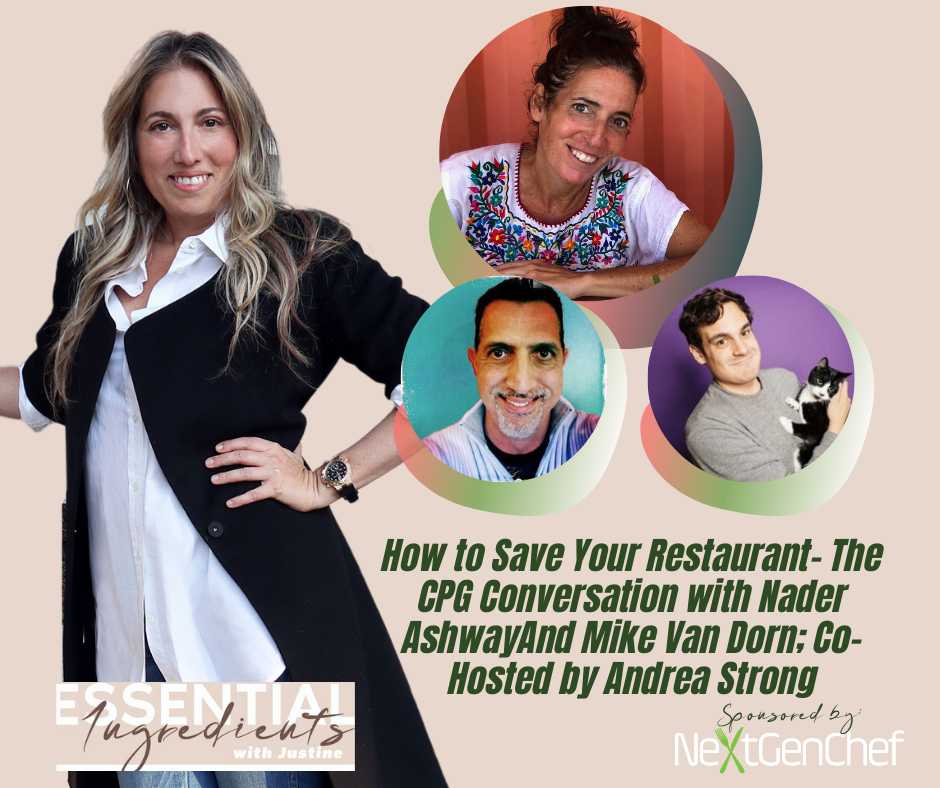
Nader Ashway And Mike Van Dorn · NextGen Purpose
Watch on YouTube
How to Save Your Restaurant — The CPG Conversation with Nader Ashway And Mike Van Dorn
The Incorporation Method helps you turn what matters into practical changes that fit your life.
“Do you have a product idea that you want to share with the world? Justine and her co-host Andrea Strong uncover the secret path to launching a successful consumer packaged goods product, navigating the CPG world from the perspectives of an investor-founder, Nader Ashway, and a director of logistics at Brodo, Mike Van Dorn.”
Full Transcript
Full conversation between Justine Reichman and Nader Ashway And Mike Van Dorn.
Good morning, and welcome to Essential Ingredients. I'm excited to welcome you guys today, I have Andrea Strong, Nader Ashway and Mike Van Dorn. It's a special track for us that we are launching today. I have, as a co host, Andrea Strong. And this is a unique opportunity for us to be able to talk about food and bringing on CPG products as a way to deal with the restaurant industry during COVID. So Andrea, welcome and thank you so much for being my co-host today in this track.
Yeah, it's my pleasure. It's great to be here and to welcome Mike and Nader. I know we're going to have an exciting conversation, and hopefully be able to lay out for anyone listening in the restaurant industry who's considering launching a consumer packaged goods, CPG, all of the steps along the way, and the pitfalls, and barriers and challenges. And yeah, I'm looking forward to a great discussion.
Yeah, me too. First, there are two guests that I haven't met before, we had a quick chat before, but not enough for me to be able to do you both justice and give our guests and listeners your bios. I'd love to start with Nader, if you would just give a little intro to our listeners so that they can get a better understanding about your background, if you would.
Oh, sure. Nader Ashway, creative director and strategy lead at Moddern Marketing, which is a boutique agency located in Manhattan. I've been in the advertising and marketing world for about 30 years, starting with some large mega agencies on Madison Avenue, going to some smaller shops and ventured out on my own 20 some odd years ago. I've been on my own as an agency owner since about 99 or so. And I just love it. I have some direct experience with CPG brands and a lot of experience with restaurants and hospitality so I think that's why I'm here.
I definitely think so. We're excited to be able to talk about that further, especially with my friend from Brodo who heads up and is the Director of Logistics of Brodo. I have to say, I do miss Brodo being a New Yorker. I used to go there a lot. So I'll let you talk a little bit about Brodo and what you do there.
For sure, guys, my name is Mike Van Dorn. I live in Brooklyn, New York, and I am the director of logistics for Brodo Broth Co. We are a Brodo Broth Company based out of Manhattan that has a few retail cafes in the city which we serve hot broth by the cup as a drink. And in addition to that, we have a full ecommerce site where we mail broth around the country, sell in grocery stores, places like FreshDirect, Whole Foods, kind of things along those lines, as well as a bit of other wholesale business. I guess I got started in the world of food right out of college. I started interning with the team at Milk Bar, other bakery group based out of New York, and got a chance to kind of learn all the ins and outs. Everything related to the cookie, from how it is made, how it is sold, how we market it, how we shred papers, about it all the kinds of ins and outs of what goes into running a retail operation and got a great chance to see how that gets scaled up into whether multiple retail, outlets, ecommerce growth. I spent quite a bit of time from an inventory, and production, and manufacturing standpoint as far as how you grow the product, and how you start scaling it, and start taking recipes that are very small batches and making them very large batches and having them still tastes great. I do a bit of that with Brodo as well. Overseeing our manufacturing, and inventory, and kind of our back end operations and getting all the pieces in. So that's what we're doing in Manhattan, what we're doing in Whole Foods in Massachusetts.
Yeah, that consistency is really key.
For sure. No, it is. Yeah, it is quite a challenge.
Yeah. Just to kick off our chat. For folks who are listening or watching who are in the restaurant business right now and have been hit pretty hard since COVID, who may have this killer recipe for granola or their hot sauce that everyone is like, Oh, my God, I wish you sold this, or their cookies, or their cakes, and they're thinking, you know what? IThis 25% occupancy is killing me, I can't pay my rent. Is there something here? Can I bring my granola to a Whole Foods, or a Corner Deli near you? I guess, Mike, we could start with you. And Nader, obviously, chimes in as well. What are the indicators really for an operator for a chef to listen to, that says, you know what? You should be taking this to market? And conversely, is there a sign where you're just not, like, absolutely do not do this, you're gonna just burn your money. Mike, if you want to start, and then Nader, we'll hear from you as well, for sure.
So yeah. I guess I'll take it a little bit. For more, it's kind of the back end approach, I suppose. But the first thing that comes to mind is looking, obviously, a product that people are excited about is something that there's something that a bit of buzz around it. But I think, going a bit under the hood, as far as, how complicated is this to make? How well does it scale up? How well does it hold up in storage? All of the kinds of ins and outs that you might not necessarily need to think about on a day to day basis. If you're just kind of making a bit here and there, and sort of what you make in a day is what you sell in a day. Kind of a slew of questions that open up once you kind of release your product out into the world and lose a bit of control from a restaurant into the realm of their own packaged goods, where there's X number of hands touching it, whether it's a cursory distributor, a FedEx, a source app, all of the different kind of components of it. I think the first thing for me is kind of understanding how complicated it is to make, and is it something that you can make large batches of and have it sit and be held at a given period of time without losing quality, both from a food standpoint, as well as a packaging standpoint. I think for me, the biggest hurdle is that despite that, a recipe is a recipe. Okay, if I'm doing this in a 35 gallon pot, clearly, I can do it in a 300 gallon pot, it will be just as great. It's never quite as simple as it seems, there's always a bit of a path of trade offs that you have to evaluate and understand. Is this a trade off that I'm willing to make, whether it's related to flavor or costs. All of the components that go into commercializing something.
Is there one thing that you think we tend to forget, we overlook when we're considering, I mean, is there that one thing that people overlook?
I guess the sort of a two part answer, I think for me, there's an element of, as you commercialize something, and basically commercialize or grow it into something that can be manufactured on a larger scale than making a handful in a day. Availability of ingredients and availability of these kinds of the secret sauce that goes into making my product tastes great, whether this killer space that I can only get from this one little guy in East Village to the commitment of your staff and team in producing your product day in and day out. It's literally like a labor of love as that gets scaled up, finding commercially available ingredients, creating a process whether it's yourself making it or a co manufacturer that can be repeatable, becomes a little bit less of an art and more of a science kind of thing. I think the other other thing that comes to mind, which is a little bit more nuts and bolts, I suppose, is just the understanding all of the costs that go into the CPG space, and understanding that this something that is commercially viable if they are now two or three other hands touching it, whether it's a distributor, the margin that a grocery store needs to take. It's a little bit different than having a direct control over your cost within your four walls.
I want to make sure that we get to Nader, but I do want to throw a question out there that we can come back to, because I don't want to forget about it. There's so many of the founders that come through NextGenChef, some of them just came up with an idea, it was Thanksgiving, and they came up with an idea. They're like, Oh, I want to package it, and I just want to talk about that afterwards. I want to throw that out there and let that simmer. But first, I want to make sure that we include Nader in this conversation because I want to hear what he's gotta say too.
Well, I think I can respond to what you just brought up into a couple things that Mike's said. As a general rule, I would say that the product has to be special in some way. Just because it's a great sauce, or just because it's a great granola, or just because it's a great cookie, the last thing the world needs is another small round chocolate chip cookie, there's 12,000 of them out there. However, if there is something special, a recipe, the texture, the shape, the size, any number of things that would differentiate it in the marketplace and get people to want to purchase it not just once but multiple times, and I think that's a really important part of the CPG equation is that you're not just trying to convert people who have never heard of you before, but you're also trying to get to convert them multiple times per year because these are consumable products. And selling once is great, but selling 12 times a year is way better, or 20 times a year is way better. So that's an important thing, it has to be special, it has to be different in some way. The other important thing is there's 100 factors that go into it. Mike brought up 20 of the logistical sides already. But trends are a really important piece of this too. I'm preaching to the choir, the guy runs Brodo, because both of these, one of these trends that has just popped up in the last three to five years and it's just blowing up everywhere. We've seen that across the food spectrum. There's a health trend, as I said, some kind of sexy ingredient like everybody wants to put collagen into everything. Now, alternative milks. I mean, remember 10 or 12 years ago, nobody talked about kale, or farro, or quinoa, and now it's everywhere. What's interesting is that it has found its way onto chef's menus, and then out to store shelves, and now into home kitchens. And that's a really interesting cycle to pay attention to how these things sort of develop. So I would say, pay attention to trends. I wouldn't say, make sure you've got something special. And to your point about somebody who just whips up something and says, oh, gosh, I can sell this. There's 50 steps between that revelation and actually appearing on a grocery shelf somewhere. That's not just a single friend who runs a specialty shop on the corner, it's the Whole Foods of the world, and the ShopRite, and the Wegmans of the world where you are shipping out pallets on a weekly or monthly basis, that's the CPG world, I think, most people want to graduate to. But there's a long distance between the idea.
Again, I'd love to tap your brain next on cultivated meats. That's a whole new trend.
Right.
They're just talking about that in Singapore. But to get back to, I'd love to hear what you also think. Thank you, Nader for that. I think that's really insightful. I think that a lot of the founders listening should really take to heart. Because I think it's so important as they're building their businesses to really hear what you're saying, and hear what you're both saying. Because you don't want to waste time, you don't want to waste money. And they're both really important, especially during these times when we have limited resources and limited time. It's really important that we pay attention to every step that we make. People don't have all sorts of extra cash and extra time to necessarily misstep here, they need to really listen to some sage advice here. I think it's really important, and I'm really appreciative that you guys have taken the time to join us today. So Mike, any thoughts from your perspective on this?
Yeah. I think to the point you just made about, there's not a ton of excess cash and excess time floating around for CPG products, it needs to be a bit, 30 guests in general to CPG, but needs to be a bit more focused. I think the one thing that I would add, or one of the things that kind of immediately comes to mind is just getting a sense of the difference in timescales between the restaurant world in the CPG world, as far as the restaurant world kind of operates like go, go, go, you're getting a delivery every day, you're turning that into finished products, going out on the menu, you can run specials, it's a very exciting, creative and very fast paced environment, which the world of packaged products is also quite fast paced, I find. But it's the scale of time that moves on is in a much very different dimension. As far as you know, you're planning things out, whether it's production. Six to eight weeks in advance, you're planning out new products. Four to six months in advance, you're planning out promotions. Many, many months in advance, I think it's a little bit of, at least for us. What I've come across with Brodo and both Milk Bar is it's a different kind of set of rules instead of languages to kind of wrap your head around in terms of how you move from idea to reality. If you have an idea in a restaurant, that is great. It's going to show up on the menu and see how it does versus getting into the CPG space, that's a bit more difficult to test, sample and try things. There's a little bit more of a runway to go down before you can actually see that product out in the real world.
Maybe we can get into what that runway looks like.
Andrea, in my mind, I was just like, we need to talk about that runway.
Yeah. How long does it take? What are sort of the benchmarks along the way? You test it, then you give it to your friends, and you give it to your mother in law, how does it work? Nader, Mike, anyone?
Sure. I guess I'll start from a product side, and then I think Nader will have a very good insight on everything from the product side as well. Phase one, you need to not need an idea. There's a whole slew of considerations as far as, do we have enough capital for this? Do we have enough staffing for this? Do we have a business plan for this? There's all of the back end considerations that, I think we could all spend like an hour talking to each one of those individually, but as far as the product itself. At least in my experience, the first starting point is, okay, we have this idea, and we want to put it out into the world. So we need to find somewhere to make it somewhere that we will be making it. Are we doing it ourselves? Are we contracting that out to someone? How are we getting this product out into the real world? Which I don't necessarily think that there's a right answer or a wrong answer for that. Every circumstance is very different, but there's the whole slew of options. As far as product incubators are very more kind of like R&D focused, co packers, there's shared commissary spaces, if you're doing it yourself, there's a whole array of options. So at least getting understanding from a manufacturing side how you'll be making it, where the ingredients will be coming from, how much it costs, how much you can reasonably make at a time and getting a little bit of a sense of, here's what is available to me. I think an equal amount of time can also be spent from the packaging side of things. One of the things that I think we've started to learn with Brodo, as we've one of the projects, we have been progressively working on how we expand our retail focus. About a year ago, we shifted from a larger 30 ounce container in retail stores to a smaller 22 ounce container, and we're continuing to explore more single serving type options, getting a little sense of what customers are requesting. What we've been learning as we continue to focus on the retail experience where the packaging conversation becomes even more important, at a certain point, what's going into the package because of the difficulties and challenges on packaging are sometimes more difficult than actually producing the product itself. So understanding options available from packaging standpoint, and how you want it to look on the shelf, how you want to merchandise it, how we want to let the product speak for itself, in addition to anything happening on an external standpoint. I think for me, those are the first two pieces that come to mind. I think there's a whole slew of questions as well around, what is the market for this product? Who's going to be buying it? Who are we going to be selling it, which I think I'll pass that over to Nader. And then can kind of circle back on anything in between that.
Yeah.
Just throw this question out to you Nader, as you're talking about that as to maybe give the listeners and the guests a timeline to consider, something to work backwards from so that they can better understand just kind of a guide as to what they'd be, where they're starting backwards from, and the timeline that they're working with them.
Sure. Well, let's do the whole thing as an object study.
Perfect.
I said, we'll do the whole thing as an object study. We'll pretend right now that one of us is a chef owner operator that has an amazing recipe, a pasta sauce, or a cookie, or a cake, or whatever. And we've decided, and everyone says, you should jar this thing. It's so amazing, blah, blah, blah. So we start to consult with people. I would say the first call you should make is to somebody like Mike, who really understands the entire ecosystem on the logistics side, who has been there before and can warn you not to do it in the first place. That would be the first thing. And then the second person you should call should be somebody like me, as Mike just alluded to, even if you've got all the logistics kind of squared away, there's a whole other slew of marketing considerations you have to make. First of all, you have to evaluate the category that you're in. Again, the world does not need another pasta sauce. There are 20,000 of them to choose from, all of them are great. Some of them are on the low end, packed with sugars and terrible for you. Some of them are $22 a jar and nobody buys them, but their premium, and everything in between. So you have to evaluate that market. We do something called perceptual mapping, which is kind of easy where you figure out where you fit in terms of what's currently offered to the consumer today. You have to become a Kentucky soccer mom walking down a crowded Island Wegmans, and as you peruse the category and perceive the category, she has perceptual beliefs about all of them. This is shit, this is too much for me, and these five in the middle are probably what I can consider financially, in terms of my tastes and in terms of what I feed my children, things like that. As Mike also alluded, you really have to figure out who you're aiming at. We see a lot of CPG companies, a lot of operators who want to become CPG companies use the ready fire aim strategy, which is really, really terrible. You should be ready, aim, aim, aim, aim, then fire. It's absolutely critical that you're very focused. We always tell our clients that even if you find an audience that you think is right for this, I would still try to get them to drill down even into a tighter segment. So if it's a pasta sauce, is there a way that we can market a pasta sauce?
Yeah.
Is there a way that we can market a pasta sauce just to seniors? And just to seriously focus where you spend your media dollars, and how you start seeding the conversation with these people because it costs money to talk to everybody. So it's a lot more financially feasible to speak to what we call a narrow casted group. Let's say it's about San Marzano tomatoes. There's people you can find on Facebook who are fans of San Marzano tomatoes, and then you can talk to them and it can grow outward from there as opposed to tomatoes. And then trying to whittle down, you spend a lot of money and you waste a lot of time. I'll stop after this. So we usually say, it's several months to a year or more to really think about getting something onto the shelf in any meaningful way. And usually, that starts with research, we were big proponents of research. So we're in a CPG category right now in the energy drinks space, and we did two rounds of research, both qualitative and quantitative. First, to understand who the target was, and then to get their attitudes and more qualitative information about their feelings towards the category, price sensitivity, usage scenarios, how often would they consider themselves using this product? Is it a morning, noon or night product? Just a million possibilities that most CPG marketers, and I'm talking to you, chef owner operators would have never thought about. So talk to Mike, because he'll set you straight, then talk to a marketing team to talk you out of it. And if you still want to go, then we'll do it.
I think that was great. I think our listeners are gonna get a lot from that. That was awesome. Really gives them a sense of the timeline, what to do next. Between the two of you, I think that you've got a winning team.
Yeah.
I don't want to get too deep into it because I know Mike has a lot of valuable things to say. But what we always say is that the answer to the CPG puzzle typically lies at the intersection of several complex vectors, okay. And as I mentioned, its category, its target, its trends. Believe it or not, we still use the 4 P's, that old axiom of marketing, still have to make sure you have a great product. We really have to figure out where you're pricing it. 9 times out of 10 CPG marketers are looking to price their products on the premium side, and the world has had enough of premium products, and they don't sell at the volume that bulk pricing products sell at. So you really have to think about that. As Mike was saying also, you end up getting in bed with distributors and brokers, and I can get you more linear inches than this guy. Your product should be seven inches tall to maximize the space. I mean, there's so much going on, but the answer typically lies right at the intersection of all of these things. And then if there's still a viable argument to be made that you should go ahead and manufacture this thing and try to sell it, then I would say, proceed.
I have one last question for this sort of section of the podcast, when is the right time to seek out investors to go get funding? I posed that to everyone here, I'd love to get your thoughts on this.
Yeah, that is a very good question. I don't necessarily think there is a one shoe size fits all answer to it. To try to not speak in like two broad terms, to a certain extent, I think it depends on what your kind of needs, and goals, and aims are, what you're trying to do with your product? Are you investing because you need to increase your manufacturing capacity? Are you investing because you need to increase your marketing spend? Where are you along the trajectory of how far into the product,are you? And then what is your ultimate goal and vision with it? Is it to be on the shelf of every single grocery store known demand? Is it to really focus on a specific segment, a specific channel? I think to a certain extent, it obviously depends on understanding your margins, understanding how much you can sell your product for and still be able to pay your team, pay yourself at the end of the day to make sure that everyone is winning at the end of it. So it's a tricky question to answer. I think you can definitely go down a train of thought where we need a million dollars right now, and then we're going to create our product from there. But I think to a certain extent, trying a bit more of this scrappy approach. At least to kind of get a sense, is this viable? Is this real? Before you start owing folks money back, all that kind of good stuff is a thing, probably a bit more on the conservative side, kind of like a tech company approach. Like, let's just bring in a lot of capital and kind of figure it out from there.
Yeah. I would add to that in terms of the investor question, and when to bring in partners. I think we all know, you have a better chance of getting a substantial investment and getting better terms if you can demonstrate proof of concept. So we always recommend a sort of iterative, integrated approach, take it slow, and then build up and show whomever that this thing is viable. So we have advised companies to start, if you think you've got a viable product, first, you've got to figure out the packaging bit. And he mentioned, Mike mentioned co packing, you don't need that until you get to a certain scale. But if you can package your products, I would say, again, chef owner operators, try doing your own little mail order business. Just try getting your current restaurant clientele and your social media following to buy it off an ecommerce little one product setup on your website. If you can move 1000 jars, maybe you're onto something. And then from there, maybe you've got a friend or a friend who knows somebody where you can get a little shelf space at a single store specialty retail where you can then see what it looks like on shelf, you can then test some pricing offers, all those things. If you went to an investor, and as Mike said, give me a million dollars and we'll figure it out is one argument. The other argument is, I've sold 6,000 jars online, and now I've partnered with so, and so, Balducci's, remember these guys? Balducci's, down in the village and we've had to replenish the shelves 17 times since we started. I think we're onto something here. That's a much better conversation for the owner operator to have.
I also think that people like to see an entrepreneur that's scrappy. That knows how to get things done, that they can think out of the box, they tried to do it themselves and can have an impact before they go to just try to get a lot of money and can see a proof of concept, like you're saying, before they asked for a lot with what they can do with a little bit. Okay, so I took X amount of dollars, and with this, I was able to do A, B and C that are interesting to me.
And with the money that you get, it's really just about scale.
Yeah.
Because then you'd hire a guy like Mike, and he would say, great, you can do it for 600 jars. But let's talk about a commercial kitchen. Let's talk about preservatives. Let's talk about shelf stability. Let's talk about moving it around the country. That's where the money really should go in terms of investment. How do I get this from 600 jars to 6 million jars over the next six month period? That's the hard part, andI have no experience of that.
We're gonna have a little advertisement from our sponsor, and we'll be right back.
Welcome back everybody. Thank you for listening. We're going to continue our conversation with Nader and Mike with a slightly different focus on the mistakes that have come up along the way and sort of what big errors have you seen chefs, or operators, or founders make in the CPG category. What are the ways to avoid that? So Nader, you want to start us off? Do you have a list of mistakes handy?
The day is young yet, I'll probably make--
Maybe one of your clients, here is all the list of mistakes that I've made, just kidding.
Certainly, I've already mentioned it a few minutes ago, but certainly not doing enough research is probably the prime mistake that I've seen a lot of clients make. They just believe in the product and they believe in their abilities. They just say, Oh, I don't need to do research.
Can I ask you one question about that? When you say research, there are a lot of chefs and bakers out there who think that research is asking their customers, or maybe asking their neighbors what they think. When you say research, you mean like hiring a company such as yourselves to do marketing research. So that's an actual expense that they should undertake.
What we recommend is, something in the 2, 3, 4,000 persons study that would yield statistically relevant results, particularly around either attitudes towards the category, or attitudes about purchasing habits, if you're trying to hone in on a target. So yeah, I don't want to get too down the rabbit hole. But yes, real deal marketing research. Because again, we're not talking about selling to just your family. We're talking about selling to millions of strangers, essentially. You want to have something that would tell you whether or not that's feasible. So that's the first mistake. The second one is getting research results. We have done a lot of research that says, the paper shows up and says, don't do it in big block letters. They're like, let's plow ahead. You really have to be careful in any kind of investment. You just are unemotional and unattached and say, is there a viable business opportunity here? The sort of one A and one B is either doing the research and then doing it, not listening to it. More quick ones and turn it over to Mike. Again, we're talking to chefs and restaurant tours, and we're in New York City, and there's a lot of amazing restaurants, and not everything can be a premium product. It really pains me to see all these chefs and restaurant tours going out there and trying to sell a $22 jar of tomato sauce, or a $16 cookie, or it just doesn't make sense. And again, it makes sense because it makes you look amazing. Even if it says Jean-Georges or Danielle on it, you probably still shouldn't do it. Now, they wouldn't do it, and I have some secrets for this later. The market just won't bear it on a consistent basis. Unless you decide to do a real sort of focus play for just aficionados, people who love and will spend $6 for a little three pack of cookies, then you do that, but then you temper your expectations that you're only going for a niche market. Just be careful about the premium side. And the last thing, and of course, the most important thing is branding, in general, and brand development, the naming of your product and the packaging of your product. All of those things are so critical to what makes a brand go. And that also should be iterative. Just because you've landed on a really cool shape, and size, and name, and logo, and design doesn't mean it can't be optimized in some way, six months down the road. So always look for those things. I said there was one more. The last, I'll say the big mistake that people don't have, and this will be a great way to hand it off to you, Mike, is that these, again, Chef owner, restaurant tours, they have this single idea, and they just have this one thing and they think this is going to be the be all. And the best brands have a long term play, they have a strategic horizon of 5, 10, 15 years, there's a line extension plan in place where they go from the premium pasta sauce, to the diet pasta sauce, to the carrot pasta sauce, and so on. It really has to be a well thought out long term plan, so that you are not just a one trick pony, and that you can maximize that huge kitchen that he is putting together for you.
Wow, that was great. I feel like everyone needs to speak to you before they launch their CPG.
How would they get in touch with you?
We'll add it. But Mike, really, I'm sure about the logistics side, right after all of that, there are pitfalls everywhere and I'm sure you've seen thousand's of mistakes.
For sure. I think I would start by kind of re-underlining everything that you just said. As far as doing, measure 10, 15, 20 times before you cut. Because in the land of CPG, once you make that cut, it is very difficult to change directions. I think an indirect answer to start, but I think the first place I would start would be becoming very comfortable, acknowledging that you will make mistakes, and that it will not be a nice, smooth, easy road in the same way owning and operating a restaurant is never, every day brings its own set of fun adventures into the kitchen. I think there's clearly a bit of a path that you can take, and there's a ton of support available from companies like Naders, there's a ton of resources available to help on the CPG path. But still at the end of the day, a little bit of your own adventure, how do you make the most of overcoming obstacles and becoming very comfortable saying, I was wrong, and I need to take a little piece of advice or be open to learning that way. I think in the land of the restaurant, to a certain extent, it's a very small insular, what we say, there's not a ton of other hands in the pot, so to speak, versus getting into, whether it's grocery. Or even telling ecommerce, you have a number of other players involved that it's not just kind of one group, but to kind of be all. The first place I would start would just be kind of having that inner zen of saying, I am comfortable becoming uncomfortable at making mistakes. I think the next two that come to mind are, as far as, I think there's the potential to give up too easily or get frustrated where, if you're listening to the four of us chat about, are all the things that can go wrong in CPG if you don't follow. It can be a little bit overwhelming and it's a little bit like, Oh, my god, how do I break into this? I think my pasta sauce is great, but is it great enough? I think there's a potential to give up on an idea or not go down the path far enough. This is more of a like pep talk. If you believe in the product, stand by your guns, and obviously, you need to listen to the research and listen to what else is happening. I wouldn't necessarily get dissuaded too quickly. And then by the same token, on the flip side, I think there's is the potential to grow too quickly with something where you have a great idea and it takes off and like, Oh, my god, we're selling, selling, selling, this is amazing. We need to blow this up. The flip side of stopping too early is going too fast, which is I think what I was saying earlier in the world of restaurants, it is go, go, go. Kind of take advantage of the next opportunity, kind of system versus CPG where you need to be a bit more methodical, bit more thought out. In a bit of a web where you're moving too fast and you have to cut corners, or you're not kind of thinking through the whole plan fully, which again, goes back to listening and allowing yourself to at least kind of have input from others into that situation.
Before you move on, as you were saying, stopping too early. Question for you on that, one is stopping too early, because in my head, I feel like I've done that myself. Because you don't give yourself that opportunity to really let it evolve, you get frustrated, or we're afraid, can you talk to me a little bit more about that? Because I'm sure, some of our listeners have experienced that.
For sure. I think part of what's tricky with it is that it isn't necessarily like, okay, step one, I have an idea. Step two, I'm going to do this. Step three, do the work. And step four, money starts coming in. It's a little bit less linear of a path as far as there's a number of different options and different roads that you can go down. And each step of the way, you learn a little bit more, and then it takes you into the next conversation with a little bit more knowledge, snowballs to certain extent. I think from a super nuts and bolts standpoint, I have an idea how do I manufacture it. It's a very, like not immediately accessible answer. I think the first place I go is allowing yourself to let the path play out a bit. Again, the investment question it's, to a certain extent, it's a little bit easier to do that if you are also aren't on the clock as far as needing to produce for that investment. But I don't necessarily think it's a black and white answer. If you didn't give it six months, you haven't given it enough time.
Patience maybe?
Yeah. I think it's both patience, as well as understanding the right questions to be asking. If you kind of keep spiraling around the same situation, either there's a flaw in that, or you might be kind of like barking up the wrong tree.
But one thing I want to add in terms of getting discouraged or figuring out, you know what? Is this just me being discouraged? Or is this actually not a good idea? Listen to the podcast, How I Built This, I don't know if you guys listen to that Guy Raz podcast, because he interviews a lot of founders, and they go through all of their darkest moments. And having people around you who believe in you, and who can encourage you, and talk you off the cliff when you need to be because we all I think doubt is probably everyone's biggest enemy. Self doubt and fear of failure. I feel like listening to those podcasts is also a really good way to keep yourself motivated and inspired, and not drinking at 8:00 o'clock in the morning because like, no, what I do. But that's really valuable. I feel like this is a CPG therapy session.
Yeah. You guys have given such great insight. I also think that you've given our listeners and our guests a lot of tools that they can use as they're deciding what they want to do, whether it's within the restaurant, or business, or building out a new CPG business. We have a lot of founders that are looking to identify what to do next. So as we're wrapping up this podcast, we have a few fun questions that we've put at the bottom of our list, just for a little levity to hear what you guys are doing on a personal level, so I hope you'll take it as it's meant, have a little fun with it. We're just kind of curious, if you were to make your own CPG, what would it be today? What would be next in line for you guys?
It would be cookies. I happen to need all the cookies. Something special, as I mentioned earlier, something infinitely re-purchasable. I'm a big fan of, and I'm not kidding, generally something that would be a sort of high consumable, and that would drive a healthy CLV. That's what I would be interested in, if I was going to venture down the road.
How about you, Mike.
So I was thinking about this one a bit. I guess, not to fully go down the the world of Brodo, but I think a little bit of a riff on what we're doing, as far as taking something that is very nourishing, healthy, warming, comforting, and being able to put that on a shelf, I think is very interesting and it resonates with folks a bit more than I think just, here's another bag of chips on the shelf, or there's a little bit more heart to it. I think, in particular, expanding more in the, one of the things that we do at Brodo which we're very proud of is that we are a frozen product and not a shelf stable one, but which has its own set of challenges from a logistics standpoint that I'm happy to elaborate on for anyone that wants to hear me moan for a little bit.
Yeah, I have a friend who is thinking of a frozen CPG, so she's gonna call you.
Perfect. But yeah, I think there's a lot of interesting opportunities in that space to kind of take back the world of frozen food from the kind of cheap, highly processed, I think it has a little bit of a slightly negative connotation. In restaurant space, there are plenty of ingredients that are frozen. It's a natural method of preservation and allows you to not add any other preservatives, very clean labels on your product. I think it would be things along those lines are really compelling. And also pair very well with Brodo. So it's a little bit of a personal and professional hope.
I ask Andrea what she would make because I want to know what she would make, but I'm gonna give her a minute to think about it. I have a question for you. I used to be able to get a cup of Brodo, and then I'd get the mushroom put in there. Can I order that online with the mushroom? And I want all my listeners to know. I want all the listeners to know because this was my favorite. I would go there every single day, and I [inaudible]. And then when my dad was in the hospital recently, I had it messenger to Mount Sinai, just so you know. So now, I need to attend to California with--
That is something that we are working very, very, very, very hard on--
Where can we find that?
We will honor on our website brodo.com. In the next few weeks, we'll have our first flavor drops launching online in a kind of a 10 ounce format. As we've kind of seen with COVID, there's been much more push to the realm of packaged goods, not having to leave your home to get things. So that is definitely something that we are looking into and actively working on as far as taking more of the shop experience and putting it online.
So I'll be pushy about this later, after we're not on the podcast, so we're circle back with that afterwards. I can figure out how I can order that. In the meantime, we'll let our listeners know how they can order it online as well, and we'll put that in the show notes. Andrea, what would you make?
It would have to be something, going back to what Nader was saying about being something special. My mom is Persian, and I had a really amazing Persian grandmother who I call Bibi. Her name is Sara, and she was the best cook ever in the entire history of the world, as far as I'm concerned. I've eaten at a lot of amazing restaurants over my career as a journalist so I would love to bring like a Bibi's kitchen, like with the [inaudible] and in her cookies, like her love, I think it would also have to be like a giving back model because Bibi was, she was born a long time ago, but she was given an education. She went to a French school in Turkey, and she learned to read and write, and she was bilingual. So Bibi's kitchen would also benefit girls and underserved communities. And I think that would be an amazing way to honor her legacy. So that's what I would do.
Well, that's beautiful. Thank God, I do have to follow you on.
Oh, boy.
That's inspirational. Why not? Are you going to donate some of your--
You've got some special cookies in your family, though Nader.
I do, yes.
Well, I want to thank you guys so much for joining us. I want to thank you, Andrea, for co-hosting with me. This is such--
Yeah, it was so much fun. I think everyone got a lot out of it. Such an interesting, informative and useful.
Everyone's information in the show notes for our listeners. We'll make sure to add brodo.com to the website.
Great. Yeah, we can use the code NextGen15 for 15% off your first order from brodo.com. Yeah.
Oh, that sounds great. All our listeners appreciate that. Okay, so NextGen15 for 15% off discount at brodo.com. I know that I'm going to take advantage of that, so I hope all our listeners and guests do. So thank you, Nader. Thank you, Mike for joining us. Thank you, Andrea, for co-hosting with me. And I want to thank our listeners for joining with us. If you haven't arrived at our channel, I hope that you'll subscribe to the Essential Ingredients channel. However, you choose to listen to your podcasts on Spotify, iTunes or iheart radio and know that we do these podcasts every week. You can listen to a new one every Tuesday, and we hope to see you again soon.
Share This Episode
Enjoyed this conversation? Share it and tag @nextgenpurpose
Listen on Apple ▶Listen on Spotify ▶Your Host
Justine Reichman
Founder & CEO of NextGen Purpose. Host and Executive Producer of Essential Ingredients — 11 seasons, 330+ episodes, and a growing movement.
About Justine →