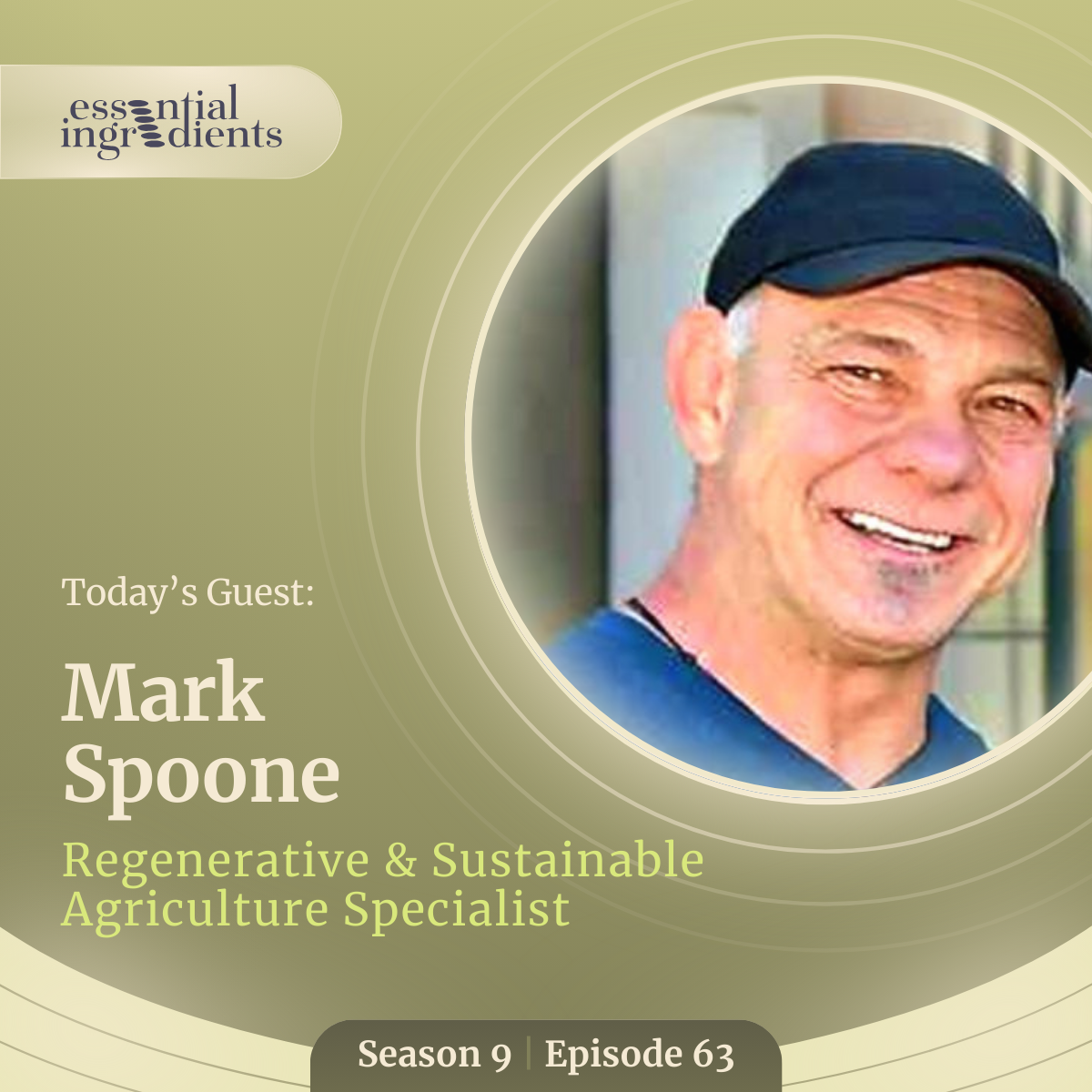
Mark Spoone · Regenerative & Sustainable Agriculture Specialist
Watch on YouTube
Transforming Agriculture: The Living Water Solution
The Incorporation Method helps you turn what matters into practical changes that fit your life.
“Mark Spoone, regenerative agriculture specialist, explores how treating the soil right — and working with living water systems — could transform our future into something richer and more sustainable for generations to come.”
Full Transcript
Full conversation between Justine Reichman and Mark Spoone.
Good morning, and welcome to Essential Ingredients. I want to invite my new friend, Mark, who is our guest today, as well. Welcome to all of our listeners and viewers that tune in each week. Because without you, we're talking to no one, so we're so glad to have you here. And you're going to be excited to hear from Mark. He's an inspiration. He's the quintessential entrepreneur. Had done a variety of things, and took a circuitous path to get there. But ultimately, now a founder and entrepreneur in the agriculture space. And I think we're all going to learn a lot, both from his journey and what he's trying to do. Welcome, Mark.
Thank you so much, Justine. I got to tell you, I'm pretty excited about telling our story. Thank you enough for the invite. I'm looking forward to sharing news, information and insights in any way I can.
Awesome. My pleasure, Mark. It's great to have you here. So before we even dig deep, let's just explain to the audience, to the people tuning in, to the people listening, what is Living Water?
So Living Water, in its simplest of terms, it's a biological fertilizer system that would reside on any farm. It can work in your home environment, but it's designed and created to really work in an agricultural environment, so large, commercial AG. Essentially what it does, in its simplest of terms, what we do is we bring mother nature back to the soil. Over the last number of years, the way that conventional farming, pesticides and everything has impacted our soil, we've lost a lot of the value that soil has become dirt. Living Water turns dirt back into soil, and all the associated benefits.
Now, I know why I think soil is important, but I'm really curious. Why was soil at the core of what you're doing? Why is this your thing?
I'm a big fan of serendipity, and I really believe in the idea that convergence takes place in very odd, unusual ways. And so you had mentioned that I've been a serial entrepreneur, and I have been since probably the mid 90s. This is my 12th, 13th or 14th startup that I've done. I've taken several companies, and I've been very, very fortunate in my life. I'm at the stage now where I have two teenage kids, and I'm looking around at the state of the world in a number of ways. And it became really important to me that I wanted to create something that was going to change things and leave a better footprint than what I started with. So I started looking around with a couple of associates of mine, and we're looking at getting into the purchase of an organic fertilizer company. So we went out, we met the founders, the owners, the company. And through the course of that, they're farmers themselves. They've been in the agricultural space for 40 years, and they had this concept called Living Water. They literally have been working on it for four or five years. And the day before we got there, they had just built a website, and they put it out there. So this is really kind of a serendipitous stumbling of sorts. We were looking at getting something that was going to be focused on a more natural way to feed the food that we eat. Through the course of that, they shared with us this idea and concept. And since then, which was probably about two and a half years ago, I've just become a soil guy. I'm a dirt guy. Now that I understand it and the profound impact that it has on human health, on global health, I just love everything about it. So again, serendipity was what ruled the day, and I'm really glad it did.
This is super interesting. Here you are, you have this new concept. You want to build out. You want to figure out, how am I going to solve this problem? This happens at this time now. All of a sudden, you have a way to do what you were trying to do in your head, this conversation that was going on, right? And here you are. You're an entrepreneur, and you're talking to these people. So tell me, this guy was selling his business. You had this idea of what you wanted to do. How did it all come together for you?
Two brothers, Brandon and Brody, and they're 4th generation farmers. They live in Idaho and spend most of their life farming with their family. And through the course of that, they started an organic fertilizer company, and they ran into a lot of the same challenges and issues that I think most people see and recognize. Over the course of the last 50 years or so, conventional farming has been completely immersed in the idea of a chemical based application. We have herbicides, pesticides and synthetic fertilizers, and we want to focus on organically growing our food as much as possible. And the thing they recognized was that conventional farming has completely depleted soil and turned it into dirt. And so for me, the thing that really struck me, and I didn't completely get this and understand it at the time, but the reality of it is that there are billions, if not trillions of living little microbes in the dirt everywhere. You go out in your backyard, you go in the middle of the Amazon, you take a scoop of dirt, and there's all these little crawlies in there. Microbes of billions and trillions of counts. And what happens is conventional farming has a tendency to get rid of weeds, get rid of bugs, get rid of everything in the soil. And through the course of that, we really start to kill that soil microbiome, just like we have in our stomachs. The soil has a microbiome. So essentially, what happened was they recognized that that was being depleted and going away. And they came up with this concept of, why don't we bring that back? Why don't we reintroduce that? And there's other companies that have biological solutions. But what they did was come up with such a unique and novel way that they made it incredibly simple for farmers to do this in a hyper cost effective way. The biggest challenge from farmers is costs and time.
Walk us through that technology, because my understanding is Living Water lets the farmers convert water tanks into bioreactors that work with the existing irrigation system. So I think I've got a couple things. A, what does that mean? B, I get that it allows them to dose beneficial bacteria into the soil through this irrigation system. So I can picture it. It's coming together. It's putting it in there, and then it's giving those nutrients back, right? And that doesn't exist in its form right now. This is not a thing anywhere else, is it?
Not in the form that it's in. And so, I guess, to give a little bit of clarity, the marketplace that creates biologicals for people to put into soil is big, huge and it's growing. The challenge is that there is questionable validity and efficacy of it. I'm going to try and keep this really basic and simple. But if you think about microbes, they're just like fish, right? They need air, they need water, they need food. So what we did is we recognized that a farmer going to a fertilizer store and buying a jug of microbes probably isn't going to have the same level of efficiency as if I'm growing microbes right next to my field, and I'm putting them in the field while they're alive. So this system, we use the big term $6 word, bioreactor. A bioreactor is a fish tank. In its simplest of terms. Every farm in the country is going to have an IBC tote. It's a great, big, giant, 265 gallon tote that they get all kinds of nutrients in. We have a kit that we can turn that into a fish tank for all intents and purposes. The kit goes on there. It has an aerator, a recirculating pump, and a pump that connects it to the irrigation. We have this proprietary blend of various types of microbes. They're in a dry state. You pour them in the tank, the oxygen hits them, the water hits them. They turn around over about 24 hours, you've got this incredible density of living microbes, fungi, bacteria, beneficial inputs and everything. So every time that farmer is putting water and irrigating his fields, we're infusing billions and trillions of living microbes back into the soil. Once those microbes hit the soil, they have this symbiotic relationship with the plants. So they feed the plants, the plants feed them.
That's amazing. So you're working with farmers, but are you going to other farmers too to talk to them about this?
Every chance we get. If anybody will listen to me, I'll tell you the story on a bus, on an airplane, in somebody's backyard. So we work really, really hard.
What's their response? How are they taking this?
It's interesting. I'd say there's been a really, very noticeable evolution in farming over the course of the last decade or so. I think most people have heard of the term regenerative farming. Regenerative farming is really taking hold because people are starting to understand and recognize it. The way that we've been doing things is probably not going to serve us to keep doing it that way. So regenerative farming is the concept of bringing living soil back to the farm. So most farmers, they get the idea and the concept. The idea of us showing up with our system, it can be a bit novel and a bit new. But they get the basics, the idea and the concept that, hey, if we can put living microbes back in the soil, we're going to make a difference for you on the farm.
And what does that look like? So there's an expense attached, there's time attached. It's just a new way of looking at things for them to do it a little differently. So are there any barriers for them that they see for this?
Over the course of time, as human beings, we get used to doing things in a particular way. And so when a new idea or concept comes along, it takes a moment sometimes for people to understand and adopt. The critical thing for us in creating the system was farmers are some of the hardest working people in the world. Dawn to dusk every day, they have very little time. They have compounded issues now with farm labor becoming a real, real challenge for them. So our system is focused on a couple of really key things. Number one, it's a set it and forget it system. We can set that up right next to their pivot. It takes less than an hour to do it. The setup cost for a farmer is zero. It costs them nothing. We'll give them the kit. But what we do ask is we ask them to subscribe to our microbial service for the entire season. So they'll pay about 7 to $8 per month per acre, and that cost will actually cover the cost of the kit. So for them, the idea of restoring their soil makes a ton of sense. And now, we have a very simple solution. It can be set up in an hour for zero cost out of the gates, and $8, possibly $9 per month per acre. So far, we've had tremendous adoption. We've grown 500% in the last 12 months, so we're starting to get the story sold.
Wow, that's great to hear. I'm excited that they're so receptive, because I do think that the more people do this, the sooner we'll have better soil. Which leads me to my question, it doesn't happen overnight. The soil doesn't change overnight, right? Because you still have the other soil there, so you're adding the nutrients to it. But is that an instantaneous thing? Or is there a runway until you feel like you have soil that is robust and going to give us the nutrients, minerals and all the different things that we need?
Generative farming is this concept where we have very specific methods and techniques that farmers will use with the idea and intent that we want to restore the soil. So most regenerative farming methodologies can take three, four, possibly five years to re-establish that soil microbiome. Here's the thing that seems really off the charts and very unbelievable to us even, is we are seeing a reestablishment of the soil microbiome in as little as 120 days. We literally have soil tests that show going from this to this in 120 days. And we've had crop consultants and agronomists quote us almost specifically and say that these are the kinds of results that normally take me three to five years to get.
Do you have any studies that show the effectiveness of your system at this time?
We've got probably 8 or 10 really, really impactful field studies. So the idea is, we can measure the tangible change in the soil microbiome over the period of time that they're using this. And keeping in mind, the idea here is that every time they irrigate, they're infusing their field with millions, if not billions, of these beneficial bacteria and fungi. So we do have tests that actually show a specific impact. The real value, and where I think you and your listeners would be most intrigued is, what does that healthy soil do to the food that we eat? That's where it gets really interesting.
So how does it impact the soil? How does it impact us? What kinds of benefits are we seeing? And if we think long term, what does that impact look like with it versus without it?
So from a food standpoint, you've probably heard people talk about, hey, if you ate an apple in the 1950s versus eating an apple today, it's a totally different nutrient profile. They're right. They're accurate. Part of the reason for that is farmers focus on, we have macros, right? Carbohydrates, protein and fat. Farmers focus on their macros, nitrogen, phosphorus and potassium. What they don't focus on are the micronutrients, and that's where we get all of our benefits. Not all, but a lot of our benefit and value. By bringing Mother Nature back with this microbial soil microbiome, what we're doing is we're letting those little guys create all the things that we need. The manganese, the magnesium, the copper, the zinc, all the things that have been missing from our food for so long. So what we're seeing is almost a complete restoration. I'll give you a small example. Alfalfa is grown many times as a feed for cattle. They'll actually measure the nutrient value of alfalfa, and it's called a relative feed value in 149 day study, in a side by side comparison. We increased the nutrient value, the relative feed value by 46% in 49 days. So our field with living water was 46% better than the standard field.
So what does better mean?
It means that just like you and I take a multivitamin, and we'll sit down and make sure that we're getting this full spectrum of Bs, and C, and E, and all the other things. Food is a similar idea. Food has some basic qualities. And within those basic qualities, we include these micronutrients, and that's where we should be getting. The vast majority of our nutrition is from the food we eat. What living water does is it allows the soil to entertain these microbes, and allows them to actually create, sustain and reinfuse all those micronutrients back into the soil so the plants can say, hey, I got some. And they update that, and then we eat it.
I totally get that, and I'd love to hear that, because I feel like we're losing a lot. I think we already have digestive issues which allow us not to metabolize it, metabolize different things and really take them in. So with that, if we're fixing the soil and then nourishing the foods, the crops, and then we're eating them, and they have more nutrients, right?
I'm not qualified to give a firm answer from a medical standpoint, but I can talk to you from a reasonable man perspective. If I'm eating food that's more nutrient dense, that has more of the good things in it that my body needs inherently and intrinsically. I'm assuming that I'm probably going to be a healthier guy. What I would say is what we're seeing, and this is anecdotally and factually on farms. By bringing this Mother Nature bat, soil microbiome bat, what we're doing is we're reducing the need. We dramatically reduce the need for synthetic inputs like herbicides and pesticides. One small example, there's a potato field that we're working with, and they have tremendous nematode damage. Nematodes exist everywhere in the world, in the dirt all the time. By re-establishing the balance in the soil, the nematodes stopped attacking the potatoes. And as a result, they no longer have to use a nematicide. Nematicides are really horrendously toxic. So if we're not having to use nematicides, or herbicides, or pesticides, or we can dramatically reduce them, the likelihood of that showing up in our food goes down.
I'm curious about something else. I know that this is all part of irrigation and putting it in there. And one of the challenges, I know we have a big challenge here in California, it can be a bit of a touchy subject when we talk about water, watering plants and watering all these different things. So have you come up against that at all? Has that been a problem, a question, a concern that people have brought up?
In a very potentially counterintuitive way, the answer is yes and no. What I would tell you is, when you have dirt that doesn't have any soil organic carbon and it doesn't have all those microbials in it dirt, it's like sand. It has very little capacity to hold water. By reintroducing the soil microbiome, what we do is, on average, we'll increase the soil's ability to hold water by 25 to 30%. So what happens is, instead of water going to the soil and running off or evaporating, we now have a significant increase in soil moisture. The result is we need less water. So that's one of the very valuable benefits of restoring soil, is we're actually reducing the amount of water that farmers need.
And then when I think about your journey here, I think about all the different things that you did to get here. And I'm curious, what do you pull on from your journey, whether as an entrepreneur or wherever, that helped you today? What are some of those key skills that were transferable, that are helping you in this endeavor?
I started my professional career, really working as a financial planner, and it's a glorified name for a salesperson. Really, what I did is I sold people investment products, but I was doing it on a personal basis. And one of the things I learned through the course of that is that people really don't have any trust, confidence or faith in you until they really feel like you care about them in what they need and what they learn. And I think that set the tone for me for a lot of what I did the rest of my life. And so one of the things that I think I've taken away the most and that comes to bear the most, farmers are some of the hardest working people in the world. Farming, by its nature, it's a gamble. Everything they do every day is a gamble, and there's so many things associated with farming that they just don't have control over. And so they're really at the bottom of the totem pole when it comes to who's making money in this food chain. And for me, I started the National Hemp Association probably 10 years ago. And the idea and concept behind it was we wanted to support farmers who were interested in using industrial hemp as a means to help restore and re-establish some of their financial security. So through the course of this, I'd say my biggest lesson is, if we can't find a way to make sure that that farmer is getting direct value and benefit, then we failed. And the downstream effects of that are, obviously, if we're giving him something that makes sense, that saves him money, that makes his life better, and he produces a better crop. The downstream effects are that you, me and everybody else, we get to eat better food. And by the way, we're capturing a ton of carbon in the soil. We're helping the climate. So for me, that's probably my biggest takeaway, Justine, is if we can't find a way to make sure we're taking care of the people, our customers, at the end of it, nothing else really matters for us.
I love that because it is personal, and everybody's being thought of, the farmers being thought of, the consumers being thought of, and it's really better for the world and better for the planet. So to me, that resonates. And I'm thinking about the listeners and the viewers that are tuning in and thinking, okay, well, what would they ask now? What do they want to know? Here you are. You're a serial entrepreneur. You're building out this amazing, purpose driven business. And so maybe you could share three things in your journey that maybe, because you've had 14 startups, you do differently now than you did in the first two as lessons learned.
So I think first and foremost, you've got to find a group of people that have similar alignment about values, what they care about, and a work ethic. So I'd say that's one of the most important things. The second piece is really empowering people to do what they need to do so they can be successful. At the end of the journey, everything everybody does for the most part is a volunteer position. So if I can't help people find ways, whether they're customers, business partners or whoever I work with, to make sure that they're getting everything they need, and they've got the resources for me to be successful, then I failed. And I think ultimately, the end of the day is kind of looking in the mirror and asking myself the question, am I doing the right things? Probably the three key things for me is really relying on the people around me, empowering them to make sure they get what they need, and giving them the tools to do it.
So now, you have this venture, and it's been two years. And so when you look ahead five years from now, what's the big goal here? What are you hoping to say?
So I want to make sure that I really bring this up. There are seven of us in this company. So we've all got essentially a very, very even equal state. We all have very important, very specific roles. So I just happen to be in the role that I'm in. But the rest of the players and everybody on this team, they're the ones that are really creating the success. What I'm doing is I'm just trying to line the pieces up along the way. So I really want to make sure that everybody understands that we couldn't have gotten to where we are without everybody's alignment and investment. They're far more important than I am in the overall scheme of things. And again, my lifelong goal is I've always wanted to be the dumbest guy in the room. That's kind of what I strive for. And I think in many of the meetings internally we have, that's typically true. I've got some really sharp, really smart partners that make it happen. So collectively as a team, I think to answer your question about where we would like to be, we would like to be as pervasive and as covering as many acres as we possibly can the world over. We recognize tremendous pressure on farmers and on our global food supply chain. We know that without equivocation, that this solution, for all the reasons that we're talking about, can completely change the entire agronomic landscape and horizon. So our goal is to create success for as many farmers as we reasonably possibly can, in any way we can.
Thank you so much. Expect that the listeners and the viewers will have lots of questions. And I hope to be able to share them with you so we can provide more information and answers to their questions.
Well, it's been a pleasure chatting with you. I just hope that your listeners really start internalizing the idea that as consumers, we have tremendous power and tremendous sway with producers and manufacturers. So for those things that you guys think are important, particularly when it comes to the stuff that we put into our bodies, make sure you talk to your local grocers. Make sure you talk to all the people in your supply chain, and let them know how important that is. I appreciate the chance to catch up. We love telling our story. You've got a tremendous following and a tremendous movement. You're leading, and we're very, very happy to be a part of it, so thank you so much.
Thank you, Mark. And just before we say our goodbyes, because you just mentioned this, to give our listeners and our viewers two questions that maybe you could share, that maybe they should ask their grocers.
I always ask when we go to the store, whenever I get a chance. I don't usually go to the information desk. But whenever we go to our grocer and I find somebody in the aisle that's actually stocking or working, one of the things I always ask is, what do you see from your organization? How important is it to provide a really good, clean, healthy, local food source? And I generally get a blank stare from the person that's doing the stocking. But every once in a while, I get some very interesting feedback, and it helps me learn quite a bit more about of what the organizational culture is. So I'd say that's one thing. I think the other thing that you can ask is ask the question, whenever you can do your source locally, and if you do, ask them if there's places that you can go to support some of those local farmers.
Mark, thanks so much for sharing that. I'd love to give our listeners and viewers a couple takeaways so they can put things into action for themselves.
Yeah. Well, thank you so much. It's been a lot of fun catching up, and just all the best to you and all your listeners. Thank you.
Likewise. Thank you again. And for those tuning in today, if you're tuning in to the podcast, don't forget that we also have a video cast that you can watch on our YouTube channel at EssentialIngredients. And don't forget, if you listen to podcasts, we are on all podcasts, also called Essential Ingredients With Justine. And we'd love you to follow, subscribe, like, leave us a comment. We want to hear from you. You dictate the information and the guests that we have that come each week, we want to give you what you want. So tell us, we really want to hear from you. Thanks again.
Share This Episode
Enjoyed this conversation? Share it and tag @nextgenpurpose
Listen on Apple ▶Listen on Spotify ▶Your Host
Justine Reichman
Founder & CEO of NextGen Purpose. Host and Executive Producer of Essential Ingredients — 11 seasons, 330+ episodes, and a growing movement.
About Justine →