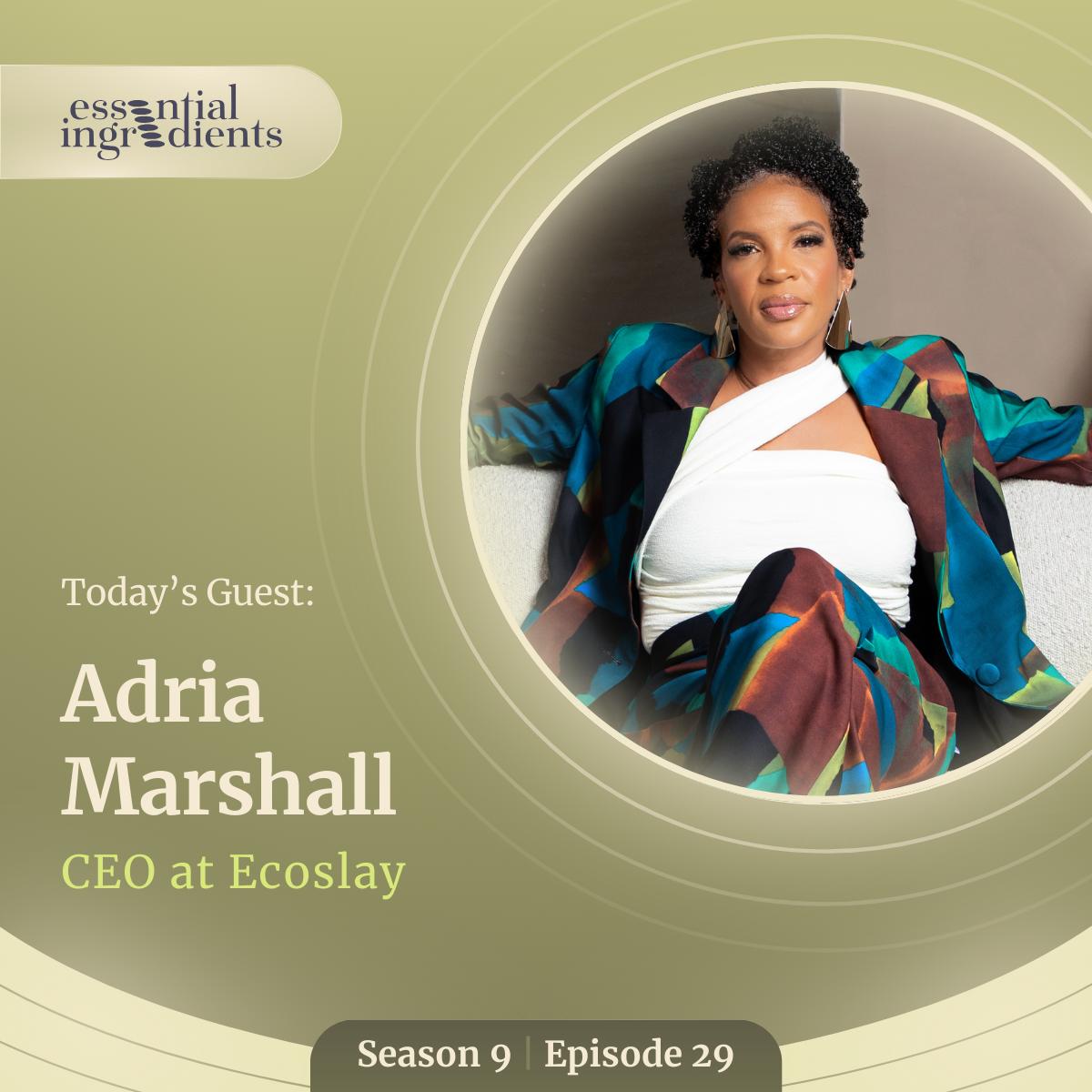
Adria Marshall · Clean Beauty Advocate & Hair Care Expert
Watch on YouTube
Detoxing Your Hair Care Routine
The Incorporation Method helps you turn what matters into practical changes that fit your life.
“Adria Marshall walks through the hidden toxins lurking in conventional hair care products and shares a practical roadmap for detoxing your routine — what to avoid, what to look for, and why the scalp is often the most overlooked skin on your body.”
Full Transcript
Full conversation between Justine Reichman and Adria Marshall.
Good morning, and welcome to Essential Ingredients. I'm your host, Justine Reichman. With me today is Adria Marshall. He is the CEO and Founder of Ecoslay. Welcome, Adria.
Thank you, Justine. Thank you for having me.
My pleasure. I'm super excited to explore this conversation with you. For those that are not familiar with Ecoslay, could we just give them the high level so that as we dig deeper into the conversation, they'll have a better idea of what we're talking about?
Absolutely. So Ecoslay is a handmade to order, sustainably packaged plant based hair care company. And we are most recently farm to pout, as we like to call it, as we partner with local farms in our area. We actually grow the ingredients that we use inside of our hair products.
Wow. What inspired you to come up with this idea? It's really very innovative, it's thoughtful, and it's not mainstream. It is as it relates to food, but it's not quite as mainstream in the industry that you're in.
It's been such a long journey. But along this road, I've always known the importance that food plays in my diet, food plays in my hair and body products, because our scalps are permeable. And so for instance, if you have a gluten allergy, it will show up in your hair care, as well as your body care. The same flare ups that you experience when you eat something with gluten. You experience those same things when you use a topical with gluten as well. I've always known the connection that is really important what you put on your body as it is what you put in your body. I am a gardener. My mother was a gardener. My grandfather was a gardener so I've always had a lot of passion for sustainability, for growing as much as you could possibly grow for eating really good stuff. And so when I went natural and started to embrace my own curls, I was really appalled by the ingredients that were inside of products. And then I was delighted when I saw that those products that work best for me were products that contain ingredients that I could grow, like flax seed, aloe vera, marshmallow root. So that's kind of how the journey began. I started off going to the Farmers Market and picking up flax seed, aloe vera and processing it at home. Boiling, stranding, and putting it into my hair care. But then later on as our success grew, like, well, wait a minute. We can actually grow these ingredients. It helps to reduce our carbon footprint, but also really helps us to be able to ensure that what we say inside of our products is actually what's inside of them.
That's amazing. I just want to go back to the beginning. When you started explaining a little bit about Ecoslay and how the ingredients in there connect to the ingredients that we may have intolerance or allergies too. And I think that sometimes, that's often overlooked. I don't want to speak for anybody else. But as you were sitting there saying this, I was thinking to myself, the only thing I ever really connect that I don't want to have is sulfide or sulfur in my hair. And with intolerances like dairy and sugar, I've thought about it when it's been in a body scrub because it's part of the name, right? It jumped out at you, and I'm like, oh, I don't react with all the sugar. I don't want to have a sugar scrub, or I don't want to have a milk bath. If milk doesn't really connect with me, or doesn't, I don't digest it well. So why haven't we been doing the same thing with our hair?
I don't know, but we really should. You should really pay attention, especially those top 5 ingredients that are on the back of the packaging on the label, because the ingredients are listed in order of volume, just how they are the food that we eat. So if you have an allergy to wheat, you should really be looking at your packaging for your body wash and your shampoo to make sure that wheat definitely isn't in one of those top five ingredients, because it's gonna affect you the same way that food would.
So when you first developed this idea, what was a moment for you that you realized that this was affecting so many other things for you, and that you needed to be able to create something for yourself that was better for you?
My initial goal was just to create some hair care that worked for me because there weren't products out there that really could get me the results that I wanted. And then it started to kind of go out of control from there. So ME looking to see what was in there like, well, I'm not going to put this junk on my head. It just didn't make sense to me. I would say the nutritional component came secondary to just being upset, disappointed and disgusted by the filler ingredients that were being placed in our hair care. And then as I start to do more research on allergens and those intolerances, and then also the good stuff that you want, I love to cheat and get as much good stuff in my smoothie as possible. And that's why I think of our hair care the same way. If you can get some of that vitamin A, vitamin B and vitamin C in your hair care that is going to help your overall, your overall diet.
And were there things that you maybe had intolerances or allergies to that you then decided, oh, I should pay attention to this as I'm building these products for yourself.
No, I actually don't have any allergies. We're fortunate that way, but I do know how much better I feel when I eat good stuff versus how sluggish I feel when I eat bad stuff. I'm thinking any possible way for me to get those vitamins and nutrients into my hair care is amazing. And our customers, it's funny because they can't quite put their finger on why when they use our products, their hair looks just a little bit better when they use other products. But I'm convinced that that is the reason why. We know where our ingredients come from, and we make sure that they're the highest quality.
So it raises the question for me. Sometimes when people are building these products and they're thinking about being shelf stable, and they're thinking about the longevity of it, did you have to give something up in order to do that to make it both shelf stable and transparent with these great products?
Absolutely. So we put a lot of thought into this. So our products are shelf stable for up to three months. And for the past three months, you need to pop them into the refrigerator. And when people pitch a fit about why do you have to refrigerate our products. I'm thinking, well, if you were going to eat something, wouldn't you be concerned if you can still eat it a year through year later that usually quiets down a little bit. That same thought process, I'm trying to get people to think about that when it comes to their hair and body care. You literally are what you eat. And what you put on your body is just as important as what you put inside of your body. So our products are shelf stable for up to three months. They're shelf stable up to a year before you open them. But when you open it, the clot starts ticking much like an item in your pantry has the clot starts ticking when you open them.
And it's so interesting to think about it this way, to change the narrative for people. Because when I was asking the question, and then I'm in my head thinking, well, then what am I going to do with the product? And you're like, put it in the refrigerator. I see myself going to the shower and forgetting to take it, and walking out wet to the refrigerator to get my shampoo out, which I'm sure over time becomes routine. You remember to do that. But I could see that in the beginning, that was my first visual. I'm like, I'm in the bath ready to wash and I'm like, wait.
Exactly. You do have to perform new habits. Now, we do have a caddy, which is really cool, so you can put all of your products inside the caddy and put them in the fridge. Then you take the entire caddy out and put it into a container on your shower so it makes it a little bit easier for you to just transfer them all at one time rather than one by one. So we try to make it a little bit easy for you, but it's definitely another muscle that you're going to have to build.
I do think that more and more people are putting smaller refrigerators into their bathroom for their beauty product. So keeping in mind the dimensions of this and that as you build those things out in our homes, or we build them out in our homes. I understand, obviously, rental apartments, it may not be there yet, or it may not be in older buildings. You have pre-war buildings in New York, and you have all sorts of things. But I do think that even just having a regular refrigerator in your bathroom, you can get one of those little, small snag ones or something. They are really cute. It doesn't look fancy. It could just be the facility keeping it fresh and alive, if you will, for your hair and body. So talk to you a little bit about this. Is this your first foray into being a Founder?
Yeah, it is. And like I said, it happened quite by accident. I wasn't out there trying to start a business. I just really wanted good hair care with really good ingredients that worked for my own hair. Then it turned out that it really resonated with a lot of other people, so here we are. But yeah, this is my first business.
What was that like for you? What I mean originally, you're working for somebody else. People have their vision, and you're following their lead, so to speak. And they're what they're trying to drive and create. And now, you've taken a role where you are now that leader, that visionary. Can you talk to me a little bit about that change for yourself and what that was like? Scary, intimidating, easy, breezy, or it felt natural?
It was terrifying. At first, it's exciting. But then the orders keep coming in and you start to get in that fear, that imposter syndrome a bit. And then you also realize that, oh, my goodness, there's no one for me to answer to other than your customer. That's who my boss really is. So there is a lot of freedom that comes with it, but it's frightening too. Especially because now that I have a staff of 13.
That is exciting. It's really a great accomplishment too to be able to build a business that is sustainable, to afford to have 13 people.
It's great. But with that comes a lot of responsibility also. It's that added weight of wanting to make solid business decisions. Do things for the right reason because it's not just about yourself anymore.
So from the get go when you started this, were you bootstrapping? Did you say, I'm going to raise money. Where was your head at around that kickoff?
It's so funny because it's been about six years now. I had the thought of starting a business, and the very first product that we launched, I knew it was going to be a sustainable business. I really didn't know what I was doing. Too much, Justine. This could be a sustainable business. I think this is before I even launched any products. It was just like, let me just think of something that I can do. I'm working for someone else, like you said. But just trying to think in the back of my head, what if? What if? What if? I created a Bamboo Edge Brush for your baby hairs. And the reason I did that was because at the time, a lot of women were using a toothbrush. A lot of women still use a toothbrush for these little hairs around your edges, and it's not sustainable and not good for your hair. So that was my first product. I remember when I went to my husband, I said, can I take $300 out of savings? I think I have an idea, and that's it. And so after that, it didn't sell that much. I was kind of doing something just to keep the juices flowing. And I guess it was about a year or so later, I had been trying to make a hair gel for a while for my own hair. And it was about a year or later that I started working with a chemist on something else altogether, not even related to the hair gel that I'm working on, on the back burner. I just learned these tips from working with him. I'm like, you know what? I think I know what I did wrong with my hair gel. And all this time, Justine, I'm really engaged in the curly and the natural hair world online, talking to people about what products they're using. We're just trying to figure this thing out together. They're not influencers. They're just people trying to figure out their own hair issues, and they're documenting it online. So there was someone I had come across on YouTube, and as I'm mixing flax seed and marshmallow root to make this hair gel using the advice from my chemist on this other thing, I'm like, well, it works really good for me. Let me send it to her to see what she thinks. And I send it to her, and I don't hear anything bad. And mind you, I had my little edge brush on my little store. And the reason I had a store is because I was a project manager at the time, and so I'm coaching my dept. team as they're creating their stores. And so I'm doing it for myself as well. I can check their estimates that they give me, so it's not really anything serious. I think I may make two, three sales a whole month. Nothing serious at all. So I put my gel that I sent to this influencer on my site, and the orders start to come again. I went from zero orders on December 15th, 2000 on January 1st because she had posted a YouTube video and it went viral. So that's how that all happened. And so to a long story short of answering your question, I'm bootstrapped from that initial $300 that I had asked my husband for a year ago to create the edge brush that was being sold on our website.
Wow. So what influencer did you send it to?
She is still in the game with all of her name. Her name is Felicia, but I haven't seen any videos from her for a while. But she definitely put us on the map.
Wow. So that's really exciting. So as you continue to expand your brand, Ecoslay, and you develop new products from the little brush to the gel, what else can we expect to see down the line from you?
Well, we have 17 products now. We have several stylers, several cleansers, several conditioners, and bonnets. And what I love the most about our bonnets--
Walk me through the bonnets.
The bonnets are locally sourced. They're made from recycled fabrics and water based ink so you'll find the thread of sustainability throughout every product that we have. A satin bonnet, and so you use it at night. And if you don't have one, you should get one.
I think so, I don't have one.
You need one because the purpose of cotton is to suck up moisture that's why you use cotton in your towels. Well, your cotton pillowcase is doing the same thing to your hair and skin at night. And you'll find this especially in the wintertime when the air is drier. You'll wonder why your hair is getting drier, and drier, and drier every night. It is going to get drier when you're sleeping on that cotton pillow case.
Wow, that's super interesting because I was trying to envision a bonnet, and then when you said it, it seems like, of course, that makes sense. You hear about it so much for our face because you're keeping hydrated. Especially for those folks that do treat their hair, whether color highlight, perm, you name it, you're continuing to dry out your hair. I'd love to tell you that I'm a natural blonde. But really, I'm not. And that bleach really does, it keeps it drier so that I don't have to wash it that often. It doesn't look dirty that often. But equally, I don't know how great it is for your hair.
You definitely should. There are a few things that you should do if your hair is color treated. One is to have a continuous protein treatment regimen for your hair. I would recommend that you use protein every single week, and you want to do that after you shampoo. Put on that protein mask for hours. I recommend leaving it on for maybe 5 or 10 minutes, and then you follow up with a moisturizing deep conditioner. Let that sit on there for 30 minutes to put that moisture back inside. Because what protein does is it roughs up the cuticles to allow the color from the strands to get pulled out, and then it deposits more color inside of the cuticle. So it's definitely allowing more sugar as it gets in, as it gets sucked right back out. So it's really important to have a protein treatment regimen for your hair to reinforce that cuticle to help lock that moisture in as much as possible, and to be continuously putting moisture on your hair so it doesn't dry out. And using a satin pillow case and a satin bonnet.
Let's go back to this whole process that you just described because I'm thinking about it going, wow, you've just taken my 35 or 45 minute routine to get dressed, showered, blow dry my hair and put a little splash of something on my face. I'm wondering, how often does one do this?
Only once a week.
So it can be like a Saturday or Sunday activity.
And the good thing about it is that it makes your daily routine go so much faster because your style is going to last so much longer because you're doing that maintenance every week. So you'll find like, I don't do anything to my hair. But once a week, I'm able to put on my bun at night. Then in the morning, I can fluff and go. There's not much to it. And so you'll find something very similar. Once you kind of train your hair into this routine and it gets used to, you're going to feed it, I mean, you come back down to your plant, right? You're gonna feed it with this. You're gonna give it these nutrients. You're gonna be doing these things on a regular basis, and it will reward you for it.
A lot of this is centered on people that have longer hair, right? Or sounds like we're talking about women. Are we talking about men too? Are men being wearable on it?
I have a lot of male customers. The structure of your hair doesn't differ based on your gender.
That's where I was going with it. But I was like, how do I say this? So now, what are your thoughts on men that get balding spots, so women lose hair too, and then they have the widow's peaks. How do some of these ingredients that you're choosing to create, some of these serums, connect with that? Are there any specifically for that?
So let's just put it at the very top of this. Of course, the better ingredients, the better your scalp is being fed, the better your body's going to treat you. That's a given. However, I strongly recommend that if you notice that your hair is thinning or you're having any issues like that, go see a dermatologist. The same way that you would go see a doctor. I do not suggest you play around and look online and try to find these oils and treatments because your hair grows in phases, and it takes about 90 days for you to see any results from a hair treatment. That's just the nature of these cycles that your hair goes through. You don't want to waste a lot of time trying different things that may or not be working. It's best to go to a dermatologist who can pull out their microscope and you can get to the bottom of what's causing your hair loss, whether it's stress, or hormone related, or nutrition related, or wherever that case may be. With that being said, we do have some pretty fantastic growth oils that we sell, but it's best to get to the root of the problem first before you start to fiddle around with it.
I think that that's a fair statement. I think it's really sound, I would agree with it. We're not doctors. I'm not a dermatologist. I could not tell you you're not a dermatologist. I think it's great to be able to pair a dermatologist and even share your product to say, how would this impact what I'm trying to achieve?
Yes. So for example, as I started getting older, I noticed that I started to have shedding. Now we have a fantastic growth oil which works great. But when I start to experience shedding because of stress and because of hormones, it was important for me to get that in check before I went back to using my growth oil. Now, using the Growth Oil in tandem to what the dermatologist has prescribed for me, it works amazing. But unless you can really get down to the root cause of the issue, you're gonna be wasting a lot of time that you can't get back when it comes down.
I would agree. Are there any ingredients that you've seen in mainstream products, not to point to any products that you feel people should be acutely aware of, maybe because they don't understand the impact of them, or how they can show up in negative ways, or that they're an outbreak for everyone?
Definitely the sulfate. Definitely pay attention to sulfates. There's been a lot of recent studies on sulfates as well as linkage to cancer and things. There's nothing definite, but things are pointing in that direction. So we are in the day and age now where there are so many good alternatives to sulfates, and there's no reason to really have to go down that path. There was a point in time where if you wanted to really clarify your hair, which I recommend that you do on a regular basis, you almost had to go to a sulfate just to get that level of clean. But that's not necessary anymore. There's so many cleansers and clays, we make a clay clarifier that doesn't use sulfate, and you can get past that.
So maybe tell the top three things that you would look for, or that a customer should look for to avoid?
Yeah, I would say sulfate, silicones and mineral oil. Those would be my top three.
What are some of the impacts that you've seen or heard of people using products that contain those three items? ingredients, so
With sulfates, I haven't seen a negative impact other than extreme drying of the hair. And then you become on this endless cycle, this vicious cycle of trying to keep your hair nice and moisturized, but the sulfates are continuously stripping the oils and nourishment from your hair. That's a good reason to avoid it, as well as the possible cancer linkages that they are still studying. As far as the silicones, very similarly. And so what a silicone does is it builds up on your hair, and you have to use something like a sulfate to really remove it from your hair. And so again, you find yourself in that vicious cycle of, you want the silicone to keep your hair nice, smooth and shiny. But then it builds up over time, and you have to use a sulfate to remove it. Now your hair is dry, hard and lacks moisture, then you want to use the silicones. So it kind of feeds on itself. And then there is the mineral oil, which is almost the same thing as a silicone in the way that it operates. It coats the hair shaft. It prohibits moisture from entering the hair shaft. So it blocks out all that moisture which makes you think that you need to put more of those products with that oil on there, but it just exacerbates the issue.
Thank you so much for that. I just want to go back because I was sitting here thinking for a minute of when we first started this conversation and talked about how you evolved from getting the herbs at the Farmers Market to then doing things yourself. To now, working with farmers. Can you talk to us a little bit about how that grew, and what it's like to work with the community, specifically the farmers.
It is so rewarding working with farmers. So we're in our second pilot phase. Ooh, this is our second full year of working with a farmer. The first year, it was definitely a lot of trial and error just getting things to actually grow. Because a lot of things that we're growing, they weren't used to growing, and they weren't used to the amount of yield that we needed for them to have as well. So a lot of conversation, I worked with the Truly Living Well Center for Urban Agriculture right here in Atlanta. So getting to go down to the farm, me and my staff, planting the seeds, tending to them, harvesting, bringing the okra back to our shop that we immediately put into our banana cream, deep conditioner and our Jello Shot Curl Definer has been awesome. And then now, we are partnering with the Chattahoochee Hills Charter School, which is amazing. So what does Chattahoochee Hills do? They are a charter school that incorporates agriculture into their curriculum, and so the kids are learning about agriculture along with all of their other studies. And so the kids at the school are the ones actually taking care of our plants, and then WE in turn get to teach them about entrepreneurship and all that good stuff. So it's a full cycle. A very, very rewarding experience.
You're building better for you healthcare. You're working with the farmers to grow your own agriculture, your own herbs, so you can then create the product. And in the meantime, you're working with a school to help take care of these plants. And through that, the kids get education. What an amazing vision you had there. Did you have that vision? I know that this was not what you planned when you decided to go to the community and start to grow these herbs. How did you go from just growing them yourselves, to then working with farmers, to then including the schools. Because not only are you creating great products, you're also giving back and giving a platform to these farmers and to the students to be able to grow, make money, but also get educated.
Yeah, it's been awesome. We were just blessed. It just fell into our laps. And so I did have it on my vision board. To work with a farm, I had that on my vision board years ago. I even bought the domain name Ecoslay Farms years ago. So I kind of put it out there. And I guess about two years ago, let me just really start to chase this thing down. So I started just calling random farms and getting shot down one right after the other until one finally said yes. So that's when I started working with Truly Living Well for about year, year and a half. I do not want to exaggerate and say that every product that we make has every ingredient from the farm. We are still in the learning phase, still in the pilot phase of it, but it's super intentional. I will say that last year, all of the okra that we use in the two products with okra did come from the farm, so we are chopping away at our plan. And our plan is to have every single product that has a global ingredient to be grown on either our own farm, which we will hopefully purchase this or next year, or the farm at a Chattahoochee Hills Charter School.
Amazing.
And I learned about Chattahoochee Hills from my publicist who was watching, just scrolling on Tiktok. She saw this amazing school with this amazing farm, and then she called me out of blue like, you have to see this. And so the next week, we call the principal. Had a zoom call, and he was so excited. And then like a month later, it was in the books.
So now you have 17 products. Is that correct?
About 17.
And 13 staff. What can we expect to see for Ecoslay in the next three to five years? How do you envision your future?
So there are a couple of things that we're really excited about. I don't think I shared it with you Justine, that when I had that product that went viral, I had a full time job so I had to go back to work. I reached out to a factory to help me fill all these orders because they did not seem to be stopping. And I'm sure you will not be shocked to know that the factory immediately wants to change all of my ingredients, everything. They seem to be just mystified by the fact that I was hand boiling and straining flax seed and marshmallow root. There was no way they were going to do it. They were going to go grab some flax seat extract off the shelf. God only knows what's really inside of that, and going to come completely change my product. So I said NO to that, and that's when I started hiring and training people. I'm doing this as I have a full time job, which was absolutely crazy. That's behind me now. But long story short, now we launched a program, it's been about a year now called the Ecobator Program, and we basically are that factory that we wish that we would have had. So you think about your aunt, your cousin, your friend who thinks that she has the best idea for a body butter, a soap, a lotion, a body wash, but she doesn't need 5000 units from the factory. She doesn't need high prices that she can't afford what she's trying to make ends meet, and she wants to use really good ingredients. And so, that's what we do. We help her out with the formulation, the manufacturing, the logistics and the packaging on her small scale products until she's ready to manufacture larger units.
I'm just curious, I know you have a background in gardening from your grandparents, your parents and you, but it also sounds like you need to have some chemistry background or something to be able to formulate all these different kinds of products. So do you surround yourself with people with those expertise? Because Lord knows, none of us have all those expertise, but we have the vision to be able to do that. We've got some assemblance and idea of what we want, and how do you make that happen.
So the problem that I made that went viral, I formulated that myself. I came back and gave it to my chemist, and he tweaked it after the fact, but I did the initial formulation myself just by watching a lot of YouTube videos, to be honest. Now, did I make some mistakes along the way that I had to go and correct with the help of a chemist? Absolutely. So now I work with two chemists. I still work with that initial chemist that gave me the idea of what I was doing wrong with that gel. I still work with him. He's amazing. But I also have a chemist that is in house as well, one of my staff members, and he helps us with the formulation for our products, as well as a formulation for the products of our own clients as well.
Amazing. Adria, thank you so much for joining us today. For those folks that are interested in learning more about Ecoslay or even buying some product, where can they go to do that?
So you can find us on social media at Ecoslay all over, and you can find us at ecoslay.com online.
Thank you so much, Adria. I can't wait to try the bonnet. I feel like protein. One thing you've just said to me that I feel is so inspiring is that this happened by accident. You weren't a Founder before, and so many people that are founders were never founders before, but you took what you were interested in and what your needs were, and put them together to create something that is better for you, better for the planet. And now, you're giving back to the community. What an inspiration. I hope that this inspires other founders to build a business that can make such a great impact as well.
I hope so too, because it's really just about putting one foot in front of the other, and just keeping that momentum and remaining consistent.
Thank you so much. We'll make sure to include the link to your website in our show notes. And for those that are listening to the podcast, don't forget that you can also watch the videocast on YouTube. And if you're watching the YouTube video and want to listen to the podcast, we're available wherever you listen to podcasts at Essential Ingredients. And don't forget to follow us at essential.ingredients on Instagram, and we look forward to seeing you here next week.
Bye. Thank you, Justine.
Share This Episode
Enjoyed this conversation? Share it and tag @nextgenpurpose
Listen on Apple ▶Listen on Spotify ▶Your Host
Justine Reichman
Founder & CEO of NextGen Purpose. Host and Executive Producer of Essential Ingredients — 11 seasons, 330+ episodes, and a growing movement.
About Justine →